@antoniomele101 Is automating econ research even worth it beyond a point? Automation in firms directly increases productivity & GDP. The value of papers is often realized through policy and that takes years anyway. Would 4 papers a year vs 1 make a difference in the grand scheme of things?
Just Accepted new paper, “Industrialization and the Big Push: Theory and Evidence from South Korea” by Jaedo Choi and Younghun Shim https://t.co/9oPPWrNFei
I also show that plants in high-INPRES districts were more likely to hold on to workers during the crisis, and that the workers they retained were more educated.
Read more here:
https://t.co/mTY7ze7bFD
This seems like a good time to share my paper, which uses firm micro data but speaks to a macro-dev question. I test the classic TW Schultz hypothesis that returns to human capital rise in disequilibria, using the INPRES school construction program (famously studied by Duflo).
Not only did INPRES raise schooling levels, but I find that it also shifted local workers toward skill-intensive production work prior to the crisis. I argue that these skills became especially valuable during the crisis, when plants were dealing with disruptions.
A fundamental lesson from my posts these last two weeks on modernization, industrial policy, and development is that development economics should be about understanding why South Korea got rich but Bolivia did not.
The current field has largely given up on that question. Sharply identified RCTs on small micro programs are a fine way to publish in the AER and get tenure at a fancy university, but a profession that knows everything about microfinance impact evaluations and almost nothing about industrialization has misallocated its own intellectual capital on a pretty heroic scale.
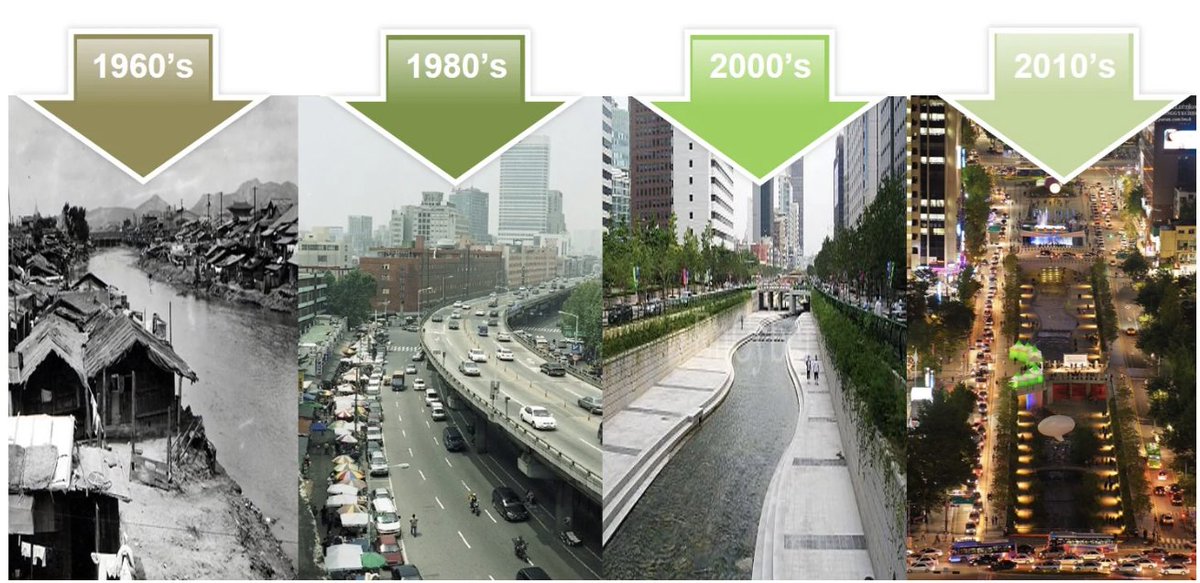
Four images of Seoul:
Today I taught a PhD class on the economics of AI. In doing so, I drew this picture on the board of my current understanding of what I called the "how good is AI" literature (aka the productivity impacts of AI). I thought I'd write up a long version of that discussion - at the very least for my own notes.
The basic point I made is that answering this question requires an understanding of the crazy multi-dimensionality of the problem that dramatically shapes the questions you ask and the answer you get.
A few key dimensions:
a) Tasks -- this one is obvious. How useful AI is depends on what specific task is being considered. Every day, we get a paper along the lines of "I had AI help with task X" (call center work, consulting, graphic design, writing ... name it) -- and here is what I found.
b) Human + AI OR Human vs. AI AKA is AI augmenting or replacing humans? -- The value of AI in helping a human achieve something is not the same as the AI doing the task itself. Yet, we often conflate the two. Economists and social scientists often focus on the augmentation test, while CS people are mostly comparing humans with AI. For example see this nice paper from Serina Chang showing how the two are not the same (https://t.co/fEBzgpyGq7)
c) Point vs Systems integration -- Early papers have mostly been about isolated tasks divorced from the specific job in artificial settings. Even "real" field experiments have focused on work like call center work that is atomistic. However, one could imagine answers we get are very different when tasks are embedded with jobs and jobs are embedded within organizations. This point is what is driving the divergence between "AI increased productivity by a gazillion percent" in studies and "95% of all AI implementations fail" narrative from real enterprises. Surely the value of AI depends a lot on this unit of analysis.
d) Which AI and How AI: CS researchers are much better on this than economists, but the basic idea is that there is no "one" AI system and results clearly depend on which AI we are talking about. And here, its not just about which model you look at (GPT 3.5 vs 4o say), but also how these models are prompted and going forward the extent to which they are daisy chained in agentic systems, or indeed fine tuned or modified in some deep way for specific tasks. Just because an AI system sucks at something out of the box, doesn't mean that with some work it can't be made to improve. Or not. We'll never know unless we stop treating AI like a monolith.
e) Which Human? -- This is one point on which we have made good progress but still a lot remains to do. Clearly the value of AI relative to a human or augmenting a human depends a lot on who the human is. Past work has found a flattening of the expertise curve in routine tasks -- but a mental model where AI's productivity effects are removed from which humans we are comparing them to would be the wrong mental model. Corollary, that human's incentives might matter as much as their capabilities!
Now imagine asking the value of AI question and blowing it up in terms of each of these dimensions:
Tasks X Augment/Automate X Point/System X <every AI model out there> X <every human out there>
it becomes pretty clear that we are only getting started in terms of understanding the societal/productivity implications of this thing. And thats even before the put the LLMs inside robots and let them loose on the world.
Grad students rejoice!
<HT: I feel like I channeled my inner @random_walker here - so this is inspired by his writings on AI snake oil and related topics!>
@SashaGusevPosts Selection bias is irrelevant here imo. Even if those who submitted (grp1) differ from those who didn’t (grp2), point is they rejected some grp1 ppl on the margin assuming grp2’s other credentials = test scores. If grp1 did better, that is enough evidence the assumption was false.
@alz_zyd_ Not sure why we should assume the economy will keep adapting the way it has in the past. The scale of change matters. Manufac automation pushed ppl into services, but automating all services won’t necessarily create new sectors. There are only so many things humans can demand.
Why can AIs code for 1h but not 10h?
A simple explanation: if there's a 10% chance of error per 10min step (say), the success rate is:
1h: 53%
4h: 8%
10h: 0.002%
@tobyordoxford has tested this 'constant error rate' theory and shown it's a good fit for the data
chance of success declines exponentially
Recently accepted by #QJE, “Manufacturing Revolutions: Industrial Policy and Industrialization in South Korea,” by Nathan Lane (@straightedge): https://t.co/7rivChhfBE
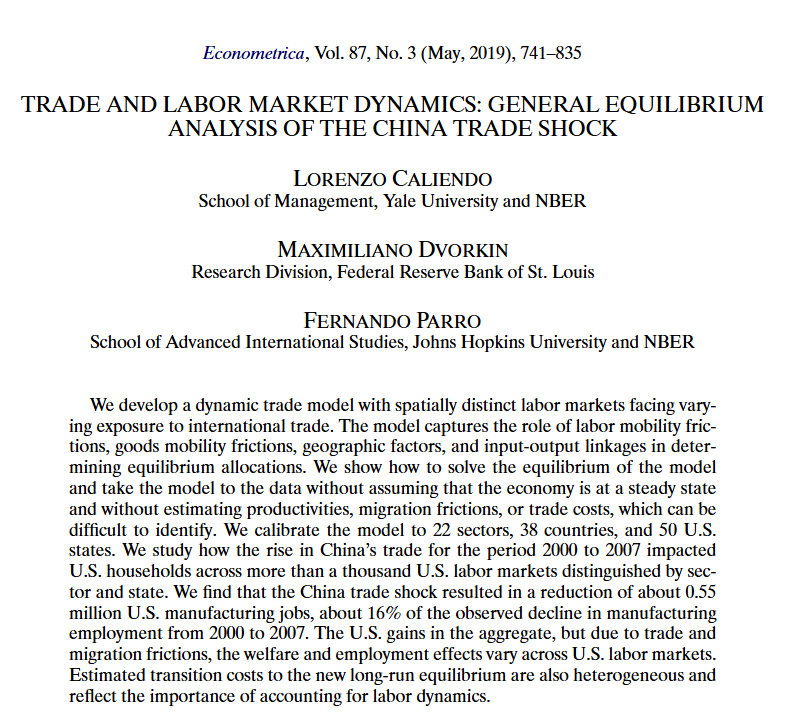
For a GE analysis of the China shock, check out this paper by Lorenzo Caliendo, Fernando Parro, and Max Dvorkin 👇
CDP: 0.55 million US manufacturing jobs lost due to China shock (16% of the overall decline)
Autor-Dorn-Hanson: 1.53 million
New Gen AI paper🚨: "The Labor Market Effects of Generative Artificial Intelligence" with Filip Jolevski (@FilipJole), Vitor Melo (@MeloVitor_), and Brendan Moore (@BrendanDMoore). https://t.co/46YnRhWobI
@MortenStostad Income is everything when you’re making just $1.50 a day. If that increases to $5 a day, it transforms every aspect of your life. Since 1991, millions of Indians have experienced such a change. There’s nothing ideological about it.
@Josh_Merfeld Learning new languages is overrated if you’re just doing data analysis IMO. If you already know one, adapting to a new syntax takes a few days max. Just using ChatGPT to translate code snippets and Googling things as needed while working on a project has worked for me