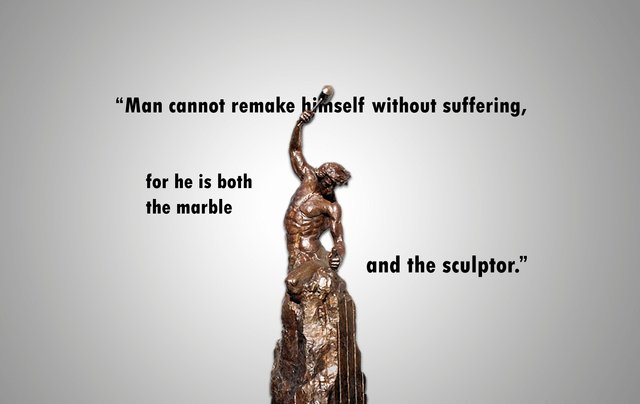
@2am_vibxz @MjsWurld Human beings 200000 yrs old but we only have a recorded history for abt about 10000,while the earth is 4.5 billion yrs old, then aren't v just a speck of dust in time but all tht doesn't matter bcause all v hve rn is the present and all we can do is make the best of this present.
@perrymetzger "Of all tyrannies, a tyranny sincerely exercised for the good of its victims may be the most oppressive... [T]hose who torment us for our own good will torment us without end for they do so with the approval of their own conscience."
--C.S. Lewis
Introducing arkenOS — an autonomous training gym that takes any RL agent from a goal to a proven, deployable policy.
We are automating complex RL research, enabling high-velocity training and rigorous, diverse environment design and testing right on your local hardware. Out of the box.
Our bet is simple: The future of AI will be built by companies giving millions of agents millions of simulated environments to adapt and learn cause and effect in, and survive. This continuous, autonomous selection will create a digital Cambrian explosion, distilling evolutionary trial and error into a foundational specialized intuition.
This is Jevons Paradox applied to software.
When something gets cheaper, we don't use less. We use more.
Coal got efficient → more coal consumed.
Compute got cheap → more compute consumed.
Code gets cheap → more code consumed.
The demand for people who can produce, manage, and direct that code doesn't shrink.
It explodes.
Agreed @0xDevShah, we literally shipped this exact pattern dynamic tool registration, prompt switching, context-driven schema changes, the whole thing. The paper is good formalization but builders have been naturally converging to something very similar for some time now
sorry, is it just me who's not getting the hype around this? the rlm paper is a great formalization of what many production teams have built over the past year.
devin, hippocratic, manus, claude code, codex cli, they all independently converge on this exact pattern.
> prompts are mutable env variables
> recursive self delegation
> persistent state across tool calls
> chunking long contexts
> farming out subtasks to sub agents
at my previous company @Parvashah_ and i built a similar agentic architecture for ads management on the meta console. the agent could dynamically generate functions and register them as callable tools at runtime. it had built-in tooling for prompt switching. as the execution context moved through campaigns, then adset, and then ad creation, the system would swap parameter schemas and validation rules. the harness would also reconfigure itself based on where the agent was in the workflow.
i'm appreciative of @lateinteraction's work. he did great work with dspy too. practitioners were doing ad hoc with prompt optimization, and he gave it a formal framework so thousands of teams could adopt it. rlms will do the same. now that the pattern has a name and ablations and a training recipe, way more teams will build on it.
that's genuinely valuable. and labs like anthropic are betting on the idea that models reasoning through code and recursive self-delegation is the path to general capability.
sorry, is it just me who's not getting the hype around this? the rlm paper is a great formalization of what many production teams have built over the past year.
devin, hippocratic, manus, claude code, codex cli, they all independently converge on this exact pattern.
> prompts are mutable env variables
> recursive self delegation
> persistent state across tool calls
> chunking long contexts
> farming out subtasks to sub agents
at my previous company @Parvashah_ and i built a similar agentic architecture for ads management on the meta console. the agent could dynamically generate functions and register them as callable tools at runtime. it had built-in tooling for prompt switching. as the execution context moved through campaigns, then adset, and then ad creation, the system would swap parameter schemas and validation rules. the harness would also reconfigure itself based on where the agent was in the workflow.
i'm appreciative of @lateinteraction's work. he did great work with dspy too. practitioners were doing ad hoc with prompt optimization, and he gave it a formal framework so thousands of teams could adopt it. rlms will do the same. now that the pattern has a name and ablations and a training recipe, way more teams will build on it.
that's genuinely valuable. and labs like anthropic are betting on the idea that models reasoning through code and recursive self-delegation is the path to general capability.
Heads up: Agent-to-agent payment protocols are dropping soon. Imagine agent societies where your personal AI buddies network, swap info, and handle deals for you. The future's wild!
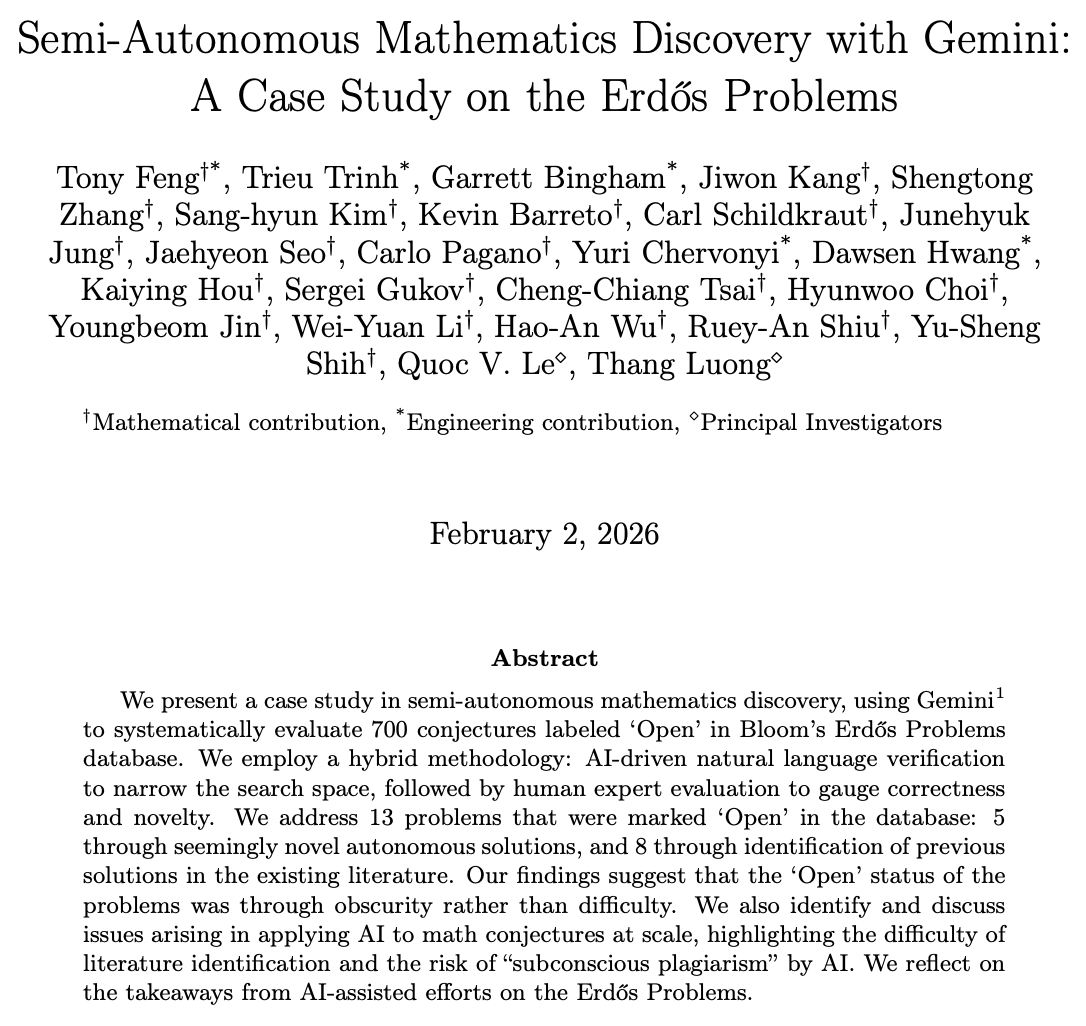
Excited to share our latest work: "Semi-Autonomous Mathematics Discovery with Gemini." We used Gemini to systematically evaluate 700 "open" conjectures in the Erdős Problems database.
The result? We addressed 13 problems marked as open—finding 5 novel autonomous solutions and identifying 8 existing solutions missed by previous literature.
Read the full case study here: https://t.co/y4WhkP4ETO