This is totally false.
Not an iota of truth in this.
There is no question of putting such restrictions on foreign travel.
We remain committed to improving ‘Ease of Doing Business’ and ‘Ease of Living’ for our people.
Let me explain what just happened today because it deserves so much recognition.
GalaxEye is a Bengaluru startup founded in 2021 by IIT Madras engineers. Today they launched Mission Drishti on a SpaceX Falcon 9. It is India's largest privately built satellite at 190 kg. And it carries a technology that no commercial satellite has ever carried before.
Normal satellites take photos of the Earth using optical cameras. Like your phone camera, but from 500 km up. The problem is obvious. Clouds. Night. Fog. Smoke. If any of these are in the way, the photo is useless. India has monsoon cover for 4 months a year. That is 4 months where optical satellites are partially or fully blind over large parts of the country.
The alternative is SAR. Synthetic Aperture Radar. Instead of taking photos with light, it sends radar waves down and reads what bounces back. Radar goes through clouds, through darkness, through smoke. A SAR satellite can image a flooded village at 2 AM during a cyclone when no optical satellite can see anything.
The problem with SAR is that the images look nothing like photos. They look like grainy black-and-white radar maps. A military analyst or a trained geospatial engineer can read them. A farmer, a disaster response team, or a city planner cannot.
Until today, if you wanted both optical and SAR data for the same location, you needed two different satellites, passing over at different times, at different angles. Then someone had to manually align and fuse the two datasets. Expensive, slow, and the data never perfectly matched because the satellites saw the same spot minutes or hours apart.
GalaxEye put both sensors on one satellite. Optical and SAR, fused into what they call OptoSAR. Three times more information than a single sensor. Processed onboard by an NVIDIA AI chip at 1.8 metre resolution.
Now in practice, during the next cyclone hitting Odisha, one satellite pass gives you a clear image of which villages are flooded, which roads are cut, and which buildings are standing. Day or night. Cloud or clear. In near real-time.
For defence, it means you can monitor a border area 24/7 regardless of weather. For agriculture, it means tracking crop health across an entire monsoon season without a single cloud gap. For infrastructure, it means monitoring construction progress on highways and bridges without waiting for a clear day.
GalaxEye tested their SAR tech on ISRO's POEM orbital platform. The satellite was tested at ISRO facilities. IN-SPACe provided regulatory clearance. NSIL, ISRO's commercial arm, will distribute the imagery globally. And it launched on SpaceX because ISRO's PSLV doesn't have the right orbit slot for this mission.
Yes, four IIT Madras graduates built a world-first satellite in 4 years in Bengaluru.
Take a bow!
Nike spent ten years trying to break the 2-hour marathon. They named a project after it. They built special shoes. They paid the greatest marathoner alive to chase it. Yesterday, a Kenyan runner finally did it in 1:59:30, wearing Adidas.
Sabastian Sawe used to be a pacemaker. A pacemaker is the kind of runner you hire to set the speed for the first few miles of a race and then drop out before the finish. In January 2022, Sawe got booked to do exactly that at a half-marathon in Spain. He'd never raced more than three miles in his life. He stayed in for the full 13 and won the whole thing. Adidas signed him not long after. Four years later, he became the first human ever to run an official marathon under 2 hours.
Nike, meanwhile, started this whole project in 2016 with a public goal called "Breaking2." They paid for the shoes, the pacemakers, the science labs, and Eliud Kipchoge himself. Kipchoge ran 1:59:40 in Vienna in 2019, but the event was a closed-course exhibition with rotating pacemakers and a pace car projecting a green laser line onto the road. The sport's governing body never recognized it as a real race. It didn't count.
Then Nike's running business cratered. Digital sales fell 26% in one quarter. Their share of footwear sold at Dick's Sporting Goods went from 39% to 32% in five months. On Running grew from $330 million to $1.8 billion between 2020 and 2025. Hoka nearly quadrupled. Roger Federer left Nike for On. Nike's board fired the CEO in October 2024.
Adidas spent the same period building a better shoe. The new Adizero Adios Pro Evo 3 took three years to develop. It weighs 97 grams, about 3.4 ounces, lighter than a deck of cards. A Wall Street Journal-cited study found that wearing a shoe 3.5 ounces lighter saves a runner around 57 seconds across a marathon. Sawe beat the third-place finisher by 58 seconds.
Adidas also did something Nike never did for Kipchoge. They wrote a $50,000 check to the official anti-doping body for track and field, asking it to test Sawe more aggressively than any other runner alive. He got tested 25 times in the two months before last year's Berlin Marathon, and Adidas signed up to fund this for the length of his contract. The logic: the moment Sawe ran a marathon this fast, the world was going to ask if he cheated, especially after his countrywoman Ruth Chepngetich got a 3-year doping ban in 2025. Adidas got out ahead of it.
The shoe retails at $500 and is barely available. Adidas's Adizero shoes won half of all major marathon races in 2024. Yesterday in London, four of the top five finishers wore the same Adidas shoe. Yomif Kejelcha crossed the line 11 seconds after Sawe and also broke 2 hours. The top three runners all beat the previous world record.
Nike's only response was an Instagram post. Three sentences long: "The clock has been reset. There is no finish line." That was their entire public reaction to losing a 10-year moonshot to their biggest rival.
The West poured $50 billion into fast breeder nuclear reactors and abandoned every single one. India poured $900 million and just achieved criticality on the first commercially viable one outside Russia.
The US spent $15 billion. Gave up. Japan spent $12 billion. Their Monju prototype had one sodium fire in 1995 and never recovered. The UK spent $8 billion. Germany spent $6 billion. France, Italy, all walked away. Six of the richest nations on Earth concluded this technology was too hard and too expensive to pursue.
India started building in 2004 with an initial budget of $420 million. Twenty-two years, a dozen missed deadlines, and a cost doubling later, the Prototype Fast Breeder Reactor at Kalpakkam just sustained a controlled fission chain reaction. The reactor is now alive.
The reason India never quit is a constraint most people have never thought about. India has only 1-2% of the world's uranium reserves. For a country of 1.4 billion people trying to build energy independence, that's a death sentence if you're running conventional nuclear.
But India has 25% of the world's thorium. The single largest national reserve on Earth.
The problem: you can't just burn thorium the way you burn uranium. A physicist named Homi Bhabha designed a three-stage nuclear program in the 1950s specifically to solve this. Stage 1: burn natural uranium in heavy water reactors, collect plutonium as a byproduct. Stage 2: feed that plutonium into fast breeder reactors, where it breeds MORE plutonium AND converts thorium into fissile uranium-233. Stage 3: burn thorium directly at scale.
India just entered Stage 2. Seventy years after Bhabha drew it up on paper.
The math on the thorium endgame is wild. At current energy consumption rates, India's thorium reserves could power the country for over 700 years. Most nuclear nations are playing a uranium game with maybe 80-100 years of runway. India is playing a completely different game with a 7x longer fuel supply.
The West quit because uranium stayed cheap and sodium coolant is terrifying. It catches fire on contact with air. It explodes on contact with water. Russia's BN-600 had 27 sodium leaks and 14 sodium fires between 1980 and 1997. And Russia kept going anyway because Russia doesn't quit nuclear projects. India watched all of that and kept going too.
When you have 1% of the uranium but 25% of the thorium, the engineering difficulty stops being a reason to quit. It becomes the price of admission to a 700-year energy supply that nobody else can access.
@ThetaVegaCap Shahpur Kandi dam inauguration on 31st March. Sowing season to begin in Pakistan. They are engaged on multi fronts, low on oil, AWACS & air fields not completely operational. US will support in exchange for helping stop the war. It’s Pakistans most vulnerable moment in decades.
@VedicWisdom1 Made a directory for Sanatan Dharma resources (texts, PDFs, Sanskrit tools, archives…). Check it out is it useful?
If you like it, add more good sources you know https://t.co/QF6L4uVaBJ
Our carbon based brains created these silicon based brains. It means there is good enough chance of us being brains created by an entity of higher intelligence than us. Convinced, since the next thing humans would want is the computer to recreate itself..just like we created them
dude computers are actually so fucking insane when you really think about it. we literally figured out how to write some fake-ass rules called code and somehow convinced rocks to follow them. like actual rocks. sand, melted, purified, carved into tiny pathways where electricity just flows in patterns. that’s it. that’s the whole magic.
and yet from that we get operating systems, compilers, kernels, networks, distributed systems, machine learning models, entire virtual worlds running inside other virtual worlds. billions of tiny electrical decisions per second, all because we defined some abstract logic.
humans basically invented a language of instructions and taught matter itself to execute it.
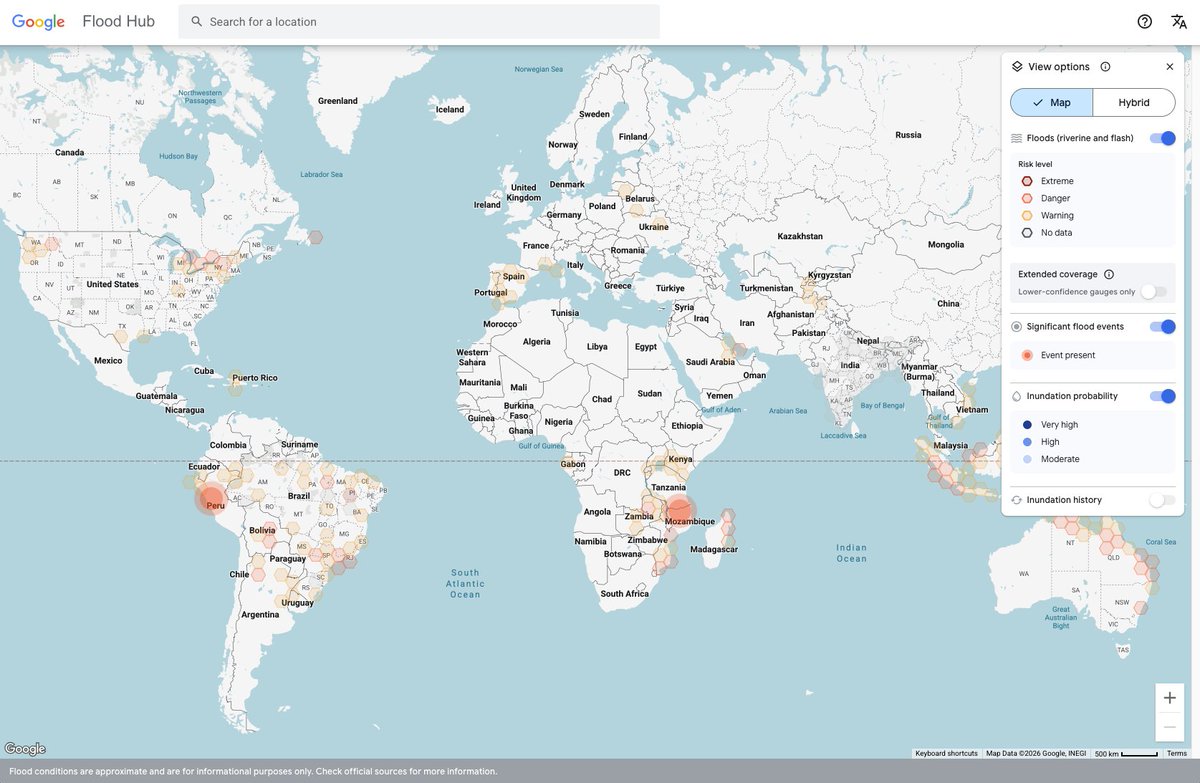
We trained a new flood forecasting model designed to predict flash floods in urban areas up to 24 hours in advance.
To help address a flash floods data gap, we created Groundsource: a new AI methodology using Gemini to identify 2.6M+ historical events across 150+ countries.
We’re open-sourcing this dataset to advance global research, and urban flash flood forecasts are live now in Flood Hub to help communities stay safe.
-Fuel price hikes of 20% overnight
-Covid-like remote mandate in schools & govt offices
-Probably 8 days of combat ready fuel (Strait of Hormuz closed)
-War with Afghanistan; Balochistan ready
-Water issues in summer after March31 Shahpur Kandi dam
@aravind any predictions?
@INCIndia Not a single Muslim nation sided with Iran in the current conflict.
Iran's only active backers in the fighting are non-state proxies like Hezbollah, the Houthis, and Congress
Introducing Perplexity Computer.
Computer unifies every current AI capability into one system.
It can research, design, code, deploy, and manage any project end-to-end.
GPT-5.2 derived a new result in theoretical physics.
We’re releasing the result in a preprint with researchers from @the_IAS, @VanderbiltU, @Cambridge_Uni, and @Harvard. It shows that a gluon interaction many physicists expected would not occur can arise under specific conditions.
https://t.co/EAZhKWacsG
True.
Once the solar energy generation to robot manufacturing to chip fabrication to AI loop is closed, conventional currency will just get in the way.
Just wattage and tonnage will matter, not dollars.
if you’re drawn to:
richard feynman
alan turing
claude shannon
john von neumann
nikola tesla
seymour papert
marvin minsky
judea pearl
dennis ritchie
donald knuth
rodd brooks
yann lecun
john carmack
dieter rams
elon musk
bjarne stroustrup
steve jobs
you’re not just into tech; you’re into the art of engineering,
the philosophy of systems, and the beauty of how things work.
you’ve found your people.
I have been watching football for 15 years and never saw Messi speaking a word in English
2 days in India and he started saying Jai Mata Di and Har Har Mahadev