The red strobe light on top of the tallest flag in sub-saharan Africa flashes as a marker and waypoint for aircraft flying at night or in poor weather.
🚨🔥 The moment the American Apache was shot down by the Iranian drone... a historic scene. An Iranian drone makes glory... and the Apache crumbles into oblivion. 🇮🇷💥
America sends its weapons... and Iran sends its messages: Our sky is not a picnic. 🚀🛑"
Fellow Ugandans, especially the Bazzukulu. Tomorrow is Heroes Day. I will address the country live on TV, radio and social media at 10:00am.
Please tune in as we commemorate our heroes and discuss matters concerning our country.
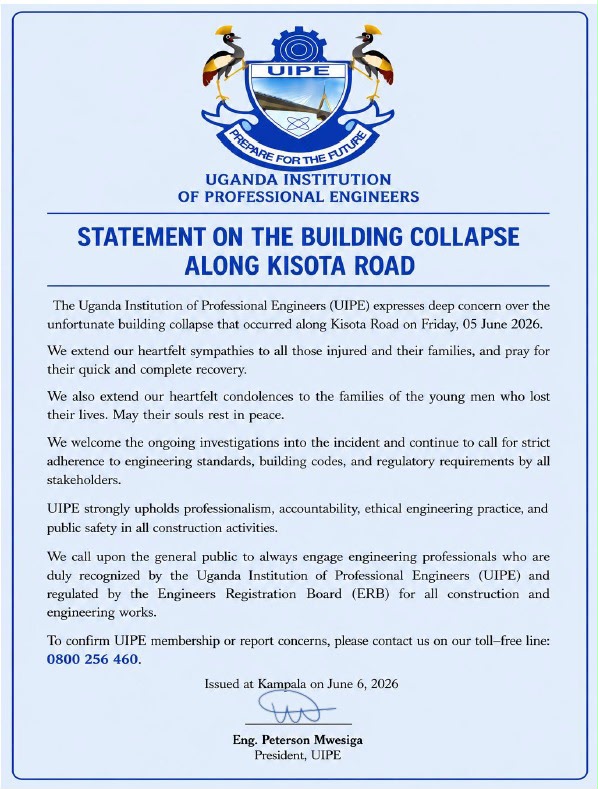
The submission by @NBRBug shifts the discussion from structural design alone to construction process management.
That is important because a building under construction is not yet the final building designed by the structural engineer. It is a temporary structural system whose safety depends on sequencing, concrete strength gain, formwork, shoring, material loading, workmanship, and supervision.
If a structure reached the 4th floor within 8 to 10 weeks, and workers were removing formwork for reuse in casting the 4th floor slab, then the key technical questions become very serious. Had the lower slabs gained enough strength? Was reshoring properly done? Were construction loads properly managed? Were materials being stored on immature slabs? Was there a competent professional supervising the sequence of works?
Concrete does not gain strength because the developer is in a hurry. It gains strength through chemistry, curing, and time.
A building can be structurally designed correctly and still fail if the construction process is poorly managed. This is why construction technology matters. Drawings alone do not build safely. Safe buildings require competent supervision, proper sequencing, quality control, and respect for material behaviour.
The NBRB findings should therefore help the public understand that building safety is not only about approvals. It is also about what happens every day on site.
Fact: President @KagutaMuseveni nominated Dr Lawrence @ReachDrMuganga (born Mukono 1976, @VUKampala VC) as State Minister for Internal Affairs in the 2026-2031 cabinet.
Fact: @Parliament_Ug’s Appointments Committee chaired by @ObothOboth rejected the nomination after due diligence revealed three passports👉🏻@GovUganda (valid), @Canada (expired 2019, renunciation process started), @RwandaGov (expired 2014). Muganga admits prior dual UG-CA citizenship, denies holding current Rwandan citizenship, and affirms he is Ugandan by birth.
Fact: Uganda law (Section 19D + Fifth Schedule, Citizenship & Immigration Control Act) https://t.co/8i3hQD6DM5 bars dual citizens from ministerial offices unless foreign citizenship is fully renounced. Other nominees with dual status provided proof of an ongoing process of renunciation and were approved.
Fact: @ReachDrMuganga has repeatedly declared loyalty to Uganda and his plan to be buried next to his parents in Mukono which is his ancestral birthplace.
With all facts now public, this matter should be left solely to President @KagutaMuseveni the elder statesman and smartest Politician among us to decide Muganga’s fate. He nominated him. He knows the full picture.
@Parliament_Ug has done its vetting. Let the appointing authority decide what serves Uganda best.
#UgandaFirst #LeaveItToMuseveni
I am interested in this guy if he needs employment. Let him contact me. Let him search for my email online and send me an email with copies of his academic papers.
Iran and the Real Meaning of Power: Why the nuclear bomb is not the lesson.
=======
There is renewed debate about whether Iran has crossed into a new nuclear reality, or at least moved closer to one. Whether that rumour is true or not, the fact that the world must discuss it seriously tells us something important about power. Iran has challenged many assumptions of modern empire, not because it is invincible, but because it has built systems that do not collapse easily under pressure.
Robert Greene’s The 48 Laws of Power has one famous lesson: strike the shepherd and the sheep will scatter. But Iran complicates that logic. The theory of decapitation assumes that a society is held together by one man, one office, one palace, or one command structure. In Iran’s case, pressure on leadership has not produced the simple scattering that powerful states often expect. The system has shown that some nations are not organised like crowds. They are organised like institutions.
That is the real lesson. A weak country is one where power sits in a chair. A stronger country is one where power sits in laboratories, factories, security systems, universities, supply chains, energy networks, industrial memory, military doctrine, and national institutions. When one person falls, another trained person stands up. When one facility is damaged, another protected process continues. When one generation is sanctioned, another generation learns to improvise.
Nuclear weapons, whether possessed, pursued, suspected, or debated, are among the most extreme symbols of strategic capability. They show that a country has moved beyond ordinary administration into complex coordination of science, industry, finance, security, secrecy, engineering, energy, logistics, and political will. The bomb itself is not the real power. The real power is the ecosystem that can imagine it, finance it, design it, manufacture it, secure it, maintain it, and politically control it.
This is part of the thesis I advance in my new book, The Five Levels of Economic Power. The lesson is not that Africa should chase nuclear weapons. That would be foolish, dangerous, and strategically misplaced. The real lesson is that no nation becomes powerful through speeches, donor workshops, mineral exports, imported contractors, or ceremonial industrial parks opened with ribbons, speeches, and branded tents. A nation becomes powerful when it builds the scientific, industrial, financial, military, and institutional capacity to defend its choices and shape its own destiny.
Iran may be sanctioned, isolated, attacked, mocked, and constantly threatened. Yet it has forced the most powerful nations on earth to calculate, hesitate, negotiate, strike, deny, and worry. That is not accidental. That is what happens when a country invests in strategic depth instead of living permanently at the mercy of external permission.
The deeper African question is therefore uncomfortable but necessary: what systems are we building that can survive pressure? If our universities are weak, our industries foreign-controlled, our engineers underfunded, our minerals exported raw, our standards imported, our machines bought but not mastered, and our institutions personalised around individuals, then we are not building power. We are only decorating dependence.
The bomb is only the visible tip of the pyramid. Beneath it lies metallurgy, chemistry, physics, software, machine tools, logistics, energy, finance, security doctrine, procurement discipline, and political continuity. That is the part Africa must understand. Real sovereignty is not announced. It is engineered.
The most powerful nations are not powerful because they possess dangerous weapons. They possess dangerous weapons because they first built formidable levels of competence. Africa must not copy the weapon. Africa must build the competence.
This is the real meaning of power. Not danger for its own sake, but disciplined capability. Not noise, but systems. Not panic under pressure, but institutions that can think, produce, repair, adapt, finance, and endure.