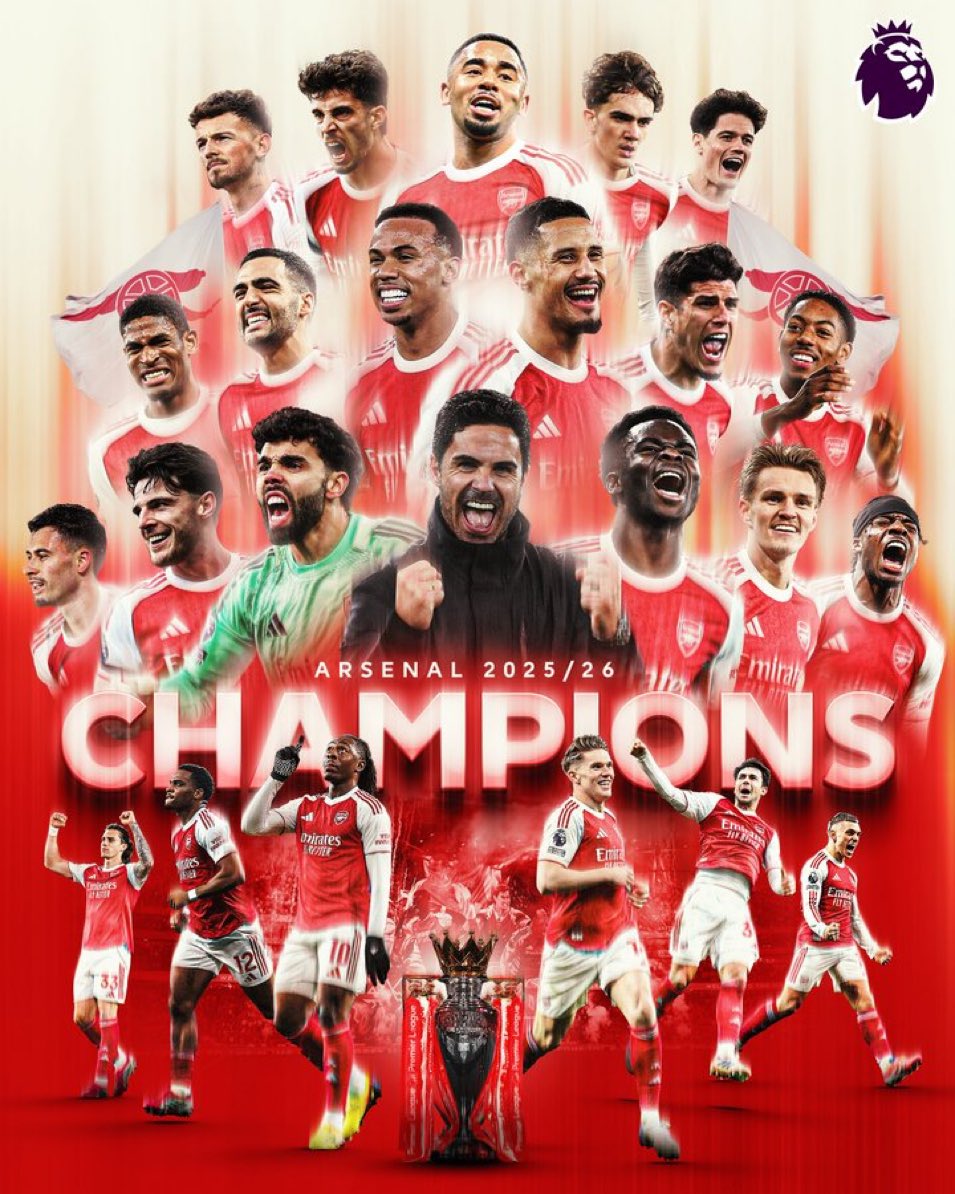
In the current Arsenal squad, there are 5 players who are 27 years old: Martin Ødegaard, Kai Havertz, Eberechi Eze, Martin Zubimendi and Declan Rice.
Back in 2019, Arsenal signed William Saliba for £27M from AS Saint-Étienne, a deal that has become one of the most important long-term investments in the club’s modern era.
And now the number 27 shows up again, but why?
Because it’s been 27 days since Arsenal won the league title.
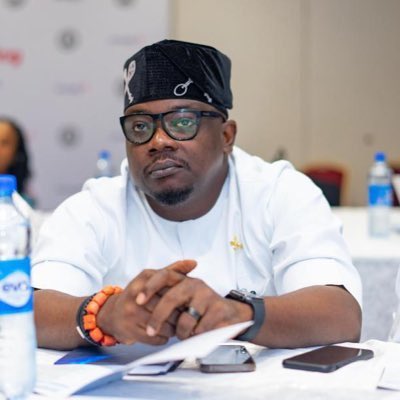
This is Engr Esosa Iyawe.
He rode on Peter Obi's popularity to win a place in the House of Reps, Representing Oredo.
After a while he defected to the APC.
Now that APC has denied him return ticket he has defected to the NDC.
He wants to ride Obi's popularity a second time.
I will be campaigning against him personally in 2027.
Unlucky!!! The Arsenal boys gave it everything. It was a day when fire was needed, and the boys did almost everything right, but unlucky with finishing. The battle is on. Now is the time for the players to stand up and fight until the very end. It’s fire 4 fire now. 💪
The news of the abduction of innocent UTME candidates in Benue State is not just heartbreaking but a damning indictment of the failure of leadership and the collapse of security in our nation.
Young Nigerians striving for an education are being met with terror. In a country where the share of tertiary graduates is already painfully low (about 1%) which is far below peers like Indonesia (about 13%) and South Africa (around 10%). This is unacceptable. We cannot afford to lose even one more student to violence.
Those entrusted with protecting these young students appear increasingly preoccupied with the next election, projecting strength and power to rig elections, rather than deploying that same power and agencies to secure our roads, prevent these crimes, and rescue the abducted children who should not be in the hands of criminals but in examination halls.
This is no longer an isolated tragedy. It is a pattern. It is a national crisis. And it demands urgent, decisive, and responsible action, not excuses, not silence, but leadership that matches the scale of the emergency this deserves.
A nation that abandons its youth abandons its future. This cannot continue.
A New Nigeria is POssible. -PO
We, members and leaders of the ADC, and other well-meaning Nigerians, lovers of democracy, are saying that our democracy must not be killed. We say NO to a one-party system and for that today we’re calling out Nigerians who believe in unity, peace, and security of our country to join us as we defend democracy in our land.
A New Nigeria is POssible. -PO
Now a Disgraced Country Indeed
Today, as the world marks World Health Day, we must pause for honest reflection.
Nigeria, a nation of over 200 million people, continues to grapple with one of the weakest healthcare systems in the world. Our primary healthcare structure is almost comatose. We now record worse infant mortality outcomes than India, a country with a larger population, while health insurance coverage in Nigeria remains below 5%. These are not just statistics; they are a painful indictment of our priorities.
Recent disclosures by the Honourable Minister of Health show that out of the ₦218 billion appropriated for healthcare capital expenditure, only about ₦36 million has been released. This is deeply troubling.
At the same time, the Independent National Electoral Commission (INEC) has projected over ₦135 billion for legal expenditures.
Let us reflect on this.
The amount earmarked for election-related litigation is far higher than what has been made available for primary healthcare, the very foundation of a nation’s wellbeing. This is the same primary healthcare system expected to serve millions of Nigerians and support critical institutions such as:
1. University of Benin Teaching Hospital, Benin City
2. University of Calabar Teaching Hospital, Calabar
3. University of Abuja Teaching Hospital, Gwagwalada
4. University College Hospital, Ibadan
5. Obafemi Awolowo University Teaching Hospital, Ile-Ife
6. University of Ilorin Teaching Hospital, Ilorin
7. Irrua Specialist Teaching Hospital, Irrua
8. University of Nigeria Teaching Hospital, Ituku-Ozalla, Enugu
9. Jos University Teaching Hospital, Jos
10. Aminu Kano University Teaching Hospital, Kano
11. Lagos University Teaching Hospital, Lagos
12. University of Maiduguri Teaching Hospital, Maiduguri
13. Nnamdi Azikiwe Teaching Hospital, Nnewi
14. University of Port Harcourt Teaching Hospital, Port Harcourt
15. Usmanu Danfodiyo University Teaching Hospital, Sokoto
16. University of Uyo Teaching Hospital, Uyo
17. Ahmadu Bello University Teaching Hospital, Zaria
18. Federal Teaching Hospital, Abakaliki
19. Abubakar Tafawa Balewa University Teaching Hospital, Bauchi
20. Federal Medical Centre, Yola
These institutions represent hope for millions. Yet, they remain underfunded, overstretched, and burdened by systemic neglect.
A nation that prepares more for electoral disputes than for the health of its citizens is a nation that has lost its way.
We must begin to ask the difficult but necessary questions: What are our true priorities? What kind of nation are we building? And for whom?
Healthcare and education are not optional; they are the foundation of national development. Any country that neglects them undermines its own future.
Nigeria must urgently reorder its priorities. We must invest in the health and wellbeing of our people, strengthen our institutions, and build a system that works for all, not just a few.
A new Nigeria is POssible. -PO
Let us reflect, sincerely and without sentiment.
In the past few days, the President has reportedly approved ₦3.3 trillion as a “full and final” payment for debts in the power sector. Yet, this is not the first time such approvals have been made.
On May 17, 2024, ₦3.3 trillion was approved for the same purpose. On July 25, 2024, another ₦4 trillion bond was approved to settle similar debts. There have also been other approvals in between, all targeted at addressing the same power sector liabilities.
This raises a fundamental question: were the previous approvals mere announcements without execution?
₦3.3 Trillion Again? Nigeria’s Power Crisis Without End
During the 2023 campaign, President Bola Ahmed Tinubu made a clear promise: that if he failed to deliver stable electricity, Nigerians should not re-elect him. Today, the reality is that power supply has worsened, to the extent that there are even discussions about disconnecting the Presidential Villa from the national grid.
Each time legitimate concerns are raised, what we see appears more like policy pronouncements than measurable progress.
Now, again, we are confronted with another ₦3.3 trillion approval to settle power sector debts.
These debts were largely accumulated under successive administrations of the All Progressives Congress between 2015 and 2025. This raises serious concerns about accountability, transparency, and effectiveness in public financial management.
It is important to note that government institutions and agencies, including the Presidential Villa owe a significant portion of these debts. Year after year, budgets were made and funds appropriated. Why then were these obligations not settled when due? And from what source will this new payment be made? Are we resorting once more to borrowing to service inefficiencies?
Key questions remain unanswered: How did the debt accrue? What is the actual total debt in the power sector? Which components of the debts are due to operators’ inefficiency and should be borne by them? Why have previous approvals not translated into tangible improvements? Who are the real beneficiaries of these repeated payments?
Is the ₦3.3 trillion approved on April 6, 2026, the same as the ₦3.3 trillion approved in May 2024, and how does it relate to the ₦4 trillion bond approved in July 2024?
Nigeria must move beyond recycled announcements and confront the power sector crisis with sincerity, transparency, and decisive reforms.
Until we do so, we will remain trapped in a cycle of debt and darkness.
But with discipline, accountability, and the right leadership, a new Nigeria is still possible. -PO
Let Easter give us hope of a better Nigeria ahead.
As we commemorate the resurrection of our Lord Jesus Christ, even amid difficult times, we encourage you to remain steadfast in hope. Indeed, “Good Friday must come before Easter Sunday,” and our present challenges must not define our future.
We understand the heavy burden many families are carrying as a result of economic hardship. As we share in your struggles, we urge you not to lose heart. These difficult moments are temporary trials—our collective “cross”—that can lead to renewal if we remain resilient and committed to the common good.
Our nation continues to face serious challenges, especially in governance and the impact it has on the daily lives of citizens. Yet, Easter reminds us that after sacrifice comes renewal, and after darkness comes light. A better Nigeria is possible when we, together, choose accountability, compassion, and responsible leadership.
We remain hopeful that, through God’s grace and the determination of our people, the journey ahead will lead to a brighter future. Though the road may be rough, we believe in a Nigeria that works for everyone.
May this Easter renew our faith, strengthen our resolve, and inspire us to work together for a just and prosperous nation.
Happy Easter. -PO