Hero pilot Captain Smit in his first public comments: “I was not going to let others die” Smit recounts opening cockpit door with “one last push” in a video call with Indian Prime Minister Narendra Modi.
“I have been flying for the last 17 years, have been a captain for the last 11 years. I knew that the aircraft was going down.”
La politique, aujourd'hui, pour la majorité des gens, ce sont des discours creux prononcés dans des salles à demi vides par des beaux parleurs soupçonnés de ne s’intéresser qu’à leur destin personnel. Et là, soudain, apparait un homme tout simple, modeste, presque timide, économe de ses gestes et de ses mots, qui ne brille pas spontanément par son charisme personnel, un homme élu par ses pairs à la tête d’une institution qu’on disait condamnée, et qui déplace, lui, près d’un million de personnes pour attendre des heures sous le soleil une célébration vieille comme le monde. Et parce que cet homme et évidemment sincère et désintéressé, quand il prend dans ses bras une fillette polyhandicapée, quand il plonge son regard dans le sien, personne, même le plus mal intentionné, n’y voit autre chose que l’image d’une bouleversante humanité.
The European Commission has drawn up plans to remove the national veto from most stages of European Union accession talks, according to two internal draft documents.
https://t.co/q98iRWAsDZ
A few weeks ago I sent the final draft of the fourth volume of The Political and Strategic History of the World to my publisher, and I must confess, when I finally pressed “send,” it was a relief.
It is a history of the world, but since people make history, it is a history of people: great people, terrible people, mediocre people, evil people. I set out to write a magnum opus, and after eight years of almost daily toil I am gratified with the end product.
With this last volume I will have almost run my course as a historian—but not quite.
I will continue to offer my commentary on current events so long as there is an audience interested in reading it, but my real passion since I was a boy continues to be history. And between us, it sometimes gets awfully tiring writing about Donald Trump or Mark Carney or the latest entrant through what has become the revolving door at 10 Downing Street.
Which brings me to my point. I have launched a Substack. It will include some missives on contemporary politics when, as happens from time to time, I feel the need to get something off my chest, or wish to let my hair down to a greater degree than my editors would allow. But mainly it will be about the fascinating people and events that have shaped the world. I am starting out with a series on what I regard as the most important speeches ever delivered. If you, too, love history, please consider joining me.
I will provide a link in the comments below.
As @Pontifex made his first trip to that most secular of countries, images of millions of people fervently pouring onto the streets suggested something profoundly spiritual was afoot. #PopeLeoXIV#WSJopinion
https://t.co/GmMffBfyDj
The first beatification to take place on U.S. soil in almost 10 years is happening in St. Louis, Missouri, today.
Bishop Barron, reflects on why Fulton J. Sheen could be on his way to becoming America’s next saint. https://t.co/IpweYviyL9
My friend Dovie argued that the logic of assisted suicide assumes some lives are not worth living. His very being was a rebuke to that idea, writes Madeleine Kearns. https://t.co/BY4W7qzgff
My friend Dovie argued that the logic of assisted suicide assumes some lives are not worth living. His very being was a rebuke to that idea, writes Madeleine Kearns. https://t.co/BY4W7qzgff
Berlin jetzt fest in arabischer Hand: Clanchef Remmo feiert mit der LINKEN, mit dabei de Chef der Palästinenser-Terrororganisation PFLP. Willkommen im neuen Berlin. https://t.co/xEPaLL6yPn
What if “suicidal empathy” has less to do with empathy and more to do with self-rejection?
Philosopher Benedict Beckeld explores the idea that in some cases, what appears to be compassion can sometimes stem from rejecting your own culture, people, and history.
Don’t miss the full episode with @Raphfel and @BenedictBeckeld
👇
https://t.co/XoMVygVP2Q
This was an amazing conversation with @BenedictBeckeld on the @brusselssignal podcast!
We cover a lot of ground, including what Benedict means by "ethnic memory" and a thourogh critique of the concept of "suicidal empathy."
https://t.co/ksBXWds1AX
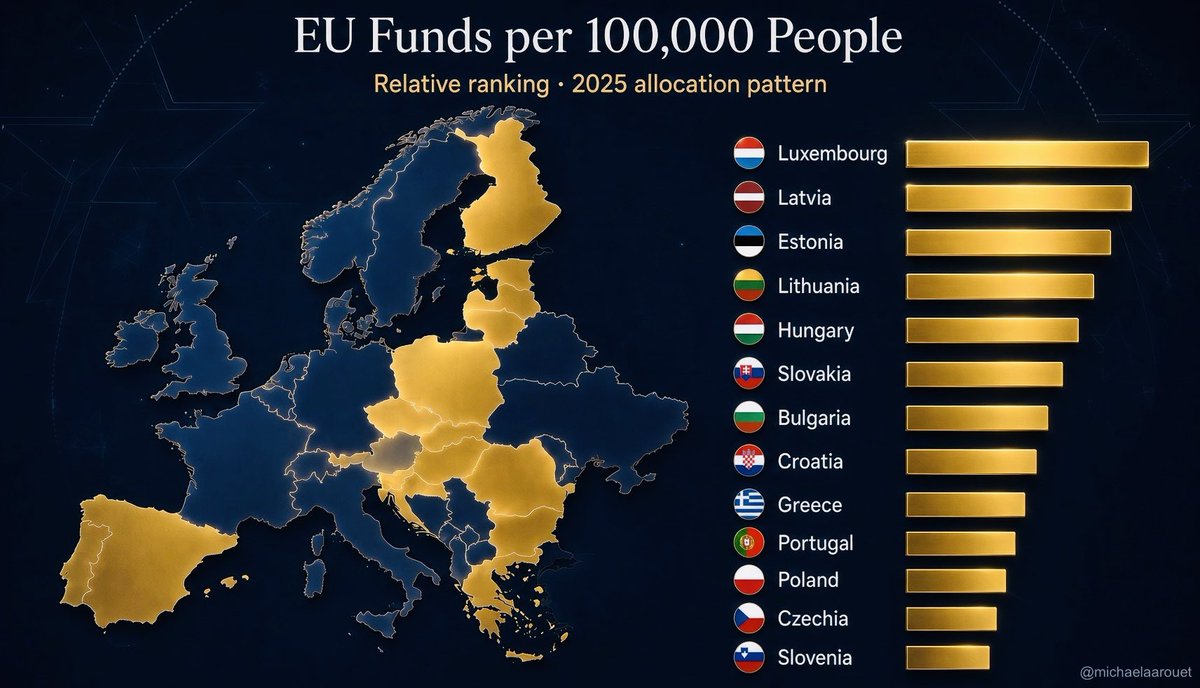
There is a popular but wrong narrative that Poland’s economic rise is an EU subsidy story. Look at the list. Hungary, Slovakia, Bulgaria, Greece or Portugal get more EU money per 100,000 people than Poland. Several have been net beneficiaries just as long, but none compounded like Poland.
Since 2003 Poland’s GDP has grown 130%, the EU average is about 35%. Per capita income has gone from under half the EU average to over 80%. That is not what “funds did it” looks like. Funds helped build roads and trains, they did not create the factories, exporters, software firms, or millions of small companies that now generate nearly half of Polish GDP.
What did:
• A culture that treats hard work and entrepreneurialism as normal, not suspicious.
• Relatively low and simple corporate tax (19%, 9% for smaller firms) that let capital stay and compound.
• Early, painful reforms that opened markets instead of protecting incumbents.
• A state that stayed out of the way more than it micromanaged.
• People who left for London or Dublin, learned, came back, and started businesses.
If subsidies were the main driver of growth, should Southern Italy be an economic powerhouse?
Dozens of students left a graduation ceremony at Ghent University after the faculty’s honorary vice-rector denounced what he called a “lynching” of the American philosopher Nathan Cofnas.
https://t.co/V7SCwQUOnW
To counter Europe’s dependence on US social media, the European Commission ordered trusted European partners to launch an X clone. Patriotic Europeans like myself were the first to join. But I worried about censorship and tested the new platform by outing myself as a pro-EU, moderate conservative. Got suspended. FAIL!
Why did I run a test? You see, free speech in Europe isn’t doing well at all at a cultural level because a progressive, liberal-technocratic ideology aggressively delegitimises all other political views, its adherents tending to feel entitled to use legal measures and institutional might against nationalists and conservatives. But my brand of EU-friendly, mega nerdy, moderate conservatism should be OK, no?
So here my test. I uploaded links to two of my papers: one on Europe’s historiographical pluralism and one on the need for conservatives to shape the European project. See: https://t.co/DlpvZDp4Iz And: https://t.co/B95ieryNPn Then I criticised the Brandmauer in Germany, calling it ineffective, both intellectually and in light of the current polls. Finally, I stated in my WSocial bio that I was “aspiring to found WSocial’s conservative corner.”
I had only friendly engagements with people. A left-wing lady liked some of my posts, and we followed each other. I liked a happy post about the EU-Canada love fest. Everything seemed fine.
Then came the Bluesky flagging; my account was shielded from the shared Bluesky universe. I didn't think too much of it. After all, WSocial had my back, and I was happy to be on it. Oops, WSocial clammed down. Block. Account gone.
Guys, pro-EU/EU-aligned social media are not going to work if we cannot muster some basic tolerance for political and intellectual diversity. I would also like to point out that I've used WeChat (Chinese) for over a decade without any suspicion, and the same holds for my two decades of using American social media. No one ever suspended or flagged me. It's a bit crazy that I went through the trouble of getting a passport-verified account on an EU-focused app—motivated by EU patriotism!—only to have it taken down within a few days.
Really, if it’s like that, just give social media to the US and China. I have to be honest.