I just found a rare MS Dhoni video that most fans have probably never seen before.
For a few seconds, it feels like we got a piece of our childhood back. 💛🥹
@HPhobiaWatch Played for country,
Inspired Youth of country,
Handling everything with humility be it criticism, people like u on daily basis.
Ever heard Thala saying "Tum sabki m** ki ch*t" ? NO n
Still Thala not a Nationalist? Reach keliye Thala ke gote lena band krdo tumlog
Whoa, Meta released a new open-weight LLM yesterday, something that hasn't happened since the good old Llama days.
Their Meta Muse Glimmer model is a 30B multimodal reasoning model with a Gemma-like architecture design. (“Glimmer” is probably a wordplay on “Spark,” the more likely capable model from which Glimmer was distilled. Muse Spark is only available through Meta’s Model API, though.)
Architecture-wise, here are some of the main points:
1. "Only" a 131k context window, compared to Qwen3.6 and Gemma 4, which support 2x that natively; it's reasonable, but maybe on the shorter end in the age of agent harnesses
2. It's a dense model, not a mixture-of-experts. (So, it's fairer to compare it to Qwen3.6 27B than Qwen3.6 30B-A3B.)
3. Hybrid attention with grouped-query attention (GQA) and sliding window attention (SWA); the SWA:GQA pattern is a 3:1 local:global ratio. Other models like Gemma 4, which uses similar components, have a 5:1 ratio for comparison.
4. It adopts gated attention for both GQA and SWA; gated attention has become quite common in recent months. It basically applies a sigmoid gate to the attention output to decide how much of the attention information enters the residual connection. The interesting point is that it uses relatively standard GQA and SWA rather than hybrid attention mechanisms such as Nemotron or Qwen3.6.
5. A very extreme GQA ratio: 32 query heads and only 2 KV heads; for comparison, Gemma 4 31B uses 32 Q / 16 KV in the local heads and 32 Q / 4 KV in the global heads. This means that Meta Glimmer has a very small KV cache.
Overall, the probably most similar architecture is Gemma 3 27B (including the Gemma-style pre/post RMSNorm placement) and Gemma 4 31B, but with some tweaks like SwiGLU instead of GeGLU activations, gated attention, and the more extreme GQA:SWA pattern mentioned before.
What stands out is its extreme KV-cache efficiency.
I.e., the KV CACHE / TOKEN ratios (in BF16) are:
- Muse Glimmer: 52 KiB (lower is better)
- Qwen3.6 27B: 64 KiB
- Gemma 4 31B: 840 KiB
Modeling-performance-wise, their own benchmarks show that it's mostly ahead of Qwen3.6. According to the independent composite benchmarks on the Artificial Analysis Intelligence Index, it's slightly behind Qwen3.6 (see figure below). So, a few days of using it will tell where it really ranks.
Overall, it looks like a solid model, particularly for agentic workflows. What stands out most is its very low memory footprint and also pretty fast prefill and decode speed. It’s also just great to see Meta releasing open weights again :).
@thdxr Hey, opencode is not working in my terminal, please help if you have any idea regarding that.
ps-i tried few of fixes available on internet but it didnt worked
Linus Torvalds said: bad programmers worry about the code. Good programmers worry about data structures and their relationships.
LLMs like to choose wrong data structures, and then write a lot of impressive but unoptimized code around them. How can you be sure it doesn't happen if you don't look? Or, if you look, but you're not good enough to know what's best?
You'll just end up in pit of failure, with an automated process of digging yourself deeper
Tom Holland sharing a quote that said “if you have a problem with me, text me, and if you don’t have my number, you don’t know me well enough to have a problem with me” really stuck with me
How can an LLM switch between low-, medium-, and high-effort reasoning? And how does an LLM learn to reason more or less?
I put together a “little” article explaining how these effort levels are implemented at inference time and during training.
Day 6/60 - System Design Series 🚀
Content Delivery Network (CDN)
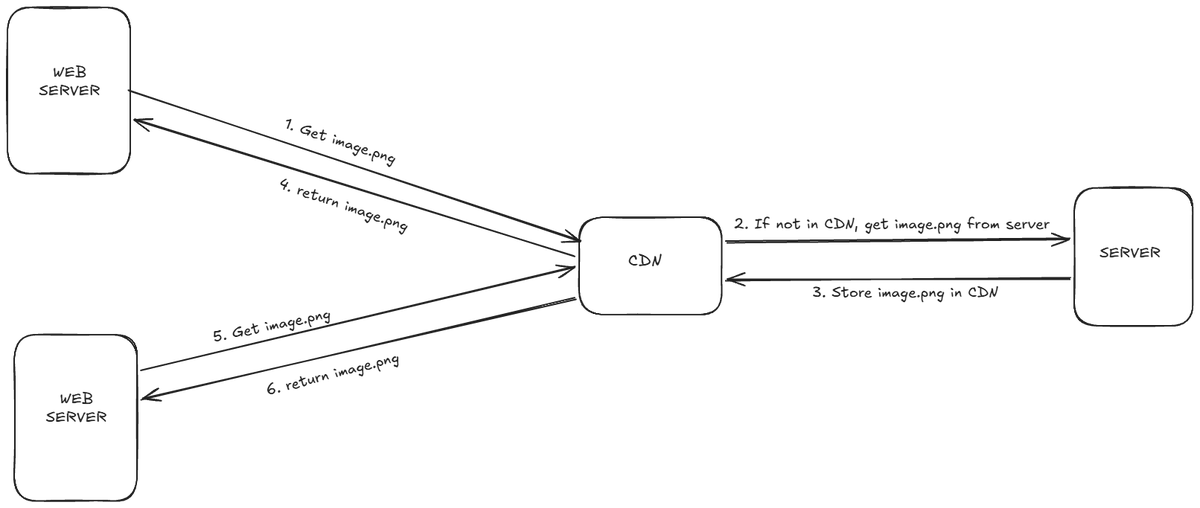
CDN is a network of geographically dispersed servers used to deliver static content. CDN servers cache static content like images, videos, CSS, JS files, etc.
How CDN works?
When a user visits a website, a CDN server closest to the user will deliver static content. For example, if CDN servers are in Kuala Lumpur, Malaysia, users in George Town will get content faster than users in India.
CDN Workflow:
1. User A tries to get image.png by image URL. URL's domain are provided by CDN provider.
2. If CDN server does not image in cache, CDN server requests file from origin, which can be a web server or S3/blob storage.
3. Origin return image.png to CDN server, which includes optional HTTP header Time-to-Live (TTL) which describes how long image is cached.
4. CDN caches the image and returns to User A. Image remains cached in the CDN until the TTL expires.
5. User B sends request for same image.
6. Image is returned from the CDN as long as the TTL has not expired.
Interviewed a Senior Backend Engineer today.
Knew payments, Stripe, REST APIs, webhooks — all of it.
Then I asked:
"A user clicks 'Pay Now.'
Their internet cuts out for 2 seconds.
They click again.
Your server processes both requests.
The user is charged twice.
How do you prevent duplicate charges — without asking the user to do anything differently?"
Silence.
Your turn:
User clicks twice ❌
Server processes both ❌
Double charge ❌
User did nothing wrong ❌
How do you make your payment API safe against this? 👇
(Stripe has a name for this solution — do you know it?)
As an AI Engineer. Please learn
>Harness engineering, not just prompt engineering
>Context engineering, not just long prompts
>Prompt caching vs. semantic caching tradeoffs
>KV cache management, eviction, reuse, and memory pressure at scale
>Prefill vs. decode latency and why they optimize differently
>Continuous batching, paged attention, and throughput optimization
>Speculative decoding vs. quantization vs. distillation tradeoffs
>INT8, INT4, FP8, AWQ, GPTQ, and when quantization hurts quality
>Structured output failures, schema validation, repair loops, and fallback chains
>Function calling reliability, tool contracts, argument validation, and idempotency
>Agent guardrails, loop budgets, tool budgets, and termination conditions
>Model routing, graceful fallback logic, and degraded-mode UX
>RAG architecture: chunking, embeddings, hybrid search, reranking, and freshness
>Retrieval evals: recall, precision, grounding, attribution, and citation quality
>Evals: golden sets, regression tests, adversarial tests, LLM-as-judge, and human evals
>LLM observability as a first-class discipline: traces, spans, tokens, latency, errors, and drift
>Cost attribution per feature, workflow, tenant, and user journey not just per model
>Safety engineering: prompt injection defense, data leakage prevention, and permission boundaries
>Multi-tenant isolation, cache safety, and cross-user context contamination prevention
>Fine-tuning vs. in-context learning vs. RAG vs. distillation and when each is the wrong tool
>Latency, quality, cost, and reliability tradeoffs across the full inference stack
>Production failure modes: hallucinated tool calls, malformed JSON, stale retrieval, runaway agents, and silent eval regressions
hey X,
connect me with brains who are working in the field of AI engineering.
and if this reaches you, i have a message for you
Please do drop the resources that i can use to become best AI engineer.
Before going for LLD round , never forget to prepare how to :
Design a Parking Lot
Design an elevator system
Design API rate limiter
Design a logging system
Design a hotel management system
Design a movie ticket booking system