🚨 Anthropic just showed a 27-minute workshop on how to actually do prompts for Claude.
Taught by the people who built it.
Free. No registration. No paywall.
I've seen $300 courses that don't cover what they teach in the first 8 minutes.
Watch the session
@MaxtheCrowhouse@CENTCOM They kill and have killed 2,000,000 iranians - their own people, you don't mention !!!!!
and ripped off fucking 109 Trillions for 1,000 years in Gold from their own people, I guess u must have got some from the Biden and the Allytolah slush fund to FundBlue .
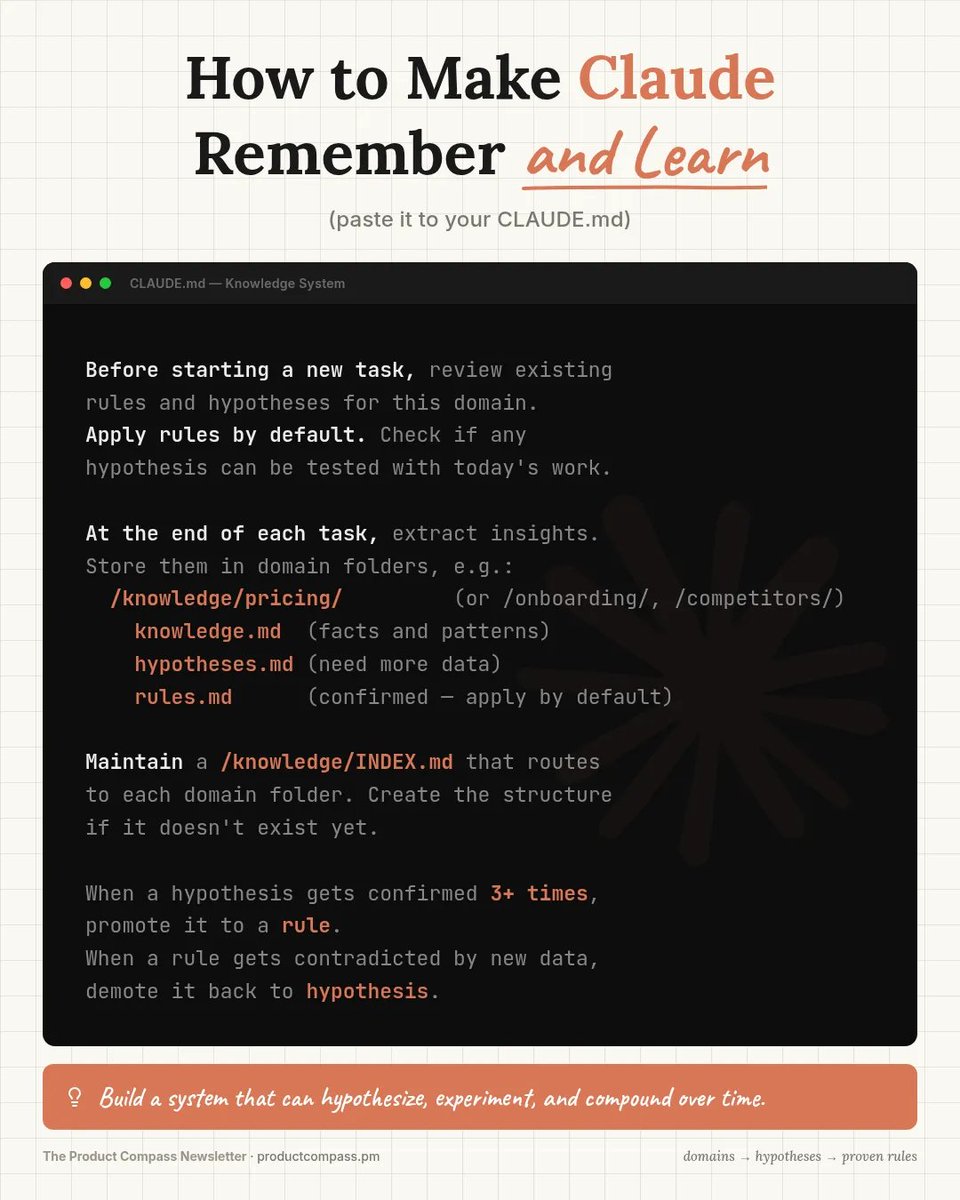
Your CLAUDE.md is probably a config file. It should be a decision engine.
Karpathy just published an llm-wiki spec. The key layer isn't the knowledge files — it's what he calls "schema (e.g., CLAUDE.md)." Not where to look. How to think.
I've been running this pattern with 120+ knowledge files for months. Three things make it compound:
— Knowledge architecture: INDEX.md routes the LLM to the right files without you pointing
— Decision journal: the LLM writes back. Templates, hypotheses, performance data update after every session
— Quality gate: hard rules that override defaults. "When evidence contradicts instinct, trust the evidence"
Without these, CLAUDE.md is a README. With them, it gets smarter every session
Great question, user is always the top priority for us, and we try our best to improve user experience.
At this speed, we rely heavily on user behavior metrics as our top-line signals (engagement, conversion, latency, etc.) to decide what “good” looks like. Every rollout is gated and monitored, so if something doesn’t resonate with users, we pull it quickly.
So the loop is: ship → observe real user behavior → iterate fast.
The work is shifting from writing code to designing systems, defining constraints, and critically evaluating AI output , and those are areas where experience matters even more.
In my view, once experienced engineers adjust their mindset, they can actually make much bigger contributions than before.
@hellocloh We started with over 50 microservices and consolidated them into a monorepo. While agents can still manage multiple repositories effectively, we find the monorepo approach to be much simpler.
That’s a great question. The monorepo helps because the agent can access the full system, but you’re right that context still needs to be constrained.
What made this much more practical in the last few months is the improvement in context management and progressive context loading, for example through agent skills and more structured retrieval patterns.
So the idea is not to dump the entire repo into the prompt, but to make the full system visible while loading only the relevant context step by step. That’s what makes the boundary manageable.
@_philschmid MCP as the glue layer between local agents and cloud compute is the pattern that scales. agents that can provision GPU resources on demand rather than being limited to local hardware changes what's buildable. Colab + MCP is the right direction.