Before AI, you can get a bachelor degree in economics without reading any books. You may get a master or even PhD without doing so. I think that’s also true for many other subjects.
An Oxford academic has warned that students using AI can obtain a degree without reading any books
Katherine Rundell warns that reliance on AI is creating a ‘vast counterfeiting of knowledge’ in universities 👇
https://t.co/NrCYEikAJC
I always expect people who cite my papers to read them carefully. But they never do, never get beneath the surface. In one paper I have 15 anagrams hidden throughout, and if you read them backward a bonus robustness result will appear. How disappointing that no one has found them!
Let me explain this for people who do not do research for a living.
Research papers are not written like novels. They are structured from the start with the view that most people will selectively read its content based on their needs. Most will glance at the abstract to find out what are the question, method, main results. Others will go further and read specific sections in details. Almost no one will read the entire paper.
There are use cases of citations that involve a low effort in reading. If you want to know if your results align with others, you don't need to understand the nuance of footnote 8 in the online appendix. You just read about the method, the data, and the key results. It's minutes, not hours. Another example is when you use a method that was introduced by a paper or a series of papers. You just need to know if the method is there. That takes seconds.
Now, there are other use cases where you have to read all the fine prints. If you extend the analysis of paper, criticize it, or want to contrast your results to theirs, nuances are not optional. That can be measured in hours or even days.
Most of the problems with citations that you will find are about the first situation, not the second. So, the situation isn't that people are not engaging deeply with imagined content they did not read. The situation is laziness or, sometimes, limited knowledge spread errors.
For instance, a few people misinterpret a result and erroneously cite a paper for it. You then come across 10 people who claim that X found Y. You should spend a few minutes to go check that it is true, but some people do not and repeat the claim. The error can also enter later. A few people might say that X found Y, but a few rounds of telephone game later Y became Z because people loosely interpreted each other instead of going back to the source every time. Again, all of them should check directly, but not everyone does.
A more excusable type of error involves the attribution of origin. No one knows the full set of all relevant papers on a topic, so it's possible to misattribute origin in good faith without being lazy. I gave an example of that recently with Jorda and local projections -- they date back to Dufour and Renault (1998), as far as I know.
Now that you all the lay of the land, let's go back to what happened here. She lazily repported what others repported without double checking. We're very far from using the hallucinated references made up by a chat bot or from arguing with strawmen instead of other papers.
I don't know about her field, but I have never caught anyone getting into a detailed response to papers they did not read in my field -- economics. If you believe otherwise you're a dumbass. Also, that would be amusingly hypocritical if you did not read as many papers as I did before making that bold claim. The errors that do slip through tend to be annoying, but ultimately inconsequential -- i.e., answers to important questions are unaffected.
I read everything three times if I’m planning to cite it. I call it Professor Gill’s Rule of Three. It is what I advise grad students to do too. If you’re going to cite a paper/book/treatise, read it three times, minimum.
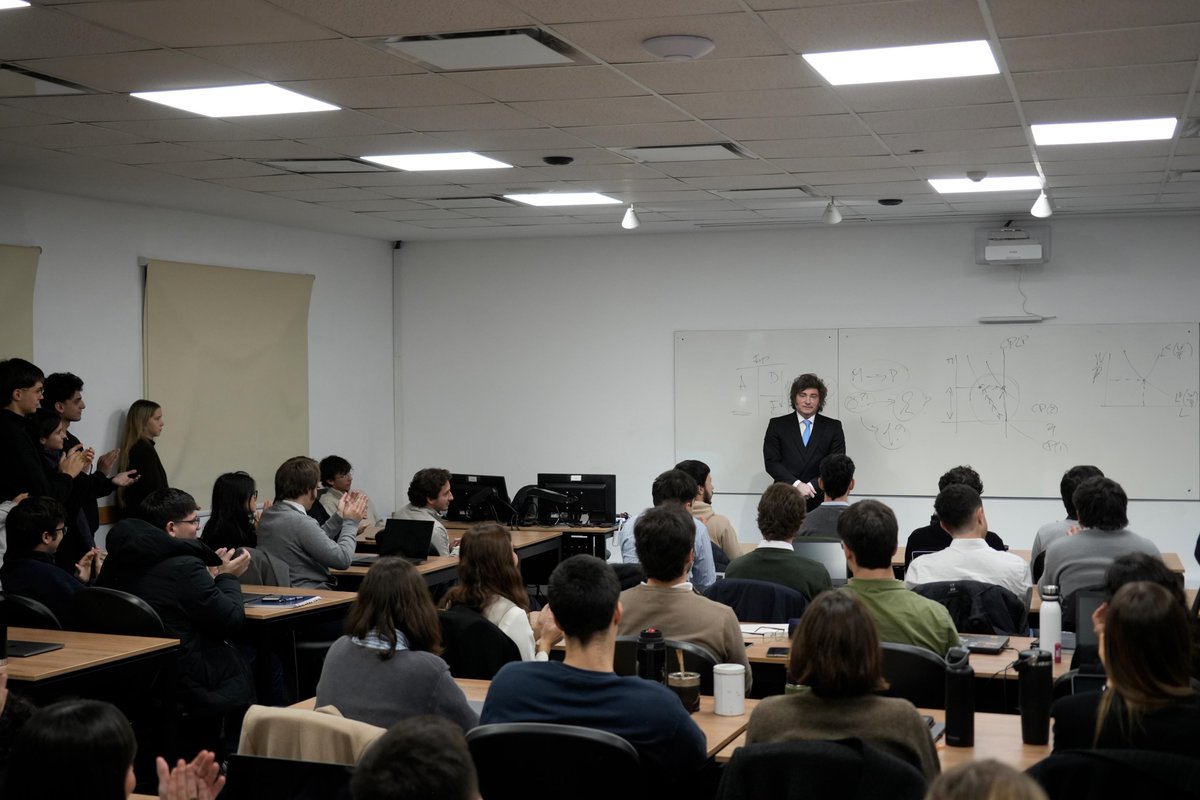
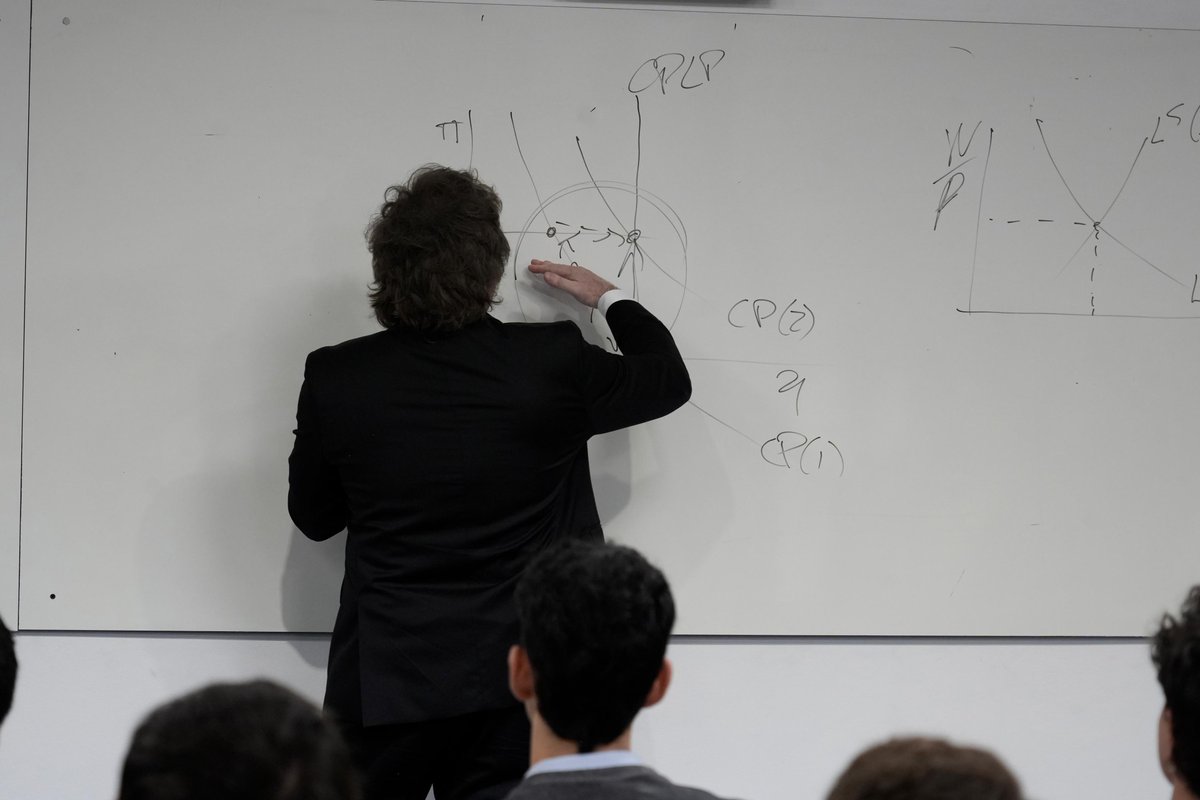
El Presidente Javier Milei dio una clase magistral esta mañana ante los alumnos de Macroeconomía Avanzada de la Maestría en Economía de la Universidad de San Andrés.
Lo acompañaron el Ministro de Desregulación, Federico Sturzenegger, y el Rector de la Universidad, Lucas Grosman.
After prompting AI to produce an essay, most students just don't know what to ask next. Where to ask AI to go deeper? Where to reconsider? Where are the weaknesses? They simply don't have enough knowledge of the subject to evaluate (and then improve) the output. [3/3]
Taught "History of Economic Thought" this semester (actually just Smith, Malthus, Ricardo, and Mill, not a broad survey). I asked students to use AI intensively, but that did not work out that well. Students just don't know how to utilize AI fully. [1/3]
The writing assignments aren't that different from two years ago, when AI was much less powerful. Yes, there are fewer typos, but that's the only improvement. My guess is that students just don't know enough to push back. [2/3]
Preparing teaching materials for Barro-Gordon makes me wonder where Gordon is now.
There are many famous Gordons in economics, which can be confusing. This Gordon is David B. Gordon, and I believe his father is Donald Gordon, an economist at UW who
Back to the original question: where is David B. Gordon now? A colleague of his at Clemson told me that he retired about 20 years ago.
His two papers with Barro have thousands of citations (one JPE, one JME). He also had two papers with Leeper that are quite influential (also one JPE, one JME).
had a big influence on Douglas North.
Then we have David M. Gordon, who was a marxist economist at the New School. His brother is Robert J. Gordon, who is probably the most famous Gordon in economics. Their father Robert A. Gordon was the president of AEA in the 1970s.
I read the trilogy three times……and then went on to read most of Lodge’s novels. I remember there is one about AI!
By today’s standards, the main characters are probably fired for unprofessional behavior by about page 20.
Semester is over, but the summer conference circuit just started! I am not Morris Zapp, but I have a long, long trip ahead, so light posting for the next couple of months.
In the meantime, read David Lodge’s The Campus Trilogy. It is truly hilarious.
Just realizing that Kydland-Prescott (1977) is such a good paper to teach from. You can learn about optimal control, rational expectations, Lucas critique, Markov feedback rules, dynamic programming, time inconsistency, policy evaluation......all in less than 20 pages.
Follow up on Kydland-Prescott (1977): Why didn't they elaborate more on the monetary policy case? They just have a simple model and a graph, and then they just move on to the investment example. Why did it take so many years for Barro-Gordon to arrive?
Is it my hindsight bias?