Imagine you have some gold onchain sitting idle.
Maybe XAUT, or PAXG.
Right now you can hold it, sure. But that's pretty much it.
What if instead you could earn on top of it, without being a DeFi quant?
Deposit into one of our upcoming vaults. One click and you're set.
Everything else happens in the background.
(XAUT/PAXG → borrow ETH → acquire pETH → mint pGOLD → deposit into the Stability Pool → earn yield + negative borrow rate)
All of this is abstracted away, while your exposure to gold remains the same.
Except now it’s generating yield for you.
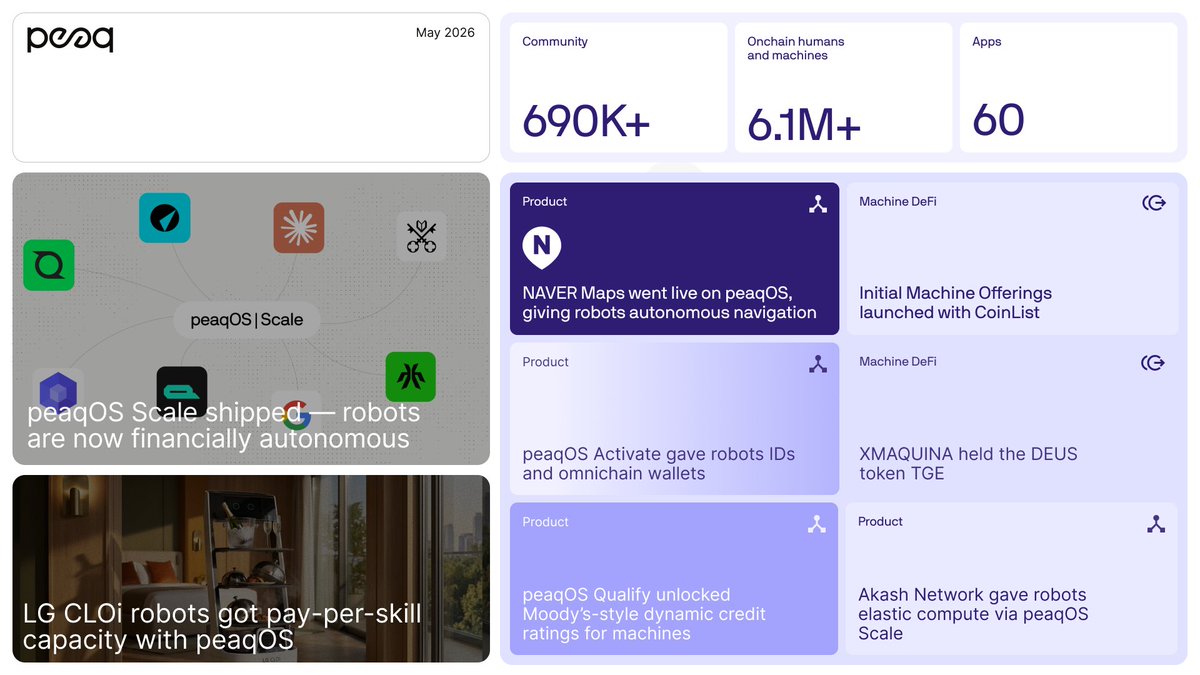
Your peaq pulse for May is here
→ peaqOS Scale granted robots financial autonomy with 14 services live
→ Initial Machine Offerings announced with @coinlist
→ We showcased pay-per-skill robotics with @LGE_Global’s CLOi robots
→ @xmaquina's DEUS token hit the markets with their TGE
→ @official_naver Maps granted robots autonomous navigation via peaqOS Scale
→ peaqOS Activate and Qualify shipped — the foundational machine ID stack
→ @akashnet unlocked elastic compute for robots with peaqOS Scale
Dive in ↓
.@akashnet and peaq unlock autonomous elastic compute for robots and machines
The strategic partnership enables on demand GPU and CPU compute for any robot or machine running peaqOS
→ peaqOS provides the context and coordination
→ Akash Network provides decentralized compute on demand
The output returns to the robot in seconds
https://t.co/y6jOdkgTKV
Trust still breaks at the control layer.
The Verus-Ethereum bridge exploit showed cross-chain verification risk is still live, while the Federal Reserve’s May 2026 Financial Stability Report says reserve transparency and redemption rights are central to limiting stablecoin run risk.
This signals that users will keep discounting convenience unless scope, custody, and failure boundaries are explicit in code, not just terms of service.
From the Federal Reserve: https://t.co/5ZV0G9wAmq
DEUS is now live on @base
Over $1M+ in liquidity seeded at launch.
4.5M $DEUS allocated to community trading incentives across the first 14 days.
Trade → https://t.co/6qZQbktU9B
The stablecoin playbook usually goes like this:
1. Start with onchain collateral
2. Scale until the yield starts breaking down
3. Move offchain to keep growing
(yep, you know who we're talking about)
At that point, you’re basically rebuilding a bank. Just with more layers and dependencies in between.
We don't want step 3 to ever even happen.
Actually, it just cannot happen, since the code is immutable and there are no admin keys to break decentralization later on.
It’s @XMAQUINA TGE day
Here’s peaq’s full statement of support, outlining:
→ peaq’s incubation of Web3’s leading robotics DAO
→ transparency on token holdings
→ XMAQUINA’s role in peaq’s Machine Economy vision
→ peaq’s commitment to support XMAQUINA going forward
https://t.co/p9we0ZY6MC
peaqOS now makes robots and machines financially autonomous
Introducing peaqOS Scale, enabling machines to leverage services and capital across Web3 and beyond
The machine market is live, unlocking billions of new consumers:
→ https://t.co/DeR6AB2g8r
A robot on @solana can also earn on @base
A robot on @base can access services on @solana
“Fully backed” and “totally collateralized” have become some of the most repeated terms in crypto. But they actually have nothing to do with "counterparty-free".
The whole point is whether those assets are controlled by someone, where they sit, and what happens to them during stress.
A stablecoin can be fully backed while still depending on third parties that users cannot fully verify.
That difference does not matter much when markets are fine, but it can matter a lot once stress hits the system.
Everyone probably remembers the USDC shock during the SVB collapse.
The reserves had not disappeared, and USDC was still theoretically fully backed. But a big chunk of the system depended on a third-party bank that the market just stopped trusting over a weekend.
USDC fell to around $0.87 before recovering once confidence returned.
A counterparty-free system works quite differently.
The launch will bring together two of Base’s most active protocols for the first time, creating a unified onchain environment for distribution, liquidity, and robotics capital markets.
@xmaquina x @virtuals_io x @AerodromeFi
https://t.co/g5ccQc0lmq
We’ll be joining @AerodromeFi Pilots Lounge today at 4PM UTC for a live AMA ahead of our upcoming launch.
Discussion will cover XMAQUINA, the roadmap ahead, and how we are building infrastructure to expand access to robotics capital markets.
Chasing APYs across Ethereum, Arbitrum, Base, and others means juggling wallets, bridges, and gas. Ymax lets you compare, route, and deploy capital where it actually earns.
Stop tab-hopping: https://t.co/3NUTABqo6g
i'm early to whatever opens on may 23.
my question is sealed until then. they answered me:
"this one will not pass quickly."
the slot is mine. https://t.co/oNr4xMlAPH
Shinzo is not an RPC provider.
Shinzo is not a subgraph replacement.
Shinzo is not a hosted API.
It's the trust layer underneath all of those.
Decentralized indexing at the source. Attestation by design. Local reads by default.
The part of the stack that's been missing.
🚨New DCF Newsletter is out.🚨
🐈The Familiar (@__Endojs__ ) PoC demo is live. A look at what capability-based security for AI agents actually looks like when it's running on a desktop.
✅ Plus: DCF expanding stewardship of the @agoric L1
✅ Grant applications submitted to LTFF and SFF
✅ @Ymaxapp traction continues.
Read more
https://t.co/4j1wAGv7xO
Robots don't have to learn on the job anymore
@codecopenflow is launching SimArena V1, where robots train in digital twins of real spaces like malls, warehouses, and restaurants, before they're deployed
No engineering team needed. Pick an environment, drop in a robot, train, all in browser
The team's joining peaq’s CBO @MartinElKhouri to break it down �� don’t miss the stream
🗓 May 21, 1pm UTC
🔗 https://t.co/78CC2Uu19e