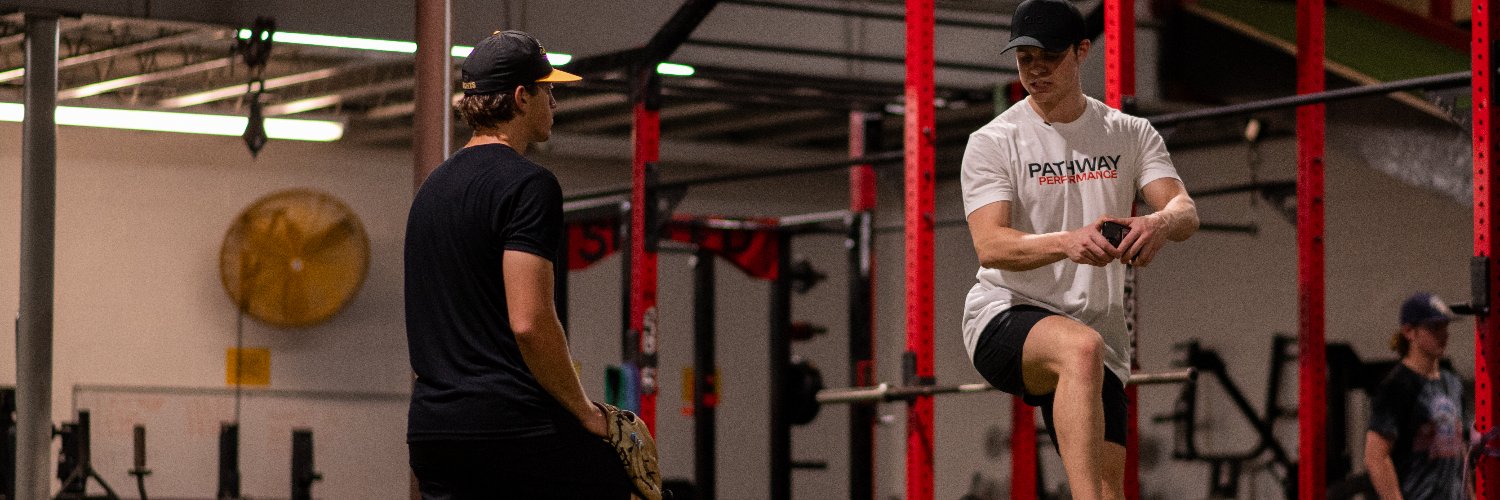
The pelvis is one of the most overlooked yet critical parts of the pitching delivery, not just in the coiling/loading pattern, but more importantly in how it relays energy up the chain like the base of a whip. This concept and the spinal engine theory, popularized in the baseball community by Ben Baggett, can get confusing fast, but one of the first keys is understanding how to control and dissociate the pelvis.
If you can't touch 90+, you're probably not playing D1 baseball. If you can't sit 90+, you're probably not playing pro ball. And to play mid-major, big D1, or get drafted? You likely need even more than that.
Yeah, this generalizes the whole velo landscape. But look at the average fastball in NCAA Regionals (just over 90mph) or watch the D2/D3 World Series — dudes chugging 90+ rep after rep. Velocity matters.
Other tools matter too, of course. But in 2026, you're not playing high-level baseball without throwing hard. Simple as that.
Chase Burns is absolutely dominating right now… 7-1 with a sub-2.00 ERA for a guy who made his MLB debut just last season. Wild numbers.
But the biggest takeaway with Burns isn't the stat line, it's his demeanor and his tempo the second he steps on the mound. The aggressive, attack-first approach to hitters AND the physical speed of his delivery. That tempo is a huge reason he gathers and moves so efficiently, he doesn't give his body time to leak into bad patterns.
Tempo. Tempo. Rhythm. Rhythm. If you train at Pathway, you've heard it. But "tempo" and "rhythm" don't mean the same thing for every guy. Everyone has a different tempo. Everyone has a different rhythm. So let's define them:
Tempo - the internal cadence your body works at during a motion. The speed of the move.
Rhythm - the specific patterning of how you flow from one position into the next.
One doesn't work without the other. Burns has a "quick," not fast, tempo and he's incredibly rhythmic in his delivery flowing through positions.
Like the legendary UCLA coach said: "Be quick, but don't hurry." That's exactly what Burns shows, the ability to let the throw build up the chain while still staying at a fast tempo.
And this isn't just stuff that looks right. Us and countless other coaches have studied frame-by-frame video on the best arms in the game. A basic smartphone shoots around 30fps, you can count the frames from move to release, and Burns is on the quicker side from peak leg lift to ball release. So are most throwers who DON'T rely on pure size and strength to throw hard. They tend to be around 20-25fps.
If you throw hard off athleticism, quickness, and efficiency, tempo and rhythm are your keys to unlocking velo, and to not feeling like a robot stuck in constraints. We tell our guys all the time: yeah, some constraints feel robotic, so get some tempo with it, feel some rhythm, make the drill feel natural without killing the purpose of the position. When they do, they start moving better, quicker, and throwing harder, easier.
Feeling stuck in your career? Tap the link in our bio to learn how Pathway can help.
This is the conversation more pitching coaches should be having. Staring a hole through the glove can lock up athletic motion, same reason hitters benefit from a broad-to-fine focus pattern. That brief look away for a pitcher also buys you time to stay closed at the front shoulder and keep the front hip down just a hair longer instead of rushing into early rotation. Won't fit every arm as many big leaguers still look at their target, but if command or flying open is the issue, it's a clean experiment worth trying !
Feeling stuck in your career ? Click the link in our bio to learn more on how we can help!
This is one of those drills that teaches your body faster than your brain ever could. The KB does the talking, loading the back side but also used as a amplifier that forces you to gather efficiently or else it’s very clear what went wrong.
No overthinking positions. Prime it into a plyo or full delivery once it clicks and you'll actually feel that sequencing and the transfer down the slope.
Athletic development is a science. Without proper evaluations, testing, and programming from educated, experienced experts in each niche of sports performance, you're training blind, or at least leaving your development up to a guess.
The majority of Pathway's arms won't step foot in the facility all summer long, yet they'll still progress and light up the gun with 90+ while pound the zone during their summer ball outings.
If you feel stuck, need a deep analysis of what's holding you back, or want a helping hand every step of your way to 95mph, DM us or click the link in our bio. Summer remote spots are still open!
If you're under 6'2", you're considered an undersized pitcher from a professional perspective. But countless athletes have reached the highest levels of the game well under 6'0" and still threw 95+ mph. Here's how.
Marcus Stroman, Tim Collins, and Clayton Andrews are all 5'6" to 5'7". All three have sat 95 mph, with peaks touching 97-98. That's not luck. It's mechanical efficiency and elite athleticism in a small frame.
Height and levers do matter. That's basic physics of angular velocity and force production. But it's not everything. Here's what these short pitchers have in common:
1. They are some of the strongest, most powerful athletes in any room. If you're short, you better be the most relatively strong and powerful guy in your gym. Look at any of them. Short, yes. Built like brick sh*thouses, also yes.
2. They are elite athletes. Quick twitch, explosive, with body control most pitchers will never have. Stroman can dunk a basketball at 5'7". So can Collins. So can Andrews. Think about the power output that takes.
3. They understand how to move. Watch Stroman's "Stro Mo" mechanics. Watch him do exercises with a glass of wine balanced on his back or videos of Collins at Cressey. That's command of the body.
4. They are the most efficient movers in the room. Levers help tall pitchers compensate for inefficiency. Short pitchers don't get that margin. Everything has to go right mechanically. That's why short pitchers who make the bigs are usually the cleanest movers you'll ever see.
5. They never gave up. People told them they were too small for years. They worked harder than everyone else because they had to. That work ethic is the foundation everything else is built on.
Height matters. Physics is physics. But if you're willing to work harder and smarter than everyone else, you can still get there.
At Pathway, we train pitchers at every height. We were founded by a pitcher whose high school nickname was legit "too small" and he still ended up throwing 90+. Don't let anyone tell you what's possible.
If this resonates, DM us or hit the link in our bio to talk with our team about what it'll take to reach your goals.
Stop pushing and start riding down the mound. Too many athletes push or stay stuck over the rubber. A great cue: think about riding the inside of the back leg with your head. That keeps you connected, stacked, and moving slightly forward down the slope.
Stuck at a plateau? Your nervous system might be acting as a 'speed governor,' holding you back from your true potential.
Lifting heavy or chucking weighted balls alone won't break the ceiling. To truly unlock velocity, you need over- and under-load training. Whether it’s some type of VBT (Velocity Based Training) in the weight room or 6/5/4oz velocity work at the field, it’s about smart, intentional shifts over and under, not just extreme weight.
Velocity fluctuations aren't a death sentence, they’re a signal. Often times they can be solved on their own with rest and focus. But If you’ve been grinding and the numbers aren't moving back up, there’s likely a deeper layer you need to look at.
Our summer remote programming is officially open to help you find that missing MPH.
DM us 'VELO' to chat if you need help getting back on track or want to add extra velocity this summer!
The difference between elite Japanese pitchers and Americans isn't because of size or strength. It's neurology.
Three pieces of research most American pitching ignores:
INTEROCEPTION. The brain's ability to feel what's happening inside the body. Elite athletes show higher insula activation, the brain region governing body awareness, than non-elite ones. Yamamoto's hour of breathwork, headstands, and barefoot work isn't warm-up. It's interoceptive training.
DIAPHRAGMATIC BREATHING. Roughly 45% of athletes have dysfunctional breathing patterns. Real diaphragm breathing activates the parasympathetic nervous system, drops cortisol, and improves recovery markers after hard training. It also drives the intra-abdominal pressure every kinetic chain runs on.
MOTOR IMAGERY. Visualization isn't a vibe, it's neural firing. fMRI shows it activates the same corticospinal pathways as actual movement. Ohtani filled out a 64-box mandala chart at 14 mapping his goals. He journals. He visualizes. He tracks subtle mechanical shifts daily. Documented neural rehearsal.
Mainstream baseball training dismissed all of this for two decades. Yoga is "soft." Breathwork is "weird." but the best players have always done it, it just hasn’t been the eye-catching highlight and has been done behind closed doors. That is until a 5'10" Japanese pitcher last season out-pitched the entire MLB postseason and Mookie Betts is now copying his routine.
The mind-body gap between Japanese and American pitchers isn't even close. Japanese pitchers learn it young. Americans don't know what it is until their 20s. The body, pelvis, and spine drive the delivery, not just the arm. With Yamamoto dominating, that's finally starting to change even in mainstream baseball.
That's our goal at Pathway. Combine the techniques that make American training great with the Japanese style of elite movement pattens, and great things happen. Not just run-and-guns. Not simply chucking heavy balls 24/7. True mind-body connection, high-level training the healthiest way possible.
If that sounds like something you're missing or you simply are stuck with just the American way, DM us "Pathway" and let's chat.
The best coaching doesn't happen through complex explanations, it happens when you build an environment where the right movement is the only option.
When you set the right constraints (like single-leg or jumping throws), you allow the athlete’s body to discover the solution independently. That 'light bulb' moment is where genuine, intuitive growth happens. Stop over-coaching and start building the environment.
1️⃣ Diagnose the gap.
2️⃣ Build the environment.
3️⃣ Set the constraints.
4️⃣ Step back and let them solve it.
Most pitchers train blind. Your anatomical structure dictates how you sequence force from the ground up, ignore it and you're taking a shot in the dark. One example of this is hip anatomy.
The ER vs IR dominant spectrum isn't a detail, it's a direction on loading patterns that affect your entire delivery.
"If I was 6'7 I'd throw hard too" - every 6'0 dude watching Jacob Misiorowski fuzz up the Yankees
The real follow-up question: Do you flow into even CLOSE to the same ranges he does in your delivery
The answer is almost certainly no.
Misiorowski is a very mobile athlete and honestly a great case study on why a guy with his levers HAS to be putting in an extreme amount of stability work behind the scenes that no one really talks about. But more importantly for this post, he's a perfect example of how elite mobility creates time to keep applying force to the baseball over a longer range of motion.
More range → more time under force → more energy → more velo. IF you can close the gap explosively
Three things that make The Miz throw absolute gas:
1. Mobility: Misiorowski has an unreal ability to relax and flow into elite positions, create massive separation AND closes the gap at lightning speed on the back end. That's the X factor. A lot of guys can get into deep positions. Very few can get outof them fast.
2. Long Levers: Yes, the height helps. But it's also the trap. Most tall pitchers fall into the "baby giraffe effect" unable to sequence those long levers into anything coordinated. Length only matters if you can organize it effectively.
3. A Rhythm Dance: Like deGrom or Yamamoto, he flows into positions and basically floats down the mound with incredibly late intent. Nothing forced. He starts with a bicycle-style leg kick, gathers efficiently into his forward move, and rides that rhythm into foot strike, landing in elite position at foot strike.
The tall athlete can model all three of these. But the average or undersized guy can absolutely steal 2 of the 3:
→ Flow (not force) into deep ranges of motion → Sequence the delivery like a dance w/ late intent → Explosively closing the gap of those ranges
That's where real energy transfer lives. And while we might not be able to anatomically get into these positions, it is still a GREAT example of the importance of pre mobility, soft tissue, and corrective work to maximize your velocity.
The difference between you getting pulled in the 3rd and making it through the 7th oftentimes isn’t your stuff. It’s your ability to remain present, reset, and focus on the task at hand, executing one pitch at a time. Here is how to do that with a simple pre pitch routine:
Step 1 — Reset (after the last pitch)
— Step off the back of the mound
— One deep breath. Drop the shoulders on the exhale.
— Let the last pitch go
Step 2 — Commit (pick the pitch and location)
— Get the sign
— See the pitch in your mind. Shape and location
— Commit fully.
Step 3 — Execute
— Step on the rubber
— Say your Cue Word
— Compete
Habits are what separate the 85 mph arm from the 95 mph arm.
If you want to max out your potential on the bump, a routine built to get you there is the most important factor, paired with the dedication and discipline to actually execute it.
Which one of these guys sounds more like you?
DM us "95" and we'll help you craft the plan and build the habits to hit your goals.
Now in a Blue Jays jersey, Dylan Cease has done nothing short of dominate this year. Here are some key positions he flows into that let him pump upper 90s:
Pelvic Posterior Tilt: Engages the glutes and backside while lengthening the hip flexors. Makes it easier to rotate down into foot strike instead of fighting his own structure to get there.
Forward Move & Drop: gravity is one of the biggest keys to efficient velocity production. Cease builds a clean linear force vector and hinges/drops into it quickly, stacking momentum on the way to foot strike.
Arm Action: short and tight, but it carries the momentum of the downswing. That energy flows all the way up into a clean flip up exactly at foot strike. Nothing wasted.
Elastic Tension: Cease produces separation, but more importantly he shows tension in his anterior oblique sling, which then propels up through the pec as he pulls into rotation at foot strike.
Blocking: the ability to finish the pelvis down into foot strike after aggressive rotation is KEY. At foot strike, everything prior has been transferred as efficiently as possible. That's what makes throwing hard actually possible.
Everything prior to foot strike is about MAXIMIZING energy creation and properly transferring it into the foot strike. That's the part most guys overcomplicate. It really is this simple:
"How much energy can I create and properly transfer? THEN how effectively can I send it up the chain at footstrike?"
That's the whole game.
No one's ever said being MORE athletic is going to hurt your performance on the mound. Go play some spikeball, rally a volleyball, throw the football around, hit the pickleball court, work on driving a golf ball.
That added exposure to different movement patterns translates more than people realize especially as you climb levels. The athlete who only knows one pattern runs out of runway fast. Train smart, manage the volume, and pick the sports that feed your baseball engine for future development patterns.
True development comes down to consistency on your specific inefficiencies in warm ups, throwing, the weight room, kitchen, mentality etc. That's it.
The gap for most guys isn't the coaching itself, it's not having a system that ties Monday through Sunday together around their mechanics, body, and schedule. Being in person every week doesn't fix that if it's not tailored toward you or there isn’t a full 7-day-a-week plan to begin with.
In-person can help younger athletes and speed up the process for sure. But most guys (older HS, college, and pro athletes) just need a personalized routine they can execute on their own with consistent weekly check-ins to stay locked in (we communicate with our guys probably at least 3-5 times a week, more than what you’d get with an in-person coach). Accountability and work ethic do the rest. Confidence comes from the reps, and the reps come from the system.