No one teaches us how to be a patient.
We're taught how to drive, manage money, interview for jobs—even how to perform CPR.
But when it comes to navigating healthcare, we're expected to know how to ask the right questions, communicate clearly, make informed decisions, and advocate for ourselves.
Most people don't struggle because they aren't trying.
They struggle because no one ever taught them how.
Effective participation in healthcare isn't instinctive.
It's a learned skill set.
And like any skill, it can be learned, practiced, and strengthened.
That's exactly what Patient Better is here to teach.
What do you wish someone had taught you before you became a patient?
2018. This was the moment an idea began to take shape.
I wasn't just writing a book—I was trying to solve a problem I kept seeing over and over again.
Healthcare was rapidly embracing technology. Chronic Care Management (CCM) and Remote Patient Monitoring (RPM) were gaining momentum, but something was missing.
Patients.
Not because they didn't want to participate, but because no one was bridging the gap between the technology being prescribed and the people expected to use it.
That became the inspiration for The Comprehensive Guide to Self-Health Management.
My goal wasn't to replace healthcare providers. It was to empower people with mild to moderate chronic conditions to become active partners in their own care—working alongside their primary care provider with the knowledge, confidence, and practical skills to manage their health every day.
The vision was simple:
Technology is only effective when people understand it.
Patient education isn't an afterthought—it's the foundation.
https://t.co/BE5PSJMa6N
Looking back at this photo, I remember sitting there thinking, "There has to be a better way."
That idea eventually became a book, and that book became part of a much larger mission: helping patients move from confusion to confidence in managing their own health.
One of the most important skills every patient can learn is how to communicate their concerns clearly. Preparation helps turn every medical appointment into a more informed and productive partnership.
https://t.co/d7bIsmj1PO
Ever leave a doctor's appointment and remember your most important question in the parking lot? A little preparation can make every visit more productive. https://t.co/y0aFzg7yPd
2019.
Long before the pandemic reshaped healthcare...
Long before patient engagement became a national conversation...
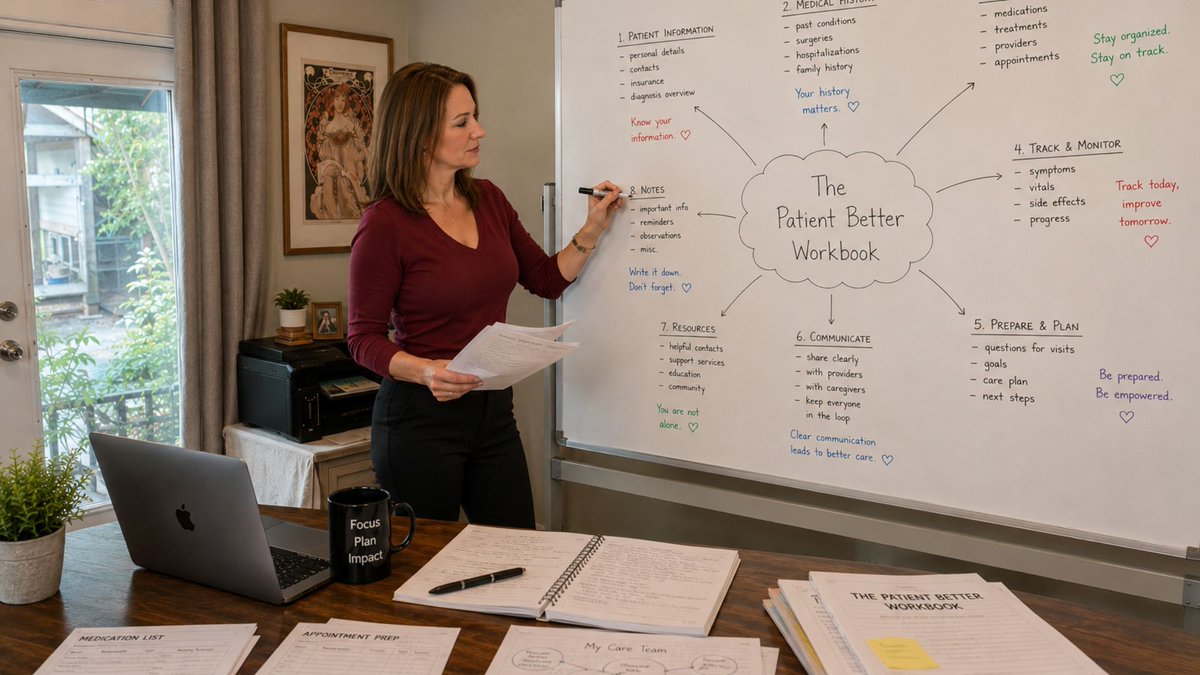
There was my whiteboard.
This is where I spent countless hours building, structuring, and trying to understand what patients and families really needed once they left the doctor's office.
One question guided every idea on that board:
How do we teach patients and families to become active participants in their care without asking them to become healthcare professionals?
As I mapped the patient journey, I realized something.
Patients with advanced conditions—and the family members who often become their caregivers—were expected to navigate one of the most sophisticated systems in the world with very little structure designed for their role.
The templates weren't created to replace the forms inside a doctor's office.
They were created to bring healthcare into the home.
To give patients and families the opportunity to slow down, think, organize, analyze, ask better questions, coordinate care, and better understand the healthcare system before the next appointment.
Every worksheet was intentionally designed to transform information into participation—not by replacing the healthcare team, but by strengthening the patient-provider partnership.
Today, in 2026, that vision has grown into the Third Edition of the Patient Better Workbook.
The healthcare system continues to evolve, and so does the workbook. Each edition reflects what we've learned about helping patients and family caregivers participate more confidently, communicate more effectively, and navigate healthcare with greater clarity.
Looking back at this moment, I wasn't just creating a workbook.
I was building the foundation for something I believed patients and families deserved all along.
https://t.co/ZQrpJEpZUm
Most patients know they should ask questions. Few know which questions actually change the outcome of their care. Signpost Questions help patients prepare for medical appointments with a practical framework that keeps conversations focused, uncovers important information, and supports better decisions. Asking the right questions changes everything.
This graphic is a roadmap for anyone who wants to start asking better questions. It shows the logic behind Signpost Questions, when to use them, and how they can help in everyday conversations, decision-making, coaching, planning, and problem-solving.
When we ask the right question at the right time, we create clarity, uncover options, and open the door to better outcomes.
Back in 2020, these pages covered my kitchen table.
Every chapter of Patient Better: A Remote Companion to Self-Health Management was spread out as I worked through the final edits before publication.
The book wasn’t inspired by COVID.
In fact, the work had been underway long before the pandemic.
What I saw was a gap in healthcare that kept bothering me.
Everyone was talking about getting patients to appointments.
I kept thinking about the patients who couldn’t get there.
The people who were homebound.
The people living in rural communities.
The people who didn’t have access to specialists or large academic medical centers.
I believed technology could help connect patients to clinicians, but I also believed something was missing.
A video visit alone wouldn’t solve the problem.
Patients still needed a way to understand their care, organize their health information, prepare for appointments, ask better questions, and become active participants in their own health journey.
That’s why I wrote Patient Better.
This photo reminds me that meaningful ideas rarely begin in a boardroom.
Sometimes they begin at a kitchen table, one page at a time.
Today, that same mission continues to guide everything I do.
Helping people become better partners in their own care has never been more important.
Patient Better was published on December 29, 2020, after years of research and development.
https://t.co/PaGCBtaEns
Patient participation has always mattered. Measuring it hasn’t been easy.
That’s why we’re excited to announce the recent launch of the Patient Participation Pilot Program.
Designed for licensed healthcare professionals and healthcare organizations, this new framework helps capture, measure, and report patient participation across the care journey—without requiring you to overhaul your existing workflow.
The pilot integrates with the care processes you already have in place, making it easier to understand what happens after patients leave your care.
Whether your organization is focused on improving care transitions, reducing preventable readmissions, strengthening patient follow through, or supporting quality improvement initiatives, the Patient Participation Pilot Program provides a practical way to begin measuring one of healthcare’s most overlooked performance indicators: patient participation.
If you’re interested in exploring how your organization can participate in the pilot, I’d love to connect.
https://t.co/cIRq0VKGBw
The most important part of recovery often begins after you leave the hospital. Learning how to manage your health is one of the best investments you can make in your future.
Ever leave a doctor’s appointment thinking, “I should have said that”? Knowing how to describe your symptoms clearly can change the entire visit.
https://t.co/oCUVCRpHnQ
In 2026, plans will be known by how well beneficiaries participate in care. Here’s what we’ve been missing — and what we can finally see now. https://t.co/zGUenYDRjG via @LinkedIn