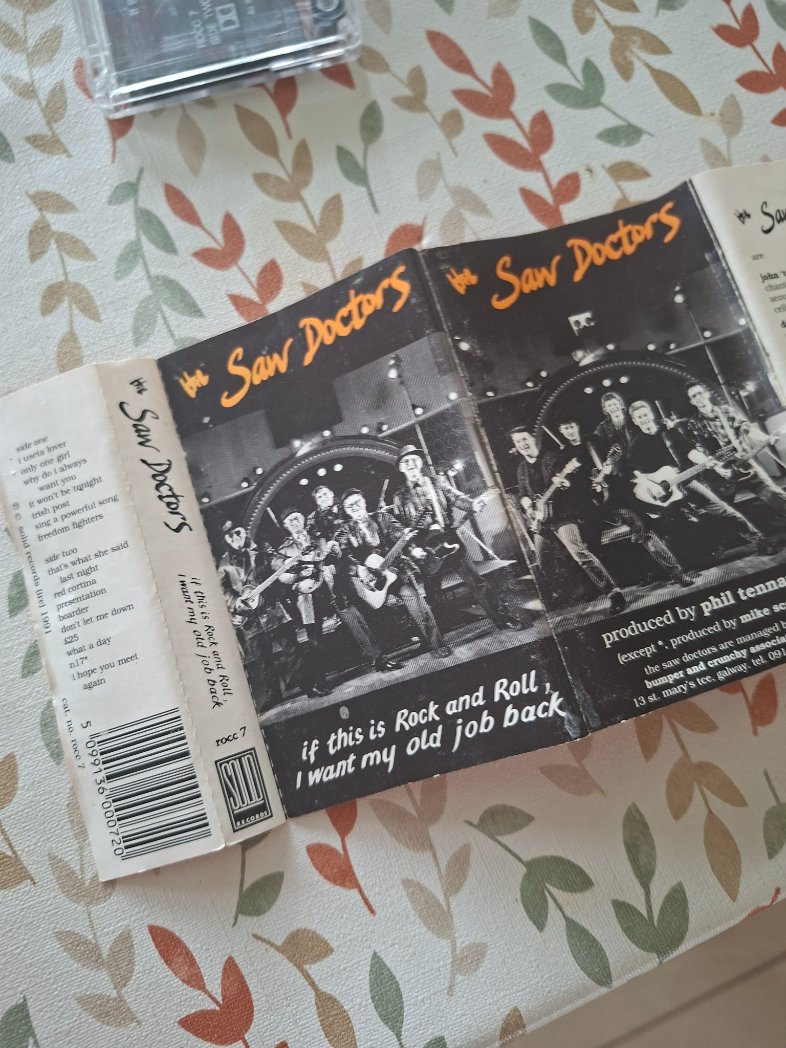
About a year ago the Saw Doctors played in Letterkenny. They were brilliant. Sad bastard that I am I brought my original cassette of their big album with me hoping to get them to sign it. They all left immediately after the gig, no joy. Spotted a lad in a lanyard. Asked him if he could get the lads to sign it. He said aye no bother but how will I get the tape back to you? I asked him if he knew big Eamonn who works in the Toyota garage in Tuam.
"Sure I knows Éamonn well, no bother".
Forgot about it.
Thought it was gone forever.
A few days ago, txt message from cousin Éamonn in Tuam. "I've a tape here for ya"...
This arrived today, signed by the lads.
Delighted.
Took a year, but it found me.
A 24-year-old Polish tennis player arrived in Paris last week ranked 114th in the world, with no sponsors, no guaranteed income, and no certainty she could even pay for her hotel room.
She had to win three qualifying matches just to enter the French Open main draw. Prize money is only paid at the end of the tournament, so a Polish sports drink brand quietly stepped in and covered her hotel bill.
Her name is Maja Chwalinska. And today, she plays in the French Open final.
Before this tournament, she had won exactly one Grand Slam main draw match in her entire career. She had battled depression so severe that in 2021 she couldn't get out of bed. She underwent knee surgery in 2022. She spent years grinding through small tournaments across Europe just to stay afloat.
Then she arrived in Paris, won three qualifiers, and kept winning. Zheng Qinwen. Elise Mertens. Maria Sakkari. Diana Shnaider. Nine straight matches. One set dropped.
She is now the first qualifier in French Open history to reach the final. The last time a qualifier reached a Grand Slam final, it was Emma Raducanu at the 2021 US Open. Raducanu won.
By simply making the final, Chwalinska has earned more prize money than her entire career combined. The runner-up cheque alone is $1.6 million. If she wins today, she takes home $3.25 million.
One week ago she couldn't pay for her hotel room.
I recently spoke at the annual Financial Times Business of Football Summit, looking at whether the multi-club ownership model is viable.
As always on such occasions, there is not enough time to discuss all the issues, so today’s article will look at this topic in more depth.
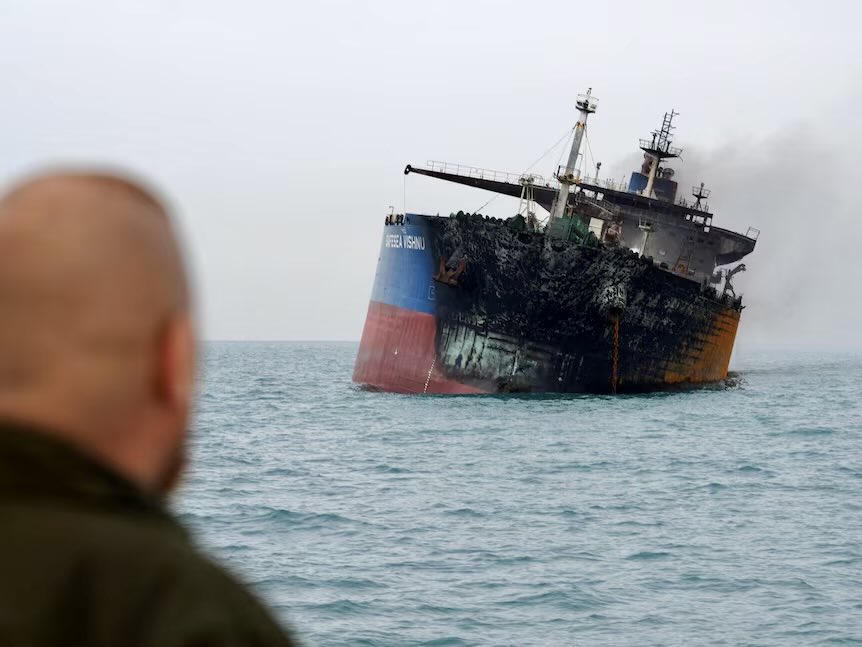
Goldman Sachs confirms Hormuz oil flows have collapsed from 19.5 million barrels per day to 0.5 million. Net disruption after pipeline rerouting: 17.2 million barrels per day offline. Two independent vessel trackers recorded zero oil tankers crossing the Strait on 12 March. The largest energy chokepoint on Earth is not closed by a navy. It is closed by a spreadsheet.
Seven major P&I clubs cancelled war-risk coverage for the Persian Gulf effective 5th March under Solvency II protocols. Premiums for remaining voyage cover surged 300 to 1,000%, reaching 1% of hull value: $2 to $3 million per VLCC on a seven-day renewable basis. The $20 billion DFC reinsurance facility backed by Chubb has limited uptake because it excludes full P&I liability. Lloyd’s still offers single-voyage cover. Nobody is buying because the premium assumes the mines, and the mines are on the seabed.
The Strait is open. The insurance is not. And without insurance, no vessel moves.
While 19 million barrels per day sit stranded on either side of the chokepoint, one category of vessel continues transiting: Chinese shadow fleet tankers carrying Iranian crude settled in yuan through CIPS. Kpler confirms 11.7 to 16.5 million barrels have reached China since 28 February. These tankers do not carry Western insurance. They do not need Western insurance. They operate under Chinese state-backed coverage, Iranian IRGC safe passage, and yuan settlement through a payment system that processed $24.5 trillion in 2025 at 43% year-on-year growth. The only oil moving through Hormuz is oil that does not touch the dollar.
This is the moment the petrodollar system was designed to prevent.
In 1974, Saudi Arabia agreed to price oil exclusively in dollars in exchange for American military protection. That agreement created a world where every barrel required dollars, every central bank held dollar reserves because energy demanded them, and American financial hegemony rested on the simple proposition that oil equals dollars. For fifty-two years, the equation held. The 2026 war is breaking it not through policy but through physics: the insurance architecture that enabled dollar-denominated oil transit has collapsed, and the only transit still functioning operates in yuan.
The dollar’s share of global reserves has fallen from 71% in 2000 to 59% today. Yuan global payments remain at 2.89%. No single event kills the petrodollar. But the Goldman data reveals what the contrarians miss: the war has created a live demonstration of a post-dollar energy system operating at scale. Chinese tankers transit. Yuan settles. CIPS clears. Iranian oil reaches Chinese refineries at $9 to $12 below Brent while Western buyers pay $96.72. The system works. It is working now. And every day the Strait remains closed to dollar shipping is another day the alternative proves it does not need the original.
President Trump’s multinational warship call is the response: send navies, reopen the Strait, restore dollar-denominated traffic, and kill the yuan alternative before it scales. If the coalition succeeds, dollar pricing survives. If it fails or fragments, the war that was launched to destroy Iran’s nuclear programme will have accidentally created the conditions for the multipolar energy order the dollar was designed to prevent.
The IEA has released 400 million barrels of strategic reserves, the largest coordinated draw in history. It covers 23 days of the 17.2 million barrel daily shortfall. The war is sixteen days old. The reserves are finite. The insurance cancellations are not.
Nineteen million barrels per day reduced to half a million. Zero tankers on 12th March. Yuan tankers the only vessels moving. And the fifty-two-year-old system that priced every barrel in dollars is watching its replacement operate in real time through the waterway it can no longer transit.
Full analysis here - https://t.co/eMrt5qYYst
It’s crystal clear now that Trump has lost control of this war. He badly misjudged Iran’s ability to retaliate. The region is on fire.
1/ I’m going to explain to you in this🧵what I’ve learned - in part from closed door briefings - about the four biggest current crises.
Former RTÉ Sport producer and director Michael O'Carroll has died at the age of 89. He directed more than 50 All-Ireland finals in his career, as well as Muhammad Ali's 1972 fight against Al 'Blue' Lewis at Croke Park and several state visits.
Actual shot (not AI!) of a French detective working the case of the French Crown Jewels that were stolen from the Louvre in a brazen daylight robbery.
Somehow he looks like he’s smoking even without a cigarette in his hand, but surely everything you know about life is screaming at you: this case is officially screwed!
To solve it, we need an unshaven, overweight, washed-out detective who's in the middle of divorce. A functioning alcoholic who the rest of the department hates.
Never gonna crack it with a detective who wears an actual fedora unironically.