@MichaelAArouet For a time I was asking me the same, how could they don't understand? They're not uneducated people, I think they just don't care, they know that it doesn't work, but they don't care, they are fanatics
@RaulTorresPLD@ingverdu Por otro lado también es entendible ser escéptico, hay ejemplos de organizaciones que han fracasado en ese intento y con muchos más recursos
@JoseLuisDazaAR@JMilei@LuisCaputoAR@fedesturze Mí inicio en el liberalismo comenzó cuando leí que había un economista que asoció los precios a señales con información (Hayek) , siempre recuerdo el impacto de esa idea
@martinvars cada vez nos acercamos a lo que richard feynman advertia , los limites fisicos de la computacion. Eventualmente un cambio en el paradigma de como se computa fisicamente va a ser inevitable
@martinvars Incluso hoy tenés varías ventajas, internet satelital, generación de electricidad más eficiente.
Cuando era chico había que ir a encender un motor diesel para tener electricidad a la noche, el ruido que hacía!
Solo había 3 canales en TV y rogar que el viento no moviera la antena
@curiouswavefn Also from FLP, vol. 1 About energy.
I remember being a freshmen in Argentina and reading this, I haven't forgotten that paragraph on almost 25 years
@vamsiprithamp For sure it's going to lead to a shift in the profession. So far AI has been pretty good solving open problems but as far as I know it hasn't created new math branches.
The cyclotron is one of my favourite examples of how fundamental physics quietly becomes indispensable to other sciences.
When Ernest O. Lawrence conceived the cyclotron at the University of California, Berkeley, in 1929, the goal was not medical imaging. The goal was to reach the atomic nucleus.
By combining an oscillating electric field with a magnetic field, the machine could accelerate charged particles repeatedly along an expanding spiral, giving physicists a compact way to produce energies high enough to trigger nuclear reactions.
Lawrence’s student M. Stanley Livingston helped construct the first successful cyclotrons, and the instrument transformed experimental nuclear physics.
Lawrence received the 1939 Nobel Prize in Physics for its invention and development.
But this is where the story becomes even more remarkable. A machine designed to investigate the nucleus eventually became a machine that helps physicians investigate the living human body.
Modern medical cyclotrons accelerate particles, usually protons, and direct them into carefully selected target materials.
Nuclear reactions then convert stable atoms into short-lived radioactive isotopes such as fluorine-18. These isotopes are incorporated into radiopharmaceutical tracers and introduced into the body. As they decay, they emit positrons, whose annihilation with electrons produces pairs of gamma-ray photons that can be detected by a PET scanner.
The result is not simply a picture of anatomy. PET imaging reveals biological activity: glucose metabolism in a tumour, blood flow through the heart, or chemical changes in the brain.
Physics provides the accelerator, nuclear reactions produce the isotope, chemistry turns it into a biologically useful tracer, and medicine uses the resulting signal to diagnose disease.
That chain from electromagnetic fields and nuclear reactions to cancer diagnosis is exactly why fundamental physics matters.
Research that initially appears distant from everyday life can create the tools through which biology and medicine see processes that would otherwise remain invisible.
( 📷 Lawrence's 60-inch cyclotron, c. 1939, showing the beam of accelerated ions exiting the machine and ionizing the surrounding air causing a blue glow.)
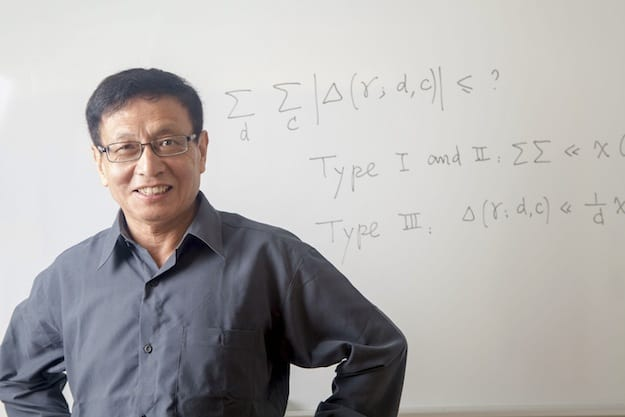
A Chinese mathematician spent 7 years making sandwiches at Subway after his PhD, and at 58 solved a 150-year-old math problem nobody thought was solvable.
His name is Yitang Zhang. The problem is called the Twin Prime Conjecture.
He was born in Shanghai in 1955 and knew he wanted to spend his life on mathematics by the time he was nine years old. That year he found his own proof of the Pythagorean theorem. Nobody taught it to him. He just worked it out.
Then the Cultural Revolution arrived and took everything.
The Chinese government closed the schools. Zhang's father had political troubles with the Communist Party, so Zhang was sent to the countryside with his mother to work in the fields. He spent 10 years as a farm laborer. No high school. No classroom. No teacher.
He read math books in the fields when he could find them.
When the revolution ended, Zhang was 23. He sat the university entrance exam and got into Peking University, one of the most competitive mathematics programs in China. He finished his bachelor's degree, then a master's. The president of Peking University personally recommended him for a full scholarship at Purdue University in the United States.
He arrived at Purdue in 1985. He earned his PhD in 1991.
Then the second wall hit.
His relationship with his doctoral advisor collapsed. The advisor did not write him letters of recommendation. Without those letters, the academic job market was closed. Zhang applied. Nothing came back. He spent the years after his PhD working as an accountant, doing delivery work, sleeping in his car during the stretches when nothing else was available.
A friend eventually opened a Subway sandwich restaurant in Kentucky and offered him a job. Zhang took it. He kept the books and made sandwiches. A man with a PhD in mathematics from Purdue, working a Subway counter because the academic world had no place for him.
He did this for seven years.
He was finally hired as a lecturer at the University of New Hampshire in 1999. Not a professor. A lecturer. The lowest rung of the academic ladder, with no research funding, no graduate students, and no institutional support. He taught calculus to undergraduates and worked on mathematics alone in whatever time was left.
Most people would have stopped believing by then.
Zhang did not stop.
The Twin Prime Conjecture is one of the oldest unsolved problems in number theory. Twin primes are pairs of prime numbers separated by exactly two: 5 and 7, 17 and 19, 41 and 43. The conjecture predicts that these pairs never stop appearing no matter how far you go along the number line. Mathematicians had believed this for over 150 years. Nobody had been able to prove it.
The deeper version of the problem asks something slightly different. Not whether twin primes are infinite, but whether there is any finite gap between prime numbers that appears infinitely often. This is called the bounded gap problem. The best mathematicians in analytic number theory had been attacking it for decades. A landmark 2005 paper by three researchers came agonizingly close and still could not close it.
Zhang worked on it alone. No collaborators. No funding. No department seminars where he could road-test his ideas. He once said he would go to a friend's house and think in the garden for hours.
In 2012, during a visit to a friend's home in Colorado, something unlocked.
He submitted his paper to the Annals of Mathematics in April 2013. The Annals is the most prestigious mathematics journal in the world. Papers sit in review for months, sometimes years. The editors read Zhang's submission and immediately knew something was different. They sent it to the leading experts in analytic number theory for review.
It was accepted in three weeks.
The paper proved that there are infinitely many pairs of prime numbers separated by a gap of less than 70 million. Not two. Not the twin prime gap specifically. But a finite gap. For the first time in history, someone had proved that prime numbers keep coming back together, that the universe of numbers never lets them drift apart forever.
Peter Sarnak, one of the most respected mathematicians at the Institute for Advanced Study, said: "He is not a fellow who had done much before. Nobody knew him. His result was spectacular."
Zhang was 58 years old.
Within a year he had the MacArthur Fellowship, the Cole Prize, the Rolf Schock Prize, and a full professorship at UC Santa Barbara. The man who spent seven years at Subway was now one of the most celebrated mathematicians alive.
He said in an interview: "I was not lucky. Maybe it is more important for a person to make himself known to the public. But that was not so easy for me."
He was not complaining. He was just being precise.
The mathematics establishment has a quiet belief that great work happens young. The Fields Medal cuts off at 40. Most mathematicians who change the field do it in their thirties. Zhang proved his most important theorem at 58, after a decade of farm labor, seven years of sandwiches, and a decade of teaching calculus to freshmen with no one watching.
He did not beat the deadline.
He proved there was no deadline to beat.