this is just the most ridiculous AI application i've ever seen lol
a Peter Thiel-backed startup that makes AI collars for cows is now worth $2 billion
and the more I read about it the cooler it gets. here's how it works:
every cow wears a solar-powered collar that talks to a network of radio towers and an app on the farmer's phone
instead of building physical fences, the farmer draws the fence on a map in the app, and the collar keeps each cow inside that invisible line using GPS
when a cow drifts toward the edge, the collar plays a sound to steer her, and a gentle vibration tells her which way to go.
it's like how a car beeps as you back up toward a wall
the cows learn the cues in a few days
so now a rancher can move an entire herd to fresh grass by sliding the fence on a map, without driving out to open a single gate
and that same collar is reading each cow's body the whole time.
it takes five readings per second on every animal, so the AI can catch a cow that's sick, injured, ready to breed, or about to give birth before a person would ever notice walking the field
so it's basically like WHOOP for cows too lol
and they gave the AI behind it the perfect name: the Cowgorithm
it's been trained on more than 7 billion hours of real cow behavior, which is why Halter calls the data its real asset and moat.
they know what a normal cow looks like better than anyone, so they can flag the odd one out instantly
it's already on more than 1M cattle across New Zealand, Australia, and a bunch of US states.
California even used it on public land to graze cattle in patterns that clear dry brush and slow down wildfires
costs about $5 to $8 per cow per month
a job that used to mean barbed wire, gates, and driving the fields all day is now mostly 1 person on their phone
Used Claude Design and Opus 4.7 to design a personal dashboard.
With Personal AI becoming more accessible in 2026, I always envisaged that one day we could have our own personal OS as well.
Here's what I came up with!
There's a physicist at Stanford named Safi Bahcall who modeled this exact principle and the math is wild.
He calls it "phase transitions in human networks." When you're stationary, your probability of a lucky event is limited to your existing surface area: the people you already know, the places you already go, the ideas you've already been exposed to. Your opportunity window is fixed.
When you move, your collision rate with new nodes in a network increases nonlinearly. Double your movement (new conversations, new cities, new projects) and your probability of a serendipitous encounter doesn't double. It roughly quadruples. Because each new node connects you to their entire network, not just to them.
Richard Wiseman ran a 10-year study at the University of Hertfordshire tracking self-described "lucky" and "unlucky" people. The single biggest differentiator wasn't IQ, education, or family money. Lucky people scored significantly higher on one trait: openness to experience. They talked to strangers more, varied their routines more, and said yes to invitations at nearly twice the rate.
The "unlucky" group followed the same routes, ate at the same restaurants, and talked to the same 5 people. Their networks were closed loops. No new inputs, no new collisions.
Luck isn't random. Luck is surface area. And surface area is a function of movement.
The lobster emoji is doing more work than most people realize. Lobsters grow by shedding their shell when it gets too tight. The growth requires a period of total vulnerability. No protection, no armor, soft body exposed to the ocean.
That's the cost of movement nobody posts about. You have to be uncomfortable first. The new shell only hardens after you've already moved.
Shopify just mass-democratized something most people won't register for another 6 months.
$378 billion in GMV. 5.6 million stores. And they just gave every AI coding agent direct write access to the entire store backend: products, orders, inventory, SEO, images.
That screenshot is a solo merchant typing "Optimize all my products for SEO" and Claude updating 32 product listings, rewriting alt text, applying meta descriptions, and verifying every change. One prompt. No Fiverr freelancer. No $200/month app subscription. No agency retainer.
The old cost stack for a small Shopify store: $200-500/month in apps, $2,000+ for an SEO audit, $50/hour for a VA. That just collapsed into a terminal command.
4.8 million active merchants. Most run 10-200 SKUs and manage everything by clicking through the admin one product at a time. Claude Code plus MCP just gave every solo founder the operational capacity of a five-person team.
And Shopify isn't building the agent. They're building the protocol that makes every agent a Shopify agent. That's the platform play.
Introducing Claude Managed Agents: everything you need to build and deploy agents at scale.
It pairs an agent harness tuned for performance with production infrastructure, so you can go from prototype to launch in days.
Now in public beta on the Claude Platform.
Estoy empezando a creer en la teoría de que para tener éxito en el trabajo se necesita el trastorno mental adecuado.
IT Software - Autismo
Finanzas - TOC
Arte - Depresión
Diseñador - TDAH
Moda - Narcisismo
Política - Psicopatía
Desempleado - Todo lo anterior
Sam Altman dijo que llegaría la primera empresa de mil millones creada por una sola persona con IA.
Acaba de pasar.
Se llama Medvi. Y los números verificados por el New York Times son una absoluta pasada:
→ Lanzada en septiembre de 2024 con 20.000 dólares.
→ Construida en 2 meses.
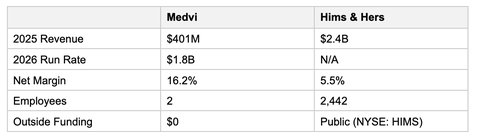
→ 401 millones en ventas en 2025 (su primer año completo).
→ Proyección para 2026: 1.800 millones.
→ Empleados: 2. El fundador y su hermano.
Para ponerlo en contexto: Hims & Hers, su competidor directo en telemedicina GLP-1, facturó 2.400M el año pasado con 2.442 empleados y un margen neto del 5,5%.
Medvi triplicó ese margen (16,2%) con dos personas.
¿Cómo? Matthew Gallagher usó ChatGPT, Claude, Grok, Midjourney, Runway y ElevenLabs para construir TODO: código, web, copy, creatividades de ads, vídeos, atención al cliente y análisis de rendimiento en tiempo real. La infraestructura médica (médicos, farmacia, envíos, compliance) la externalizó a partners especializados.
Él se quedó con lo que mueve la aguja: marca, adquisición y experiencia de cliente.
Esto no es solo la historia de un tío listo. Es la prueba de concepto de una nueva categoría de empresa.
Las compañías AI-First (las que nacen sin legacy, sin departamentos hinchados, sin procesos heredados) van a jugar en otra liga. No es que vayan un poco más rápido. Es que están operando con una estructura de costes y una velocidad de ejecución que las empresas tradicionales no pueden replicar sin reinventarse de raíz.
¿Es todo perfecto? No. El chatbot de Medvi inventó precios y productos que no existían. No tiene tecnología propietaria ni fosos defensivos claros. Pero eso es casi lo más interesante: con ejecución pura y velocidad, está generando más de 3 millones de dólares al día.
¿Cuántos Medvis van a aparecer en TU mercado antes de que reacciones? Porque ahora no van a venir con 500 empleados y 3 rondas de inversión, viéndoles venir de lejos. Van a venir con un portátil, 12 herramientas de IA y hambre infinita.
Today we're introducing the world's first AI CMO.
Enter your website and it deploys a team of agents to help you get traffic and users.
Try it now at https://t.co/KbAE6FNgzE
🚨The CEO of Coinbase just said something nobody's taking seriously enough.
AI agents will outnumber humans in transactions. Soon.
> "They can't open bank accounts. No ID. No SSN. Banks literally cannot serve them."
> "But they already own crypto wallets."
So the biggest economy of the next decade won't run through banks at all. It'll run through blockchains. Not because crypto won. Because banks physically can't onboard a customer that isn't human.
Banks weren't built for what's coming.