@CyrusShepard Agreed! Google loves playing boogeyman with the web to help their systems get a better result. See "don't buy or solicit back links" advice. Because the subtext is: because we can't tell what's real
@glenngabe How can you prove those mentions are inauthentic unless they are so blatant it's crazy. Ie linking my marketing services from 100 recipe pages or something. The rule is only scary if it's actually possible to tell who is really breaking it reliably
@alexhalliday@lilyraynyc Exactly. Schema exists to help search engines understand data. What it can understand it can better rank. So, if LLMs are pulling from Search engine results and usually only the top X results then Schema -> Rank -> RAG -> Citation -> Click. It seems pretty straightforward
Hey @iPullRank & @ItamarBlauer I enjoyed the video you posted recently. Just FYI there are like 10 mins of dead air on the back end of it. 20 min video but the content finishes around 8 mins.
I can't reply so here I will repost. But just wanted to clarify my understanding then.
LLMs like schema? Yes.
LLMs always get schema? No
What about when added to my page? Maybe, depends on who scraped page and if they stripped it.
Correct?
Please read the whole thing. It's just 3 points.
1. LLMs *do understand schema* when they see it in input, contrary to a popular belief that the structured data is lost due to tokenization. This is because they're trained on it as they are trained on code.
2. LLMs *don't* always see schema in input because most tools and functions supplying context to the model strip it away during pre-processing.
(The next part is where SEO people get confused.)
3. The tools AI systems use to process content which is passed as context to LLMs sometimes parse the HTML page by using structured data to better understand the page and sometimes they don't. It's a software design choice and nothing to do with LLM's capability.
TL;DR: LLMs understand structured data if they get it, but most of the time they get plain text / markdown, which *may* or *may not* have been rendered by leveraging schema at the pre-processing level.
@glenngabe How does each of these companies keep doing roughly the same thing and not realise it? Billions in funding and not a few grand per month for a lowly SEO?
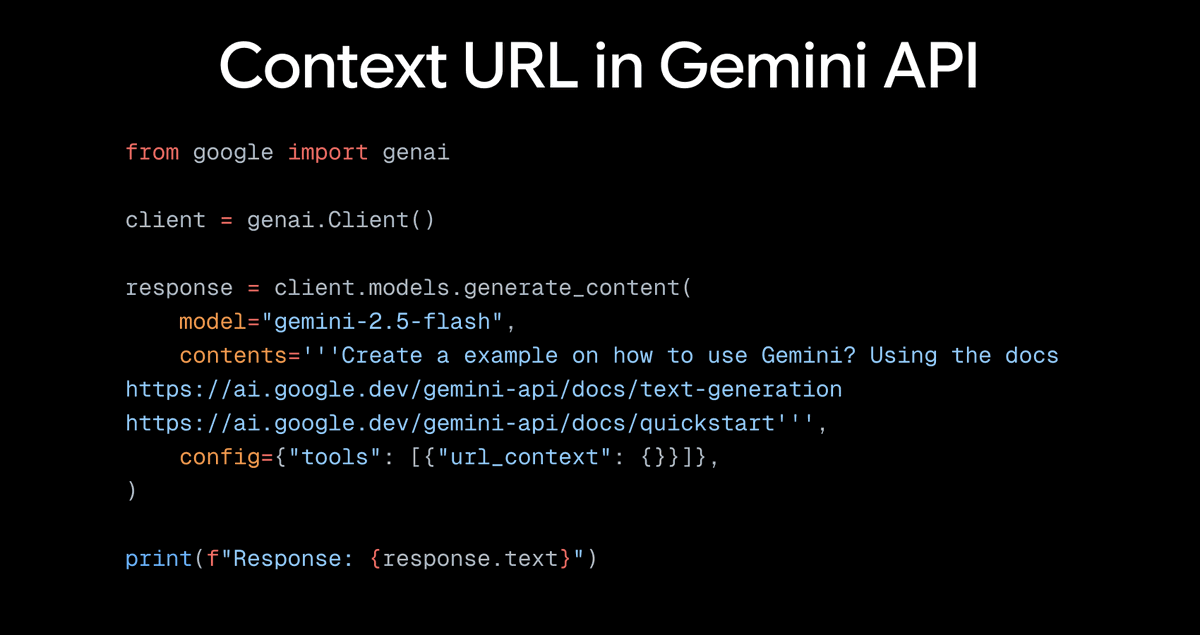
Context URL now GA in Gemini API. 🎉 Context URL allows Gemini to extract content directly from URLs including websites, PDFs, JSON files or images as additional context for inputs.
- Provide up to 20 URLs in a single request.
- Extract context from web pages, PDFs, and image (jpg/png), or JSON, XML etc.
- Provides inline citations with start and stop index
- Uses the internal Index, if URL is not indexed tries to fetch live
- Billed per inputs tokens added to the context
- Supported with all Gemini 2.5 models
@nadimul_abrar @aivanlogic Yes in most cases. Also Google still gets 90 something percent of all search. We are years away from this being sustainable as a stand alone strategy. Also, content structure is probably the least of anyone's problems.
Honestly dubious on this like most SEO s but, ChatGPT I can attest to bringing I higher-quality users if we count higher quality as being by conversion rate alone. I'm seeing 30% CVR for ChatGPT clicks right now.