Echo chambers in the honeybee dance communication! We automatically detected 100K waggle phases of dancing bees and found a fascinating aspect of how bees organize their colony space. A thread.
@manysarahs@_JohnMola Yes variation in cuckoo aggressiveness between hosts, vosnesenskii is much more agressive, and they paying the price for it much more ahah, it’s also much more demanding for the cuckoo female, but with bigger colonies she also has higher reproductive success.
@manysarahs@_JohnMola I looked at the impact of social context at emergence of new cuckoo female on their later host nest pref after lab hibernation… interesting data that I should publish some day.
@manysarahs@_JohnMola I’ve studied many nests of centralis and vosnesenskii parasitised by insularis… cuckoo reaction, killing rates, agression index, reprodutive success, were very different
@manysarahs@_JohnMola B. insularis is very protective of her egg batches at first, she’ll aggress anyone coming close, she is more relaxed once egg hatched and would let workers feed them. If the host queen is peacefull, she might just be cool
With her hanging around, very dependent on social context.
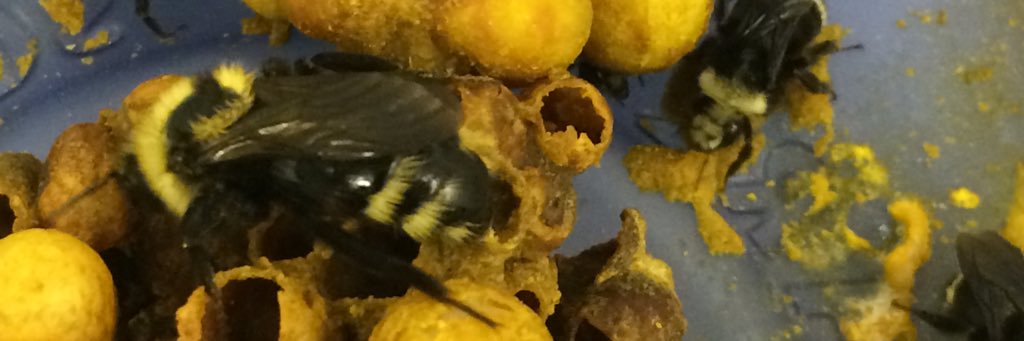
@wurflenii@manysarahs It is also true for B. insularis. If the host queen is not aggressive, she often remains apathetic in a corner of the colony. Cuckoos mostly kill when provoked. However, since they can do it within a second, it often ends up that way. I have never attempted to remove the her.
@manysarahs@_JohnMola Nice! B. insularis female behavior mostly depends on host species and host colony size, but to my experience with various hosts she is usually killing the queen once ready to take over the nest. Did you notice if she is already laying eggs or controlling workers?
A PostDoc position in Chemical Ecology is available in my lab, see https://t.co/NMqrV5QPB1
Please re-tweet to anyone potentially interested in the job!