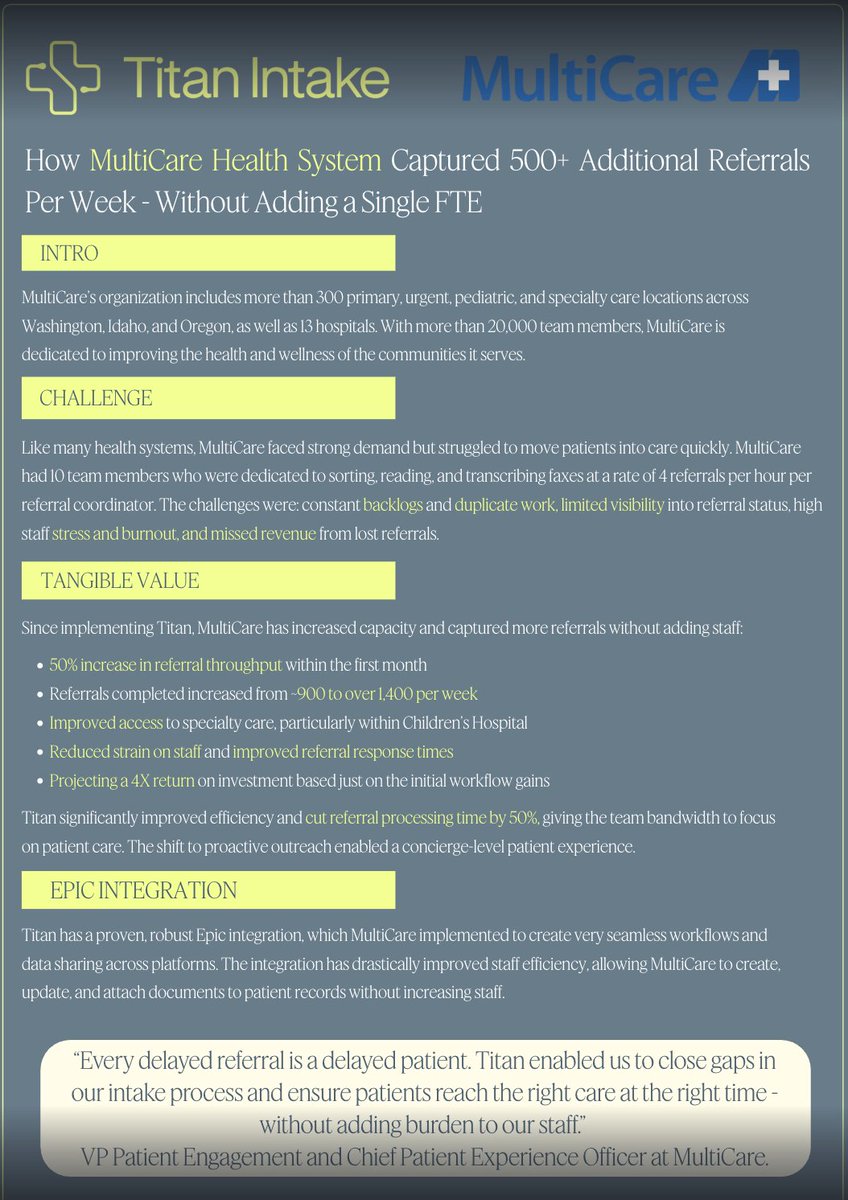
The https://t.co/pQVLOqWBIk team has built *the* best tool for increasing referral throughput for clinicians, and it's not even close. Within the first month, @MultiCareHealth is adding 500+ additional referrals per week without adding a single FTE - 4x ROI
Knowledge without action is merely information. Learning things without actively applying them is academic at best and solipsistic at worst.
Building things without testing them with users is the same.
And interestingly enough too, action also produces more information.
This is why the *learning-->applying the learning--> learning more* cycle is so powerful. This principle has been baked into software development culture for a while now (see Lean and Agile software dev methodologies). Software teams *build-->test-->gather feedback-->iterate*. This is why modern software if done correctly is on a path of continuous improvement, providing more and more marginal value for its users. As a side note, small failures and teachable mistakes are a natural part of this process.
Why hasn't this principle been applied to heathcare operations?
"Everything around you that you call life was made up by people that were no smarter than you. And you can change it, you can influence it, you can build your own things that other people can use. Once you learn that, you'll never be the same again." - Steve Jobs
Believe it or not, this also applies to healthcare operations. With what's possible with LLM-native workflows, now more than ever is the time to influence your world and build things.
EHRs are expensive. $4B for Epic at Kaiser Permanente. $2.5B for Cerner and Meditech at CommonSprit Health. $1.2B for Epic at Mass General.
And these are just the install costs. This is only the cost for the initial setup and rollout. The ongoing costs, the cost of maintenance, support and upgrades are a whole other number.
Why so much? And what was the return on this investment for patient care?
https://t.co/3E0xKy7Yo2
@StuartBlitz Make it a co-working that includes self-funded plan with direct fees already negotiated with primaries, add in a couple specialists and an ASC. Heck at that point are living quarters for everyone. You’ll have a self sustaining bio dome with healthcare for all.
Remember how long you’ve been putting this off, how many extensions the gods gave you, and you didn’t use them. At some point you have to recognize what world it is that you belong to; what power rules it and from what source you spring; that there is a limit to the time assigned to you, and if you don’t use it to free yourself it will be gone and will never return.
Marcus Aurelius, Meditations
When neurosurgeons take call, they commit to dropping everything for true emergencies—rushing to the hospital, answering questions, reviewing scans, no matter the hour. It means limited plans, staying local, arranging childcare, and keeping one eye on the phone at all times, often for weeks at a time.
What we didn’t sign up for: dropping everything to fix EHR glitches that block discharges or transfers. If routine tasks like medication reconciliation are prone to errors, it’s not on us to be weekend IT support. We clicked the needless buttons. If the system fails, it’s time to fix the system, not burden the doctor.