Every one of them becomes a kid again.
They all revert to a moment way back when they were in Little League, when winning a World Series was just a dream.
The guy who kept Shaq and Charles Barkley in line on TV for 37 years used to spend his mornings shaving and dressing his son, who could barely move and breathed through a ventilator. Then he'd go to work and laugh with those guys all night like nothing was going on.
Tonight Ernie Johnson said this season will be his last, and Barkley tried to thank him on air and couldn't get the words out.
I don't think most people watching that clip know what Ernie was carrying all those years.
He and his wife Cheryl adopted Michael from an orphanage outside Bucharest in 1991, when he was 3. He had Duchenne muscular dystrophy, and doctors didn't think he'd make it to his 20s. He lived to 33. When Ernie was home, getting Michael ready in the morning could take an hour and a half, and Ernie did the showering and shaving and dressing himself.
In 2006 he told viewers he had non-Hodgkin's lymphoma, and by the end of October he was back at the desk while he was still going through chemo.
When Michael died in 2021, Ernie wasn't on the show that week, and Shaq, Kenny and Chuck spent about six minutes trying to hold it together while they talked about a kid most of America never met.
Then last year he had heart bypass surgery, and this summer he turned 70.
Ernie's dad pitched in the big leagues and then called Braves games for decades, and he gave his son a rule Ernie's talked about forever: if somebody spikes you at second base, never rub.
If you've ever wondered why nobody's been able to copy Inside, that rule is a big part of it. Barkley could say the dumbest thing imaginable, Shaq could fall out of his chair, Kenny could go running to the big board, and Ernie would just pick it up and bring it back to basketball with that yellow legal pad. Those three got to be chaos because the guy in the middle never made his own stuff the show.
He still calls hosting a "get-to job," and he was calling it that the same year he buried his son.
So when Charles Barkley, who's roasted pretty much everybody alive on live TV, can't finish a sentence to the man, that's why.
Many companies train their managers to give feedback effectively, and often. But improving the skills of the feedback giver won’t accomplish much if the receiver isn’t able to absorb what is said. https://t.co/Ts5Rw43aH9
AGREED!
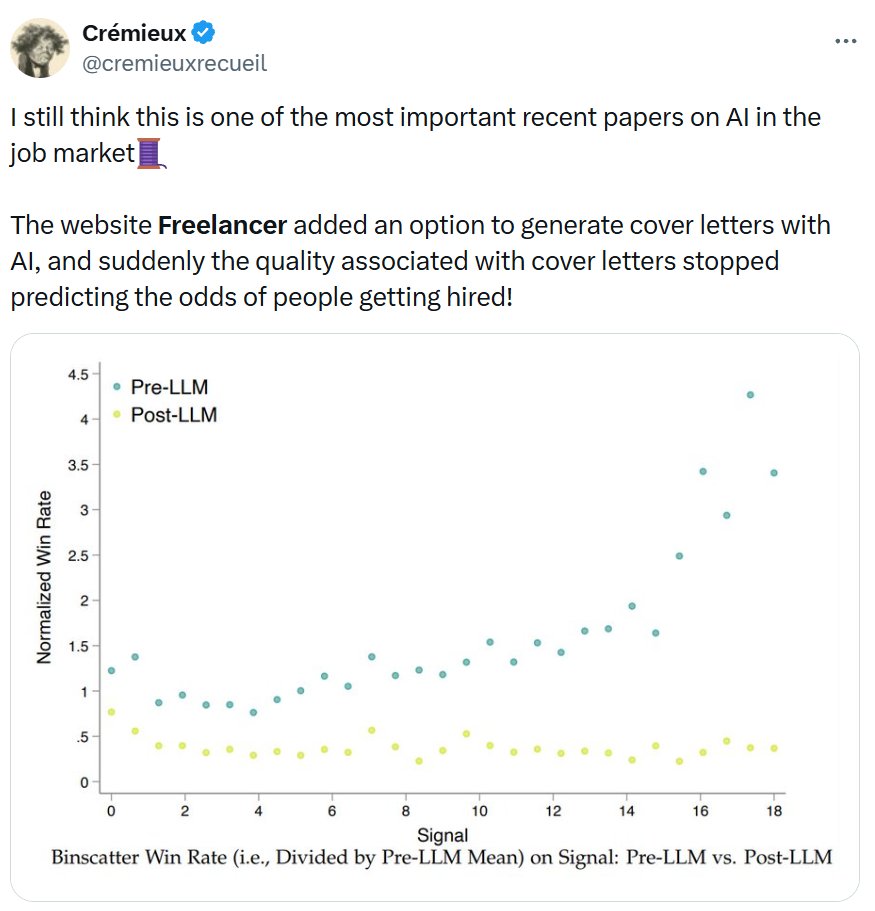
There's a great paper on this that showed that LLMs have basically completely eliminated the signaling benefit in putting in the effort to make a good job application.
The best cover letters used to get people hired more, but slop has eliminated that.
The way to the reconcile capability level of AI vs. GDP impact is that the diffusion of AI will take much longer than people think. And it will also show up in ways that are hard to measure in GDP immediately.
You could bring the world’s greatest superintelligence to many workflows, and still be bound by the laws of corporate physics: getting data prepared and put into a pipeline, process reengineering and change management, aligning on how the new workflow should function, and so on.
Even after you solve all that, you’re still bound by the speed of the real world: waiting for a customer to respond to a proposal, getting a permit for a project, a drug discovery pipeline taking years to eventually reach the consumer, and so on. Not to mention lots of positive daily AI use-cases are entirely net neutral to GDP, at least in the near term.
AI diffusion is going to be the theme of the next decade. The upside is that there’s a tremendous amount of opportunity in building the bridges between superintelligence and real-world workflows.
Welcome to Matrixed Org World. Meetings proliferate when authority is dispersed. If you want fewer meetings, give people actual responsibility. Most leaders lack the stomach for old-school military hierarchies. It feels risky upfront, but empowering commanders drives speed.
. @nejatian hates meetings.
I have seen a clear pattern over the decades: Companies with heavy meeting cultures move slower.
I would see people spending days preparing slides for a 1 hour meeting. Slides they would use once.
Make meetings the exception.
And solve for energy. When you design your days around what gives you energy, that naturally leads to fewer meetings. Since, meetings rarely energize.
"Even as they adopt AI, companies are measuring employee performance with familiar metrics of success: productivity, goal completion, and efficiency. As such, employees who rely heavily on AI may appear highly productive",
(1/3)
@TiloJacs@tomfgoodwin Completely agree!
Every single one of these had meaningful improvements in the user experience of a personal item that you use *multiple times a day* that *touches your lips.* This is not following fashion fads.
I was so sharp and so ready for this fight I cannot believe what has happened. The talk of me being off while walking in to the fight is nonsense. I was calm, ready, and confident. I am in shock what has taken place. The devil is literally staring at me right in front of my face here. I am not engaging. I will be at church tomorrow.
I will overcome this.
I will not be deterred.
I will return.
"Notable accomplishments are rarely achieved by people who work 40 hr per week or less. World-class performers work on average 60 to 80 hr per week with commitment and passion."
@RobertMSterling One of the smartest CPOs I’ve ever reported to said “They say people don’t like change and that’s not true. People don’t like change when it doesn’t make sense.” She made major org changes in ensuing months but explained them all and took ownership. Makes all the difference.
@tomfgoodwin More time with Gen Z+Gen A will quickly change your tune. "Polished" ads like the Mad Men, Ogilvy aspirational navel-gazing clever-by-half perfection turns them off as inauthentic and manipulative. Something raw, personal, and peer-driven is more trustworthy.
Natural charisma is a myth. Connecting with anyone is just a skill.
@cduhigg studied "Super Communicators" and found one pattern: they ask 10-20x more questions than average people.
But not just any questions. Deep questions.
The difference:
Shallow: "What hospital do you work at?"
Deep: "What made you decide to go to medical school?"
The deep question makes them tell you who they are. Their sick dad, their desire to heal, their childhood dream.
Now you're not networking. You're connecting.
The strategy: stop asking what people do. Ask why they do it. The "what" is a resume. The "why" is a connection.
@thesamparr
Step 1b: Founder's ego is fed by being the critical bottleneck. This is the biggest danger to scalability, heck sustainability, of a small founder-led business.
I say it often, but blogs, news sites, articles, case studies, almost all the time focus on the exceptional.
That means our perception of best practice or likely results, is essentially survivorship bias.
It's not to say the people who do amazing things are lucky, but it's also not true that what they did is a replicable playbook.
It doesn't make every successful company "a great idea"
It's just if 10,000 companies set out to make DTC Jeans, 2 brands will get famous.
If 25,000 people set out to reimagine Yoga clothes, 1-4 will get famous.
Quite often I think we may be worshipping companies that did things no better than anyone else, but won the lottery, because stats say if enough people buy tickets, someone will win.
There is also the role of reputation, connections, wealth.
& Quite often the winners seem somewhat unremarkable
I'm far far more inspired by not especially successful companies that do really amazing stuff, that challenges conventions, pushes boundaries, and feels original.
We should find a way to celebrate these.
Than the 23rd company that used Gin Lane style branding to shift reimagined shampoo , and whose Mum was a board member at Target.
I wonder what testable aspects of candidates' backgrounds they AREN'T testing? What simple attributes correlate with great future performance...but are ignored?