Look everyone... don't ever be concerned with my positions; be concerned with the risk you are taking.
I've been trading for 43 years and have had only a few single-digit drawdown years. All of my trades are made from very low-risk entry points and always with a hard stop loss in place.
I could turn out to be wrong and the market may have already made its low. If so, I'll get stopped out. That's the business.
I'm wrong just as often as I'm right. The difference is that my risk is always defined and controlled. What matters is not being right all the time; what matters is that the risk taken relative to the potential reward, adjusted for batting average, is managed in a way that produces a profitable outcome over a large sample of trades.
That's how I've approached the market throughout my entire career, and it's no different today. The distribution of gains and losses over time forms a profitable bell curve because risk always comes first, and risk is always managed in relation to reward.
As the market opens higher this morning, it's important to remain disciplined and avoid chasing an early rally—especially following a significant down day and a weak close on Friday.
One of the most common mistakes investors make is assuming that the first bounce marks the start of a sustainable advance. In many cases, the initial rally is simply an oversold reaction or what traders refer to as a "dead cat bounce."
Historically, after a sharp decline, I prefer to give the market time—often until midweek or even the end of the week—to see whether buyers are truly stepping in with conviction. Very often, after the first reaction higher, the market resumes its downtrend, undercuts the recent lows, and additional damage occurs.
Patience and selectivity are critical. Let the market reveal its true character before becoming overly aggressive. Focus on preserving capital, managing risk, and allowing the price action to confirm whether the move is the beginning of something meaningful or merely a temporary bounce within a larger decline. https://t.co/JXzFFTmMtn
This has been the battle cry for me of 26' thus far. A few things I did NOT have on my bingo card or got DEAD wrong.
1. Rates. I thought if anything rates would fall and I got creamed pretty good the night the Iran stuff started as I went long 2yrs in a big way only to get my head handed to me which leads to...
2. War/Iran/Oil. I don't trade on macro theory or news but if you had told me US would start a war with Iran I would have bet against it and...
3. Oil >100$ with S&P at all time highs...most would have bet against this, and did. But I didn't see this coming at all.
4. The strength in some of the AI picks & shovels plays...this I had on my radar but not the parabolic moves we've seen in $MU, $MRVL, $SNDK and the like
5. U308...I've liked this story and traded uranium stocks for years, was long pretty strong to start the year and they failed and went no where.
There's many more but this is where I've been reminded when you get lots of stuff wrong and aren't down you are winning and to always stay flexible. What is next? I haven't a clue but I'm pretty sure there will be more surprises along the way.
Quick update on the general market...
1. This is one of the more impressive lockout rallies I've seen, at least when looking at the Nasdaq.
2. Sentiment has remained very contained, almost impressively so and still very constructive.
3. Almost no distribution, and no meaningful distribution (heavy volume selling days where NYSE or Nasdaq close down >1%)
4. Breadth. While many are saying breadth is terrible it is pretty consistent with what we've seen over the last number of years, namely that the environment is more selective. NYSE A/D line looks like it wants to confirm upon a breakout and the NYSE Comp is tracing out a pretty nice consolidation.
Conclusion: 'Well, this is a bull market, you know!'
-Mr Partridge aka 'Old Turkey'
(Reminiscences of a Stock Operator)
Bull: The broader uptrend remains firmly intact, powered by massive AI tailwinds and leading stocks have been incredibly resilient, repeatedly shrugging off recent shakeouts.
Bear: Valuations are becoming stretched and participation is still too narrowly concentrated in the largest names. Additionally, treasury yields are rising on renewed inflation fears and the market is rapidly pricing out 2026 rate cuts.
Trader: Respect the uptrend, but keep an eye on yields. Stay selective and don't get shaken out of the true leaders.
With both PPI and CPI coming in hot, I see risk continuing to rise. The Fed’s hands are now tied, and rate cuts appear to be completely off the table for the foreseeable future. Interest rates have already been moving higher, and if inflation remains sticky, the market could soon begin pricing in the possibility of rate hikes. While there are currently no clear signs of a meaningful economic slowdown, persistently higher rates could ultimately lead to an “engineered” recession.
Mega-cap stocks continue to lead the market, with GOOGL and NVDA showing the strongest relative performance, while META remains the clear laggard among the group. At the same time, market breadth has been deteriorating and participation continues to narrow. Currently, only 40% of Nasdaq stocks are trading above their 200-day moving average, and just 46% of S&P 500 stocks are above their 50-day line.
Be careful chasing extended stocks in this environment. This may be a good time to finance risk by taking partial profits in names that have already produced solid gains and that allows you to freeroll the rest of the trade risk free. https://t.co/JXzFFTmMtn
We are in a very concentrated environment. The Nasdaq 100 is up 16.2% year-to-date. Four stocks ��� Alphabet, Nvidia, Micron, and Intel – are responsible for 8.4% points, or 52.3% of the gains. With the market hitting all-time highs, only 40% of Nasdaq stocks are above their 200-day moving averages, so it's a selective environment. Money has chased a small list of names which is producing a number of climax moves in individual names. Examples include: $INTC, $MU, $SNDK, $BE, $STX, $AMD. There is some serious momentum in these names, but investors need to be careful of getting caught up in the emotion that comes with a parabolic rise. The nature of this market has been one of concentration and selectivity. With many stocks becoming extended, the landscape is becoming more selective. The bull market is intact, but with pockets of froth forming. https://t.co/JXzFFTmMtn
@AnkurPatel59 Set up C: on the uptrend HL position. Highly possible moving up to the new high.
Set up B extended, low volume no price action, bull weakness.
Set up A: break out downtrend, needs HL confirmation. So wait here not to buy.
Most traders study indicators.
I study past big winners. 📈
Because the market keeps rewarding the same characteristics over and over again.
The biggest winning stocks from the past all had clear similarities:
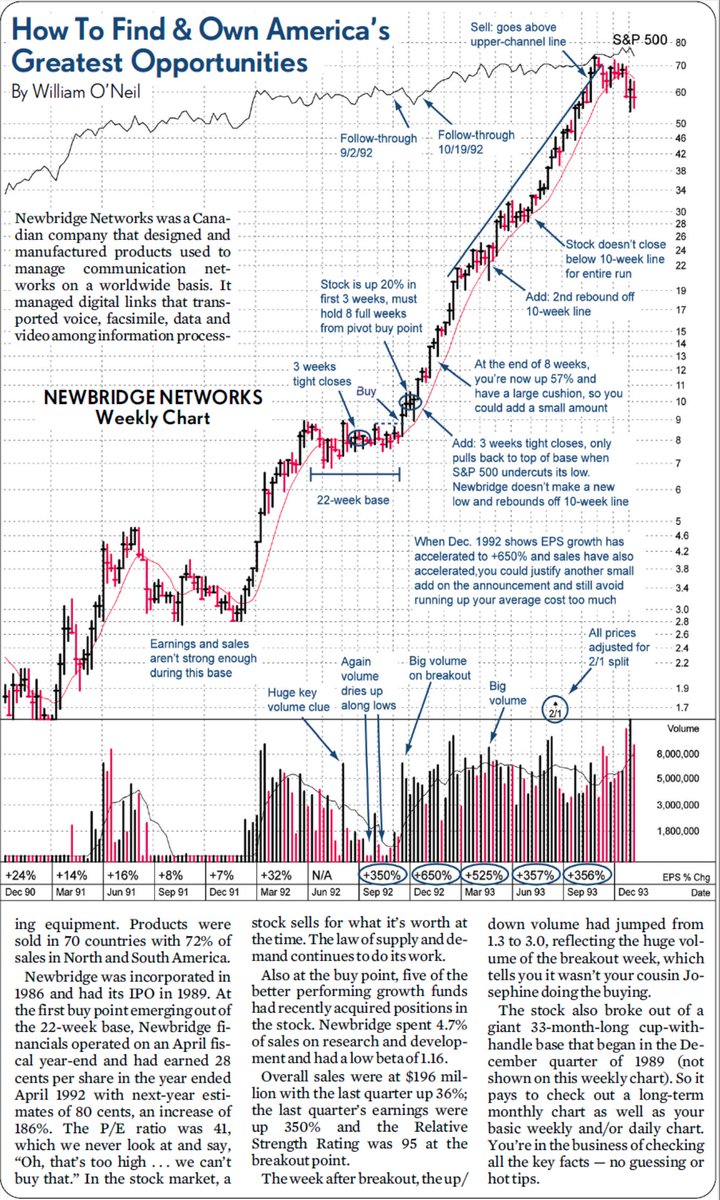
1) Massive Relative Strength: The stock already outperformed the indices before the huge move started. Strong stocks tend to get even stronger.
2) Big Fundamental Growth: EPS growth +50% or more. Sales growth +20% or higher. Institutions need a reason to pile into a stock.
3) A Real Catalyst: AI, crypto, rare earths, data centers, drones, fiber optics. Big winners usually have a strong story that attracts serious capital.
4) Tight Bases: The best stocks don’t move randomly. They pause, tighten up, shake weak hands out, then break higher again.
5) Strong Volume Clues: Multiple accumulation days with huge volume spikes often tell you that funds are building positions early.
6) Clean Trend Structure: The biggest winners respect moving averages like the EMA8 and EMA21 for weeks or even months.
That’s why I spend so much time studying past leaders.
Not to admire them.
But to train my eyes for future winners.
These patterns repeat.
Every cycle. Every year.
You don’t need random trades.
You need a blueprint.
Learn how the biggest winners looked before they exploded.
Then wait patiently for the next one.
I’ve taught this process to thousands of traders.
You can learn it too.
QQQ has broken through its trend line if you draw it from 7/10/24 to 10/29/25, and is starting to reverse. Combine that with insane upside moves and speculation, tell me the market has gotten ahead of itself. So I would advise caution and reduce exposure. At a minimum, the uptrend needs a pause to rebuild bases.
lower...
For starters the stock is 12$ and has no earnings which means very low/poor institutional sponsorship=poor quality
-Stock is not really in a stage 2 uptrend
-Stock is running into a LOT of overhead supply
-Stock does not have a good looking weekly in terms of volume characteristics
-Stock doesn't have good volume characteristics on the daily as last 7 days are all above average with not much price progress and wider action, I want exactly the opposite
-Stock has negative earnings, does have sales so mixed bag at best
-It's also in the cyclical area (mining/metals) so a discount there as well
-stock is not tight on its right side as a breakout to yesterdays lows measures +/-17%, no where close to what I'd want to see
Doesn't mean it can't work (it'll probably blast off here) but I'm a probabilities guy and this is an avoid every day of the week for me
Longer post on recent Market/Sentiment reflections:
Been pretty busy watching/trading/highlighting stocks the past week or two but been meaning to do an update. It was exactly a month ago when I said based upon what I was reading that I thought the lows may be close. I also said I didn't think we'd get a 'V' recovery. Got one right and the other way wrong but neither matter to me as I follow rules not my personal opinion.
I've incrementally gotten fully invested (decent amount of jockeying required) over the past two weeks but I made a comment yesterday during a Q&A that prompted me to do some self reflection...the comment/question was 'how many of you would have more exposure if you were just watching stocks and ignoring the news or the indices'?
We've had a rip your face off rally to new highs and then have started to have some stocks form handles and emerge. How many people took BIG positions in these setups? I have no clue but if history is any guide my gut says most bulls are underinvested and there's a LOT of macro bears (all straits of Hormuz & oil experts currently) shorting this rally.
Who knows maybe we crash, I highly doubt it but as my buddy @Upticken says 'there will always be a reason NOT to buy'. Ask yourself this: how many people have had more reason(s) than normal not to buy? I jokingly took a snap shot of my journal yesterday talking about how 'my feelings don't matter' because at the end of the day the market does not care so to have a process that overrides how I feel is paramount.
This is what my mentors have all had in common, the ability to follow rules regardless of feelings. I'll never forget a convo I had with @markminervini in May of 2020 when we both saw a ton of stocks setting up in the worst of Covid and I asked him 'what do we do'? He said 'I'm terrified, but we buy and if we get stopped out, we get stopped out.' Everything I bought for the next six months felt like it went straight up and anytime I made a bullish comment people said I was a moron. I already felt like a mature trader/risk manager at that point yet I felt like I became a real pro as I completely let the price action & process dictate my movements.
Everyone likes to think they can divorce their ego from the trade or their performance but that is often what you have to risk/sacrifice first. If you are worried about looking/feeling dumb because you lost money or got something wrong then you are likely to struggle. Consequently that period from May of 2020 through early 2022 was the best risk adjusted (real measure of skill for a risk manager) period of performance I'ver ever had.
This has a similar feeling although not nearly as extreme. We have a pretty decent wall of worry out there (war, politics, inflation, who knows what else) and the market seems to be telling a different story. Good luck and don't take your cues from anything other than your own process, just sharing how mine has hit a recent inflection.
Another example is from January–February 2012. This is an old phase, but the behavior is very similar.
Before this, from June–July 2010 to October 2010, Nifty moved up around 23 percent. That is a fast move for an index. After that, the market corrected nearly 27 percent and this decline lasted for about a year.
During this fall, the market kept attempting multiple counter rallies. This is exactly why these rallies cannot be trusted fully. At one point, everything starts looking strong, and then suddenly the market turns choppy again. The main trend is still down. Selling pressure is still present. These are only relief rallies within a broader downtrend.
Still, these phases give tradable moves if you pay attention.
During the 2010–2011 decline, and into early 2012 where the market finally bottomed, Nifty moved about 23 percent from the bottom. From the breakout level, the move was around 17 percent.
I have already shared the list of stocks from this phase. These were the runners. Many of them delivered close to 50 percent moves. Not all of them were clean trades, but this is not the point.The point is to study these stocks and understand which ones were giving proper structures during this phase.
That is what you need to focus on in the current market. Look for similar setups. Look for similar structures. That is where the opportunity is.
#Nifty
Prior to the President’s address, the NDR Hormuz Stress Index began showing early signs of easing. Crude markets are tight, overbought and sentiment is excessively optimistic. Overbought conditions have historically seen low or below average returns but not necessarily outright declines. The combination of an elevated z score and a falling Stress Index would suggest crude prices are increasingly vulnerable to the downside. However, if the Stress Index reverses and climbs back to elevated levels, mean reversion becomes more unlikely.
Overbought and oversold conditions can produce nice counter-trend rallies, but you have to be very careful because they can also indicate the start of something more significant and may not turn on the schedule you anticipate.
This is why when I fade a strong market I do it from a very tight entry with a minimal stop loss, and use intraday progress as a cushion to "earn" the right to take overnight risk. If I can't time the trade well and get myself at a decent profit intraday, I generally just punt the position and I won't take the overnight risk.