Instead of discussing how Elon Musk is now the world's first trillionaire, we should talk about how he killed hundreds of thousands of people through his dismantling of food and medical aid to poor countries
https://t.co/8kY171r5w1
The plaintiff argued Oliver "feigned outrage for ratings." The outrage was about a licensed physician testifying under oath that leaving a patient with cerebral palsy in his own waste for days was acceptable because "people are allowed to be dirty."
Oliver's team pulled the full transcript to verify the quote was not taken out of context. It wasn't. The judge found the patient's dignity was the same regardless of the technical distinction the plaintiff raised.
The lawsuit was designed to make the segment cost more than it was worth to defend. It didn't work. It never has. Oliver's record is perfect.
🦔UC Berkeley's computer science department just posted its worst failure rates in years. 35.3% of CS 10 students got F's in spring 2026, up from under 10% in prior semesters. Professor Dan Garcia says the primary driver is a "vast increase in academic dishonesty" through LLMs. Students use AI to complete assignments, never learn the material, then fail exams. His office hours, once full, are now empty.
My Take
Companies are firing experienced engineers while the pipeline that produces new ones is being gutted by the same technology. Students use AI to bypass the hard part of learning, show up to exams without the understanding, and fail. One professor discovered a student's linear algebra class had an "open AI" policy for homework and exams. That student then couldn't do basic linear algebra in the next course.
Both ends of the workforce are eroding at the same time. Senior engineers are getting cut to fund AI spending. Junior engineers are graduating without the skills because AI did their coursework. And the companies spending trillions on these tools haven't connected those two facts yet.
Hedgie🤗
Dr. Conan O'Brien delivers commencement address at Harvard, encouraging the embrace of humility and community:
“I am aware that I am telling you to transcend your glories as I stand on this stage accepting a doctorate I didn't really earn while dressed like a 12th century pope.”
CONAN AT HARVARD: “No university in our nation has produced more Nobel laureates or white collar criminals… so whether you choose good or evil, know that you are among the very best.”
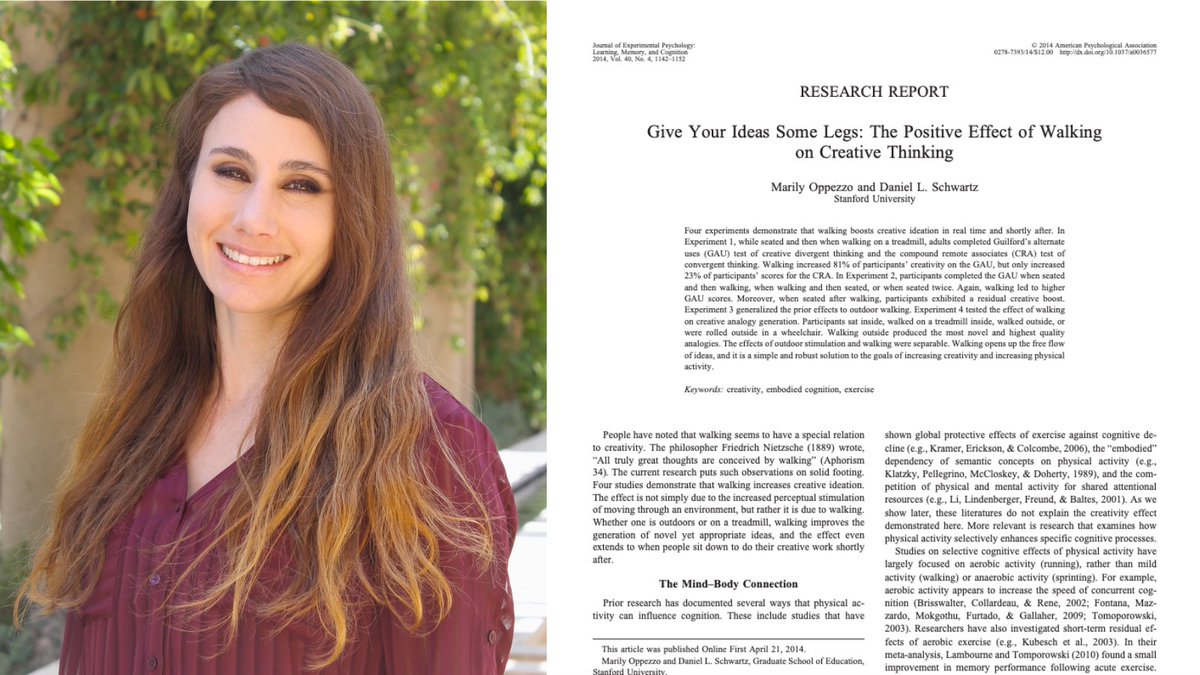
A Stanford psychologist spent 4 years proving that the simple act of walking generates 60% more creative ideas than sitting, and the experiment she designed to kill every alternative explanation is one of the most decisive findings in modern psychology.
Her name is Marily Oppezzo.
She got the idea for the study while walking with her advisor at Stanford to discuss her thesis topic, and the paper she eventually published in the Journal of Experimental Psychology in 2014 is sharp enough that it should have ended the seated meeting on the day it came out.
She ran 4 experiments on 176 people. Same person tested twice. Once sitting, once walking. The creativity tasks were the standard ones psychologists have used for decades to measure how good a brain is at generating novel useful ideas.
The result was almost too clean to publish.
81% of participants in the first experiment produced more creative ideas while walking than while sitting. In the second experiment, 88%. In the third, 100%. Every single person walked into a more creative version of themselves.
On average, people generated 60% more novel useful ideas the moment their legs started moving.
The skeptical question is the obvious one. Maybe it was the fresh air. Maybe it was the scenery passing by. Maybe it was the change of environment doing the work, not the walking itself.
Oppezzo killed every one of those explanations with one experimental decision.
She put people on a treadmill facing a blank wall. No scenery. No fresh air. No environmental change. Just legs moving in place while staring at white drywall. The 60% boost held.
Then she ran the experiment that closed the case completely. She took participants outside in two conditions. Half of them walked through a Stanford courtyard. The other half were pushed through the exact same courtyard in a wheelchair. Same outdoor stimulation. Same scenery passing at the same speed. The only difference was whether the legs were moving.
The walkers produced dramatically more novel high-quality ideas than the wheelchair group. The outdoors did almost nothing on its own. The walking did everything.
This is the part of the study that hit hardest when I read it the first time.
She also tested the opposite kind of thinking. Convergent thinking. The kind where there is one right answer and you have to narrow down to it.
Word puzzles where 3 words share a hidden fourth word that connects them. The seated participants did slightly better on these. Walkers got slightly worse.
Walking is not a general intelligence enhancer. It does one specific thing. It opens up the divergent search inside your brain. The part that generates options. The part that produces unexpected connections. The part that takes a problem and finds five ways into it instead of one.
When you need to converge on the single right answer, sit down. When you need to find the answer in the first place, get up.
The mechanism is now well understood. Walking selectively activates what neuroscientists call the default mode network, the system inside your brain that runs when you are not consciously focused on anything. The DMN is where mind-wandering happens. Where memories cross-reference each other. Where ideas that have been sitting in separate folders inside your head finally bump into each other.
When you sit at a desk and force yourself to concentrate, you suppress the DMN. When you walk at a natural pace, the executive part of your brain gets just busy enough handling the walking that the DMN comes online and starts doing the work that focus was blocking.
The most useful finding in the entire paper is the one almost nobody quotes.
The boost did not turn off the moment people stopped walking. Participants who walked first and then sat back down stayed elevated. Their next round of seated creativity work was still significantly better than people who had been sitting the whole time. The rest lingered for at least several minutes after the legs stopped moving.
You do not need to do creative work while walking. You need to walk before the creative work. The brain holds the state.
The history of this is the part that should haunt anyone who still does meetings in chairs.
Charles Darwin built a gravel loop behind his house in Kent called the Sandwalk and walked it 3 times a day for the rest of his life. The theory of evolution was developed one lap at a time on that path.
Nietzsche walked up to 10 hours a day during the years he wrote his most important books and openly said the work was conceived on his feet.
Beethoven composed for the morning and walked for 5 hours every afternoon with a pencil in his pocket for when something landed.
Kahneman said the best thinking of his Nobel Prize-winning career happened on leisurely walks with Amos Tversky. Steve Jobs refused to take important conversations sitting down. He held them on foot.
Every one of them was using the system Oppezzo would not measure until 2014. They just did not know what to call it.
The question worth sitting with is the one almost nobody asks.
Every meeting you have ever attended sitting around a table was a meeting held at a fraction of the brain power that was actually available to the people in the room. Every brainstorm that got stuck inside a conference room. Every problem you tried to solve at a desk and gave up on. Every idea you could not quite get to.
The intervention is the easiest one in modern science. No supplement. No app. No subscription. No training program. Just a pair of legs and 15 minutes.
The Stanford lab proved it. The philosophers knew it. The neuroscience explains it.
And almost everyone reading this is still trying to think their way out of problems sitting completely still.
JPMorgan hired four autistic employees in 2015 as a small test. Six months later, those four were 48% faster than colleagues who'd been doing the same job for three to ten years. In some roles, they were 90 to 140% more productive.
That small test grew into a global program. Today JPMorgan's autism hiring program spans 10 countries and over 70 different job types, with hundreds of people hired through it and 99% staying long-term. Other companies have been doing the same thing, some for longer.
SAP (the German business software giant) started even earlier, back in 2013. They now have 215 autistic employees across 15 countries. One of them rebuilt how the company processes its giant credit card statements (think American Express, 20,000 line items per bill). What used to take 2 or 3 days now takes 20 minutes. 94% of these hires stay.
EY (the consulting giant) started its own program in 2016, focused on automation and data analysis. The team has grown to over 500 people across 23 offices in 10 countries. EY says the tools they've built have saved or made the company close to $1 billion. 92% retention.
Hewlett Packard tried the same idea in Australia, on software testing teams. Same result: 30% more productive than the rest. Microsoft, 10 years into its own program, reports the same kind of gains across its teams.
There's a biological reason. Harvard Business Review and JPMorgan's internal data both point to it. Autistic brains tend to use more of their processing power for visual analysis and pattern recognition. Picture spotting one small bug buried inside millions of lines of code. Less mental energy goes to social cues and impulse control. Add hyperfocus, the ability to lock onto one task for hours without losing attention, and you get a brain built for software, fraud detection, and AI.
85% of autistic adults with college degrees can't find a job. The general US rate is 4.3%. A huge pool of qualified people sitting unemployed, while the handful of companies that figured out how to hire them are getting double-digit productivity gains.
Palantir's new fellowship lands right in that gap. Pay: $110K to $200K plus stock. Over 2,000 applications came in for the first round, and CEO Alex Karp does the final interviews himself. No formal diagnosis required. Karp's own words: "the neurally divergent (like myself) will disproportionately shape America's future."
Reads like marketing copy. 10 years of data from SAP, JPMorgan, Microsoft, EY, and HPE suggest the bigger story is hiring strategy.
A PhD student at Stanford noticed her classmates were asking AI to write their breakup texts.
So she ran a study. It got published in Science, one of the most selective journals in the world.
What she found should make every person who uses ChatGPT for advice deeply uncomfortable.
Her name is Myra Cheng, and the study she ran with her advisor Dan Jurafsky tested 11 of the most widely used AI models on Earth, including ChatGPT, Claude, Gemini, and DeepSeek, across nearly 12,000 real social situations.
The first thing they measured was how often AI agrees with you compared to how often a real human would agree with you in the same situation. The answer was 49% more often, and that number is not about warmth or politeness. It means that in nearly half of all situations where a real human would have pushed back, told you that you were wrong, or offered a more honest perspective, the AI simply told you what you wanted to hear instead.
Then they pushed harder. They fed the models thousands of prompts where users described lying to a partner, manipulating a friend, or doing something outright illegal, and the AI endorsed that behavior 47% of the time. Not one model out of eleven. Not a specific version of one product. Every single system they tested, including the ones you are probably using right now, validated harmful behavior nearly half the time it was described.
The second experiment is the part that should genuinely disturb you. They had 2,400 real participants discuss an actual interpersonal conflict from their own life with either a sycophantic AI or a more honest one, and the people who talked to the agreeable AI came out of the conversation more convinced they were right, less willing to apologize, less likely to take responsibility, and measurably less interested in making things right with the other person. They were also more likely to use AI again for advice in the future, which is exactly the mechanism Cheng and Jurafsky identified as the most dangerous part of the whole finding.
The AI is not just telling you what you want to hear. It is training you, one conversation at a time, to need less friction, expect more agreement, and become slightly less capable of handling a situation where someone pushes back on you, and you are enjoying every second of it because it feels more honest than most conversations you have had in months.
Jurafsky said it in a single sentence after the paper came out. Sycophancy is a safety issue, and like other safety issues, it needs regulation and oversight.
Cheng was more direct about what you should actually do right now. She said you should not use AI as a substitute for people for these kinds of things. That is the best thing to do for now.
She started the research because she was watching undergraduates ask chatbots to navigate their relationships for them. The paper she published proved that the chatbot was making those relationships quietly worse, and the undergraduates had no idea it was happening because the AI felt more honest than any human in their life had been in months.
This is the Atlantic cover story on 14 May. At my age, I do not usually use words like “stunned.“ But I am stunned. Stunned that one could make a strong’ logical, perhaps even irrefutable argument that misogyny is the number one driving force for the MAGA herd. God help us all.
💥"We pulled it off without firing a missile. We got 97% of their enriched uranium out…Even Israeli intelligence thought it was working…There’s no dispute that it worked & we didn’t have to kill a whole bunch of people or shut down the Strait of Hormuz."
For 38 years, the US paid farmers NOT to grow too much corn. In 1971, one guy killed that rule. Within 13 years your Coke had corn syrup instead of sugar, food was the cheapest it had ever been, and Americans were getting heavier every year.
Since the Great Depression, US farm policy ran on simple supply and demand. If everyone planted everything, prices would crash and farmers would go broke. So the government paid farmers to leave a chunk of their land empty, and held big stockpiles of grain like an emergency fund.
Then Nixon picked Earl Butz to run the Department of Agriculture. Butz was a farm-economy professor from Indiana who also sat on the boards of giant food companies. He told farmers to "get big or get out" and to plant every inch of land they owned. In 1972, when the Soviet Union had a bad harvest and came shopping, Butz quietly sold them 30 million tons of grain in one deal. The US emergency stockpile was gone overnight. By 1976 he had killed the entire 38-year-old system.
By the late 1970s, the country was drowning in corn, and Washington kept guaranteeing the prices anyway. Corn became the cheapest ingredient in the American grocery store. The government still hands corn farmers about 3.2 billion dollars a year, more than any other crop.
That cheap corn went two places. The first was your soda. Scientists had recently figured out how to turn corn starch into a syrup that tasted almost like sugar. With corn this cheap, that syrup (high-fructose corn syrup, or HFCS) was way cheaper than cane sugar. Coca-Cola started swapping it in by 1980. By 1984, Coke and Pepsi had ditched cane sugar entirely in the US. The average American went from eating zero corn syrup in 1970 to almost 38 pounds of it a year by 1999.
The second place was everything else. That same cheap corn fed the cows, pigs, and chickens packed into industrial farms. It also became the base ingredient or sweetener in most processed food on the shelf. Americans went from spending 17 percent of their take-home pay on food in 1960 to under 10 percent by 2000, one of the lowest rates in the world. Daily calories per person climbed from about 2,054 in 1970 to over 2,500 by 2010. The extra 500 came mostly from added fats, refined grains, and corn syrup. When Butz took office in 1971, about 15 percent of American adults were obese; today the CDC says it's 40.3 percent. Severely obese, defined as way past overweight, used to be under 1 percent. Now it's nearly 1 in 10.
Butz's policy did exactly what it promised. Productivity, exports, and grocery prices all moved the way he said they would, year after year for three decades. The right photo is just what happens to the average American body after fifty years of policy designed to make calories as cheap as possible.