🚨 Our lab's first paper is published!
The claim: anxiety distorts not just what looks threatening, but the task models people use to plan. 🧵
This tiny study provides preliminary support that world model variation is critical to explaining anxiety.
https://t.co/9ZUSMTm5Vm
Computational models are a key part of science but discovering new ones is hard!
DataDIVER discovers concise models from data, surfacing new mechanistic ideas and generating clear predictions for future experiments
Preprint from @GoogleDeepMind Neuroscience Lab + collaborators
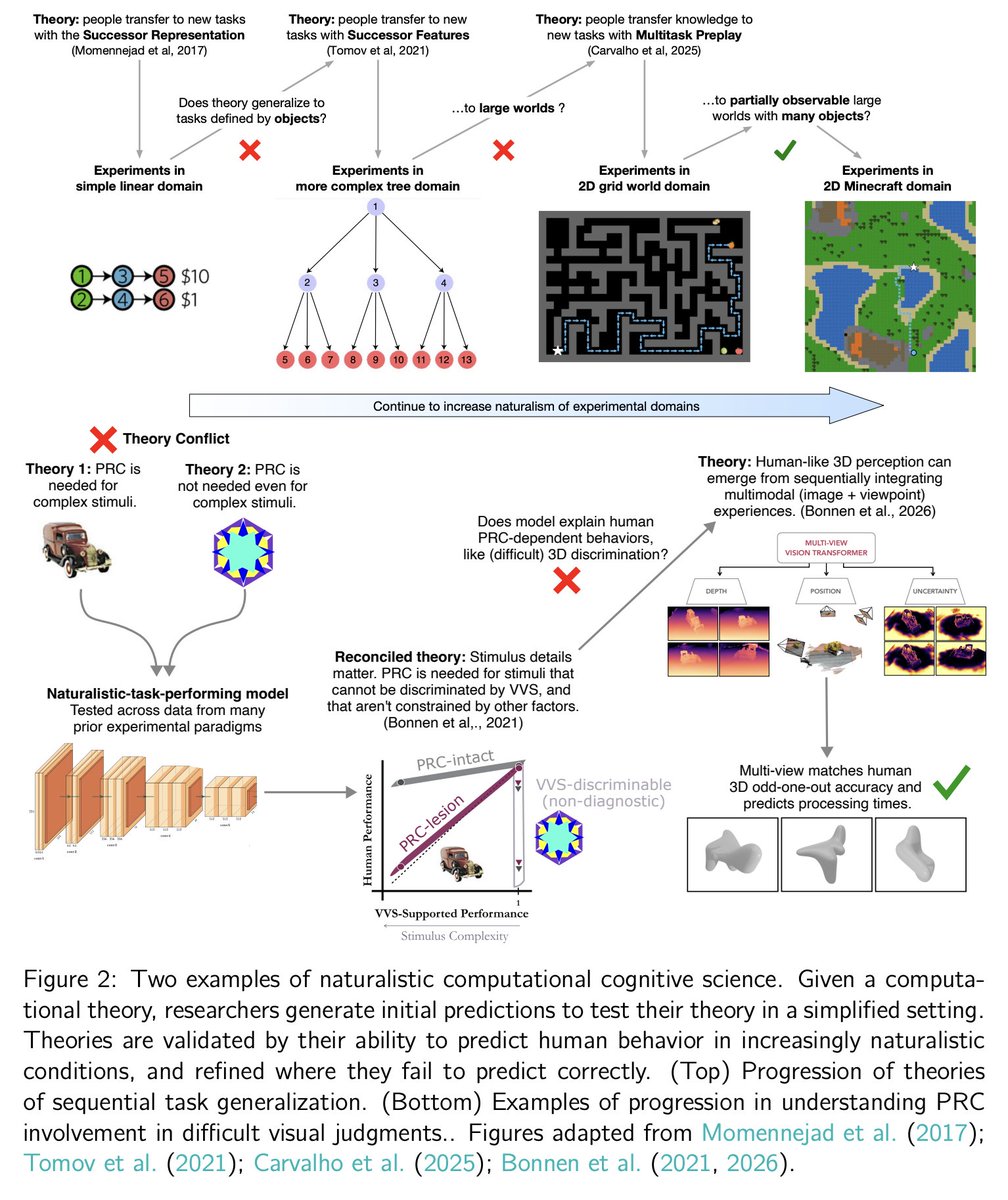
We've updated the preprint of our Naturalistic Computational Cognitive Science paper — we've clarified and streamlined the arguments, and expanded examples where we see increasing naturalism already yielding new theoretical insights, from RL to perceptual neuroscience. 1/4
A standard stimulus-generalization account predicts anxious people use threat-associated keys *more*, to pre-empt new threats. We found the opposite: the actions themselves are excluded from the planning repertoire. A distinct mechanism.
🚨 Our lab's first paper is published!
The claim: anxiety distorts not just what looks threatening, but the task models people use to plan. 🧵
This tiny study provides preliminary support that world model variation is critical to explaining anxiety.
https://t.co/9ZUSMTm5Vm
🔥🚨 Lab's first paper is out !! Thanks @micahgallen for reposting here.
The article is open access, showing anxiety biased how we form world/task models when when we confuse actions coincidental threat as if those actions cause threat.
Read here: https://t.co/jQfeLfGJIn
Anxiety distorts not just what looks threatening but the specific task models people use to plan their actions, suggesting world model variation is critical to explaining this condition.
https://t.co/y6O5buclBv