smart speakers feel like a product that arrived before the software was ready.
@Google and @amazon sold millions of them long before today’s conversational AI. people were already willing to put a microphone in their kitchen and ask it for help.
now that we can have much more natural conversations with AI, i’d expect smart speakers to be having a huge second moment.
Alexa+ and Gemini for Home are already moving in that direction. the opportunity seems obvious: talk through your plans while cooking, ask follow-up questions, give your assistant something to handle without reaching for your phone.
i wonder how much the first generation shaped our expectations. once you’ve decided that little speaker is mostly for music and timers, what gets you to try again?
i think the appeal of Grok @bot and Meta’s @Muse is pretty simple: they bring the Hermes / OpenClaw idea to people who would never set up an agent themselves.
no server to configure. the assistant already has a computer in the cloud. connect your apps, send it a task from your phone, and let it work. that’s something you can explain to anyone in a sentence.
also, giving them little mascots was a good call. Grok Bot’s little ball was all over X. people started recreating it for their own side projects. they wanted the little guy too.
voice is having a moment.
@WisprFlow turns spoken thoughts into polished text, and @OpenAI's GPT-Live-1 brings conversations that can handle you interrupting and talking over the AI.
speed is a big part of the appeal. Wispr says its dictation is around 4× faster than typing. when you’re explaining a feature or giving an agent a long brief, that’s a meaningful difference. i suspect it also encourages you to share details you might have skipped to save yourself some typing.
my bet is that voice becomes a normal part of working with AI. getting a rough idea out while walking makes sense. precise edits and shared offices still give you plenty of reasons to use a keyboard.
the real test is the time saved from first thought to usable result. speaking faster only helps if you don’t spend the next five minutes fixing the transcript.
has voice become part of your daily workflow yet?
@pieteromvlee the onboarding example really captures the problem. how will Elyx handle changes made directly in code, so the design files stay in sync with what actually ships?
Personnellement j’ai pas du tout aimé Da nang. Si je peux te donner un conseil c’est de pas réserver pour une durée trop longue. Comme ça tu peux tester différents endroits et rester la où tu te sens bien. L’avantage de l’Asie c’est que l’avion ça coûte rien, donc tu peux vraiment bouger de partout.
today i visited the Three Natural Bridges in Wulong, China.
absolutely unreal place. it looks straight out of a movie, and Transformers: Age of Extinction was actually filmed there.
this is one of my favorite things about China: staying in a huge city, then taking an hour-long train ride out to Wulong for a day somewhere like this.
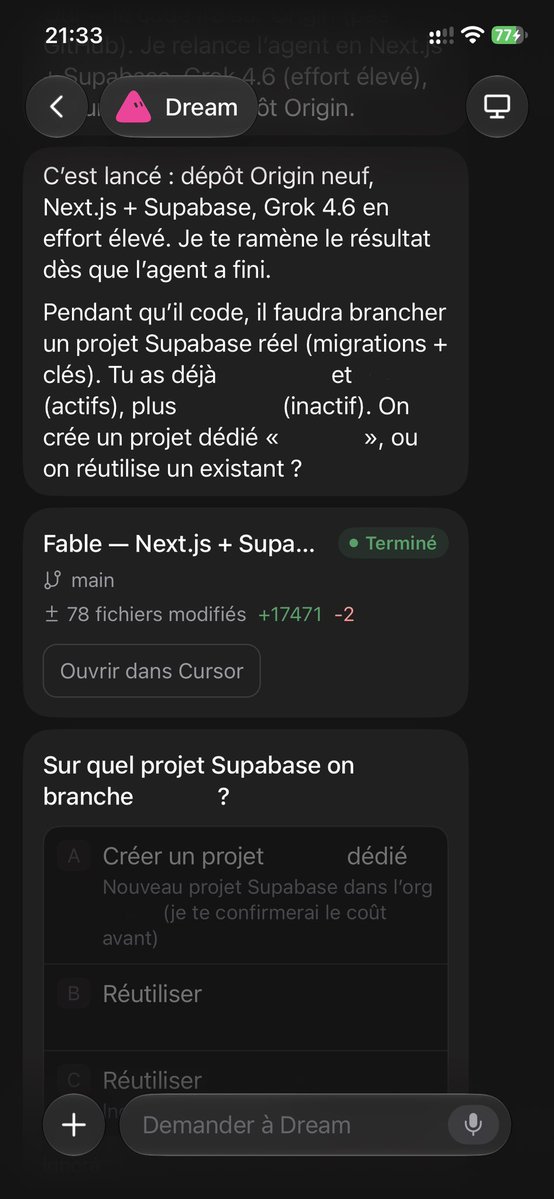
on the way there, i worked from my phone with @bot. planned the next few days, handed over my dev tasks, and got everything running. then i went exploring.
by the return journey, the builds were deployed and the @vercel preview links were waiting for me. i spent the train ride testing them and sending feedback, all from the same phone.
the @bot integration with @cursor_ai makes this feel surprisingly simple. the agents have their own computers in the cloud, so they can keep working while i’m out walking around.
this is exactly what i want from the AI setup i’m building: more days like this.
thanks for everything @SpaceXAI
@kepano being able to open a note, let an agent edit the file, and see the changes immediately is exactly the workflow i want. glad you kept external edits in mind!
working remotely from China has been so much easier than i expected.
i left France 8 months ago to travel through Asia: Thailand, South Korea, Japan, Vietnam, and China. originally, China was going to be a holiday. i was worried about being able to work properly there.
once i had a good VPN set up, though, i stopped having issues. i’ve found reliable wifi pretty much everywhere i’ve wanted to work. you can order almost anything in a few taps, and the quality of service you get for what you pay still surprises me. everyday life here feels surprisingly easy.
i’ve stayed the longest in Chengdu. i love how relaxed the city feels, and on weekends i take the train out to go hiking in the mountains. it’s become one of my favorite places to spend an ordinary working week.
if you’ve been curious about traveling and working from China, i’d absolutely recommend the experience. i’m really glad i gave myself time here beyond a holiday.
Apple update day still gets me excited every year.
i’ve already updated my devices, and everything feels noticeably smoother so far. i’m seeing similar impressions on X too.
the frustrating part is that EU users still miss out on Siri AI on iPhone and iPad. getting excited about an update, then checking which parts you’re actually allowed to use, is getting old.
i can see arguments on both sides of the Apple / EU debate. but the customer still pays the full bill, VAT included, for a smaller feature set. whichever side you agree with, that’s a frustrating outcome.
situations like this are part of why i’m glad i left France to live and travel in Asia. i just wish where you live mattered less to what your devices can do.
Hello, iOS 27. 👋
Take a tour of the latest updates, including the introduction of Siri AI, an entirely new version of Siri that draws on your personal context and helps you search for content or take action across a variety of apps.
See what's new: https://t.co/WQ2sBBtRuw