@anthonystauffer See you on Bluesky? Feels like the majority of tech twitter has just migrated, but not enough music, arts, (& other communities I enjoy) are there yet. I’m wondering how to persuade them to jump.
In a rare outing for our opinion site, I’ve written about why councils seeking to ban bikes from city centres due to delivery bikes are treating it as a “cycling problem” when it’s actually a law enforcement problem - these are mainly electric mopeds.
https://t.co/23L3gh3WT3
The russians have no more shyness or hesitation and publish a video of a russian UAV hitting a residential building in Kherson.
United24
The russians are showing the whole world that they hunt and kill civilians.
They can do this because the West has shown nothing but weakness for 32 months.
“We assume that car use is an incompressible liquid that must be routed somewhere. But it’s more more like a gas that fills whatever space it is given.”
—Ian Lockwood, Harvard Loeb Fellow, transport planner.
#Toronto 🧵
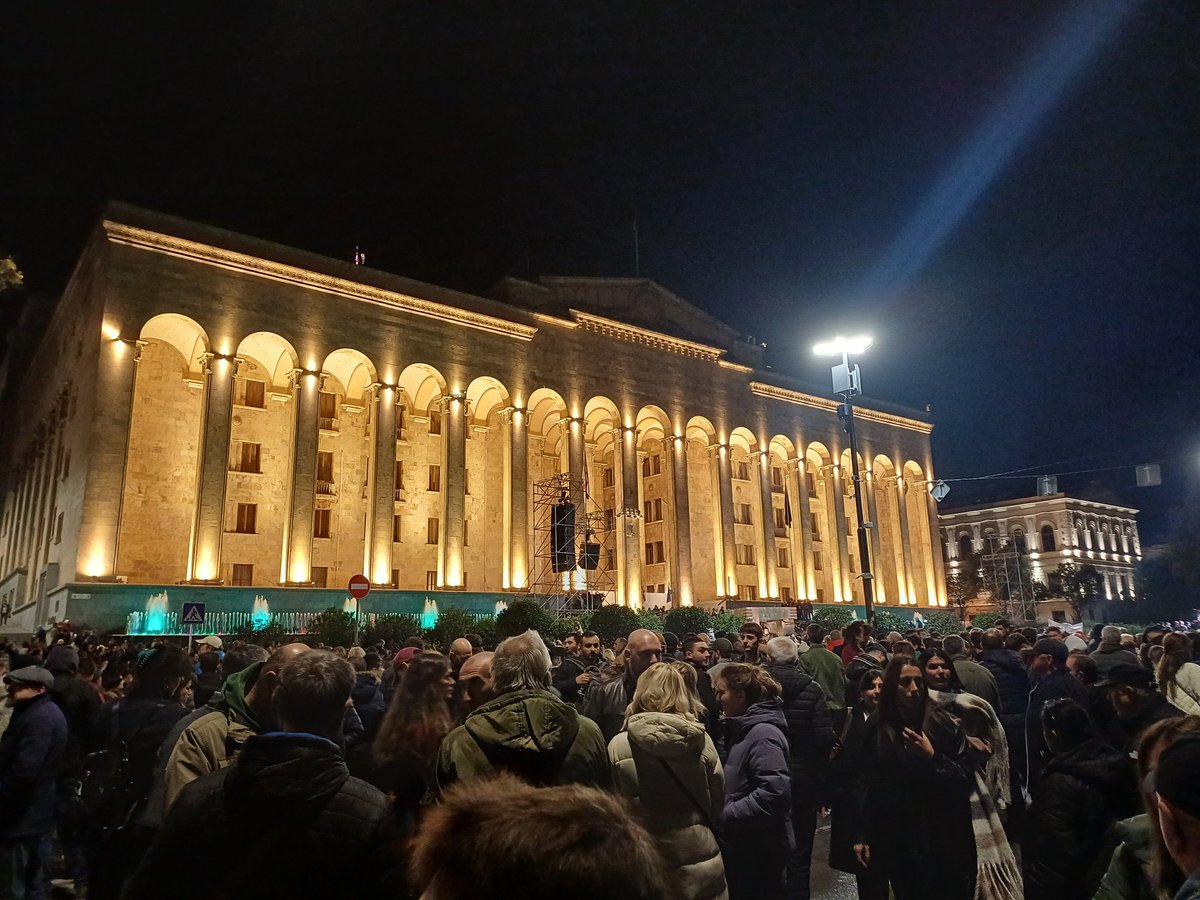
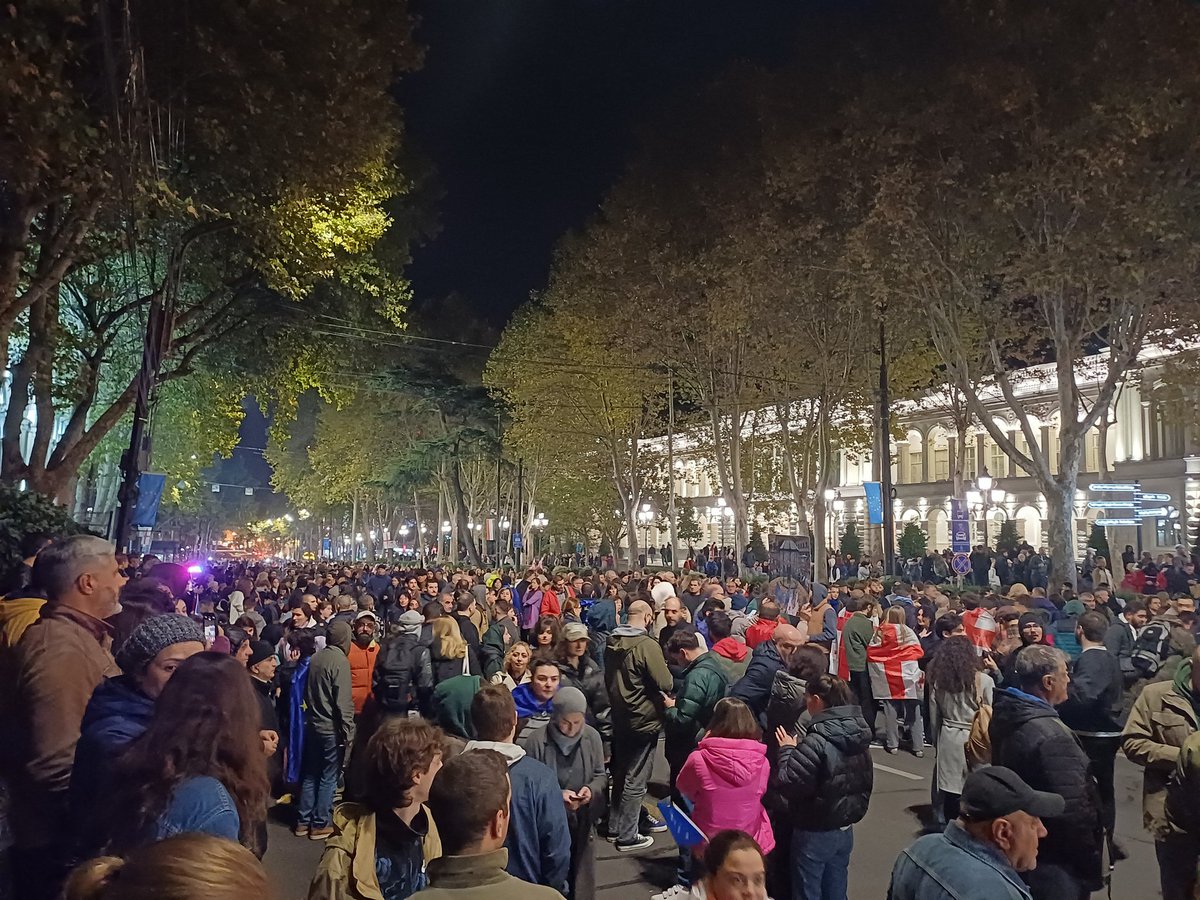
Protests starting up on Tbilisi's Rustaveli Ave, in front of Georgia's parliament building. Thousands here already for what promises to be a pivotal night in Georgian history.
“The cardinal error of the Germans who opposed Nazism was their failure to unite against it. At the crest of their popular strength, in July 1932, the National Socialists had attained but 37 per cent of the vote. But the 63 per cent of the German people who expressed their opposition to Hitler were much too divided and shortsighted to combine against a common danger which they must have known would overwhelm them unless they united, however temporarily, to stamp it out.” ―William Shirer, The Rise and Fall of the Third Reich: A History of Nazi Germany
“Hitler’s oratory moved people and appealed to their hopes and dreams. But his speeches malevolently twisted hope into some gnarled ghastly entities, and appealed to the latent, darkest prejudices of Germans.”—Richard Perloff
"'When mass dictatorship occurred in Russia, then in Italy, we said to one another, ‘That is what happens in backward countries. We are fortunate, for all our troubles, that it cannot happen here.’ But it did, worse even than elsewhere, and I think that all the explanations leave some mystery. When I think of it at all, I still say, with unbelief, ‘Germany—no, not Germany.‘" — Carl Hermann quoted in 'They Thought They Were Free: The Germans'
FRAUD IN GEORGIA
Although the overall statistical impression of the elections in Georgia was positive (https://t.co/yjNyYBjBjm) , the Devil, as usual, was in the details.
The respected Levan Kvirkvelia pointed out a discrepancy between urban and rural voting patterns.
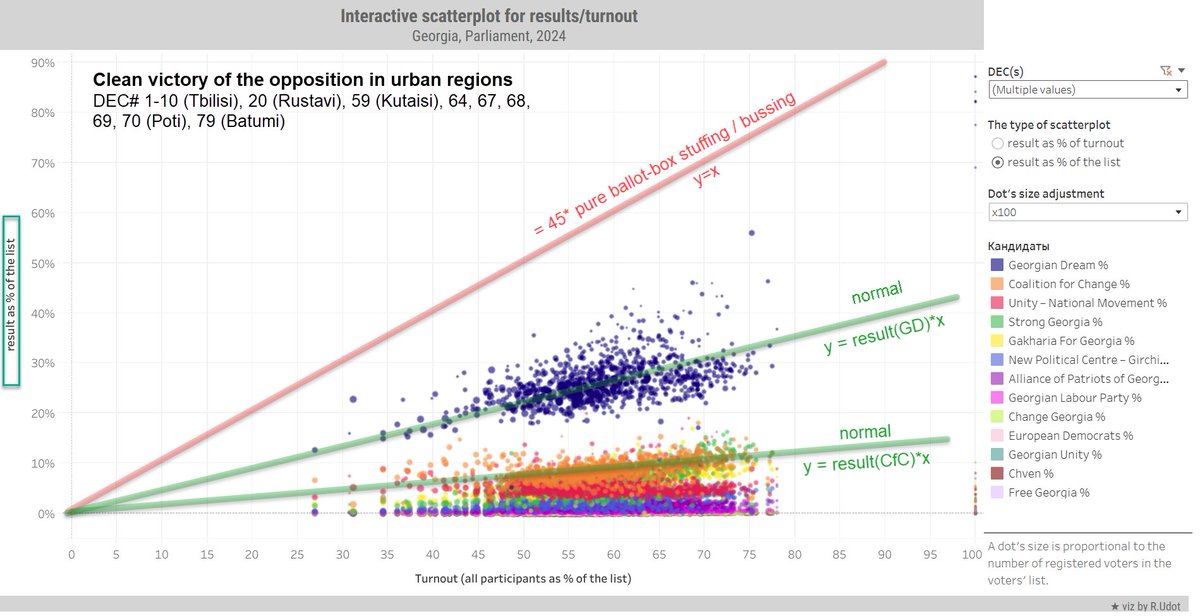
His observation was confirmed, indicating manipulations favouring the ruling party in specific districts, i.e. all except districts DEC 1-10 (Tbilisi), 20 (Rustavi), 59 (Kutaisi), 64, 67, 68, 69, 70 (Poti), and 79 (Batumi).
There is a method or hypothesis known as the Sobyanin-Sukhovolski's (S-S). For instance, you can find it mentioned here: https://t.co/kxujSNiaPE
According to this method, if we plot voting results on the following axes:
X-axis = turnout (number of voters / registered voter list)
Y-axis = candidate/party result (number of votes for the party / registered voter list)
we observe these patterns:
In fair voting, the slope of the point cluster aligns with the candidate’s percentage (if a candidate has 30% support in the population, then out of every 100 voters, 30 support the candidate, or y = 0.3 * x).
In cases of ballot stuffing, the slope of the cluster is 45° (out of every 100 stuffed ballots, all 100 are for the beneficiary of the fraud or y = x). For the victim, the slope is 0° (out of every 100 stuffed ballots, 0 is stuffed for the victim).
In the case of 'misrecording', when votes are not only stuffed in favour of the beneficiary of the fraud but are also added by taking them away from other parties, the slope becomes steeper, or y > x. For the victim, the slope is negative (they don't get any votes with the growth of the turnout, they lose them).
This pattern can be observed in the data from Georgia when dividing it into two groups:
Group 1: DEC 1-10 (Tbilisi), 20 (Rustavi), 59 (Kutaisi), 64, 67, 68, 69, 70 (Poti), 79 (Batumi).
Group 2: all other districts.
It is clear that the S-S hypothesis holds in Group 1 but not in Group 2. This discrepancy suggests a basis for suspecting fraud in Group 2, while no such grounds were observed in Group 1.
President Salome Zourabichvili has expressed frustration over her inability to contact Interior Minister Vakhtang Gomelauri as reports of voter intimidation and violence emerge from polling stations across Georgia. In a video address, the President reiterated her call for the police to respond swiftly, emphasizing the need for immediate action to prevent further unrest.
The British Sleep Society recommends abolishing the twice-yearly clock change and reinstating Standard Time throughout the year for better sleep and circadian health. 🕰️
Check out the full article here: https://t.co/hLamkj3zIw #SleepHealth#StandardTime @meganRDC
This woman voted in Moldova’s election on Sunday, then asked a surprised election monitor where she gets paid. So I decided to ask what she’d been promised…
The authorities believe Russia has been channeling-in money to buy votes: that Moscow has not ‘let go’ of #Moldova