@SlickWillay@Julio_Rosas11 Why TF does Mexico let this migration happen? What don’t they comprehend about the US electoral system and governance. No way no how will they get across the border even IF Dems get a leg up this midterm.
@LeoRosenboim@c14english@DBalazada Nobody believes this, nor does anyone believe that somehow they will get away with rapidly their weapons, nuclear or otherwise, without instant and devastating reprisal—not that anyone believes they are actually accomplishing this rebuilding as described above.
@333too3 I doubt this experience will change her mind—it's a trick of this ideology to shapeshift its way of staying front and center. She'll say something like "those were not the people I've supported."
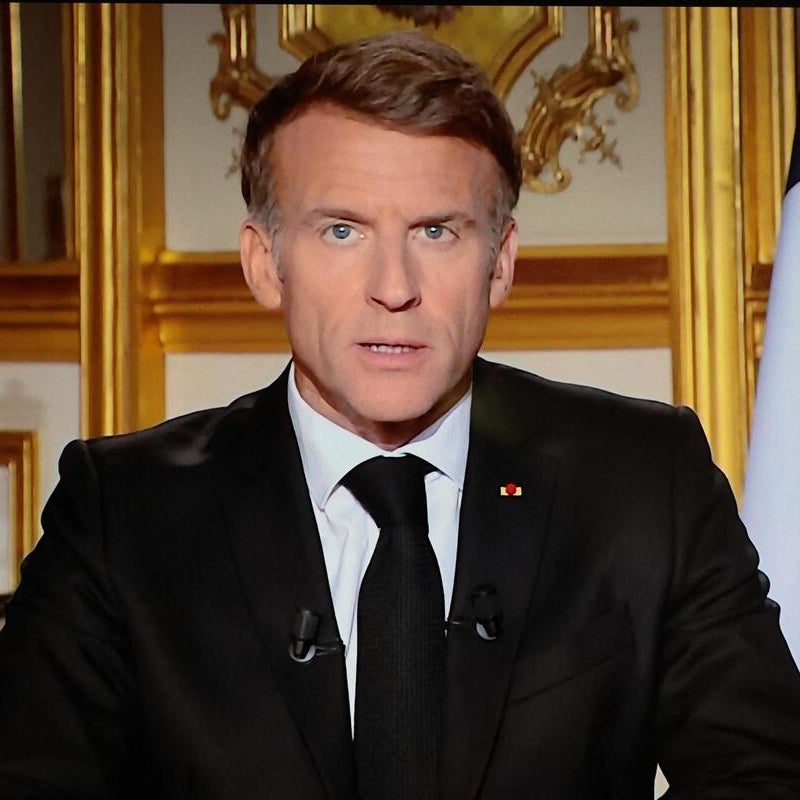
There's something fascinating about Macron, and a question that keeps coming back: is he cynical, or does he actually believe what he says?
My take: he believes it. And that's far more worrying.
Look at his path. His father was a neurology professor at a public hospital. His mother was a physician for the French social security system. His grandmother, a public school principal, partly raised him. Then the elite track: Henri-IV, Sciences Po, ENA (the school that trains France's top civil servants), the Finance Inspectorate, deputy chief of staff at the Élysée, Minister of the Economy, President.
From birth to power, he never really left the orbit of the State.
People will say: "He was a banker at Rothschild." Sure, for four years. But investment banking isn't entrepreneurship. You advise deals between large institutions. You don't risk your own capital. You never lie awake wondering how you'll make payroll. It's a world of networks, access and files. An extension of the high civil service, not its opposite.
He never started a company. Never hired anyone with his own money. Never watched a customer walk to a competitor. Never got a tax audit and wondered if his business would survive it.
For him, the reality of building something simply doesn't exist. It's not contempt. It's a blind spot.
The image that comes to mind is a beautifully machined gear, spinning perfectly, that doesn't mesh with anything. It spins in a vacuum.
His whole worldview works like that. Inside his world, everything is coherent. Every step follows logically. The reasoning is brilliant. But the axioms are wrong. And when you reason flawlessly from false premises, you reach false conclusions with flawless rigor.
The most interesting part is what happens when reality knocks on the door.
When you fail, you have two options. You can say: "I was wrong. What I've believed for fifteen or twenty years is false." That's brutal. It's an identity collapse. Or you keep the cognitive dissonance and explain the failure some other way: people didn't understand, we didn't explain it well enough, the reform didn't go far enough, the opposition blocked it.
It's the exact same mechanism as "that wasn't real communism." The model is never wrong. It just was never applied properly. Reality is wrong, the theory is right.
And meanwhile, the country burns.
That's why "cynical or disconnected?" is the right question. You can reason with a cynic. He follows his interests, so if you change his incentives, you change his behavior. A disconnected believer, you can't. Every failure becomes more proof that you need to push further in the same direction.
I think this explains much of the madness of European leadership. Not a bunch of villains plotting in a back room. Possibly sincere people, shaped in the same mold, raised on the same ideas, plugged into a system that is a flat denial of common sense. People so cut off from reality that their sincerity is what makes them dangerous.
Macron is the purest embodiment of it.
When you build a company, reality corrects you every single week. A customer who doesn't pay, a product that doesn't work, a competitor who moves faster. You don't get a choice: adapt or die.
The State never dies. It never gets the bill. And people who have only ever known the State end up believing reality is just one opinion among many.
The problem isn't that he lies. The problem is that he can't see.
My friends, here's the funny thing: we think we're living in a complex system.
They talk to us about multiple crises, multifactorial causes, endless "context." But step back, and the fight we're watching today is almost biblical in its simplicity.
It's the eternal fight. Freedom versus control. The individual versus the mass. The one who creates versus the one who confiscates. Capitalism versus communism.
And today, communism is infecting the West. Deeper in some countries than others, but everywhere. Not with tanks. Not with gulags. In a far more insidious way.
Antonio Gramsci understood this back in the 1930s, from a prison cell in Mussolini's Italy. The revolution had failed in the West because the people didn't want it. So he changed strategy: stop trying to seize power by force, and conquer the culture instead. Win the schools, the universities, the press, the arts. Impose your words, your assumptions, your morality. Make your ideas the "common sense" of the age. Once the culture is conquered, political power falls on its own, like ripe fruit.
In 1967, Rudi Dutschke gave it a slogan: the long march through the institutions.
Fifty years later, look at the result. The universities. The legacy media. The schools. The senior civil service. The NGOs. HR departments. A huge share of the institutions that govern our lives has been captured.
And yet the peoples never wanted this. They were never asked. And the one time they were asked, they said no.
That is the paradox of our time: entire nations governed by ideas their own peoples reject.
So look at the map. France. The United Kingdom. Germany. Sweden. Belgium. The Netherlands. Ireland. Canada. Different languages, different histories, different voters. The same chaos. The same paralysis. The same ruling class reciting the same catechism.
So stop looking for explanations everywhere. Stop looking for scapegoats. It's not the Jews' fault. It's not the boomers' fault. It's not the fault of the Muslim neighbor who works and raises his kids in peace. It's not the fault of the twenty-year-old who was never taught anything else.
Yes, some of them may be caught up in the effects of this system. Some may have benefited from it, voted for it, repeated its slogans. But never focus on the effects. Focus on the root cause. Attack the root cause, and the effects disappear on their own.
You don't cure a fever by fighting the thermometer. You cure it by killing the infection.
And the scapegoat is exactly the trap Marxism sets for us. Divide, designate a culprit, turn people against each other, so that everyone fights the symptoms and nobody touches the disease. Let's not hand them that gift.
The enemy is ideas. Marxism and all its offspring: class struggle turned into identity struggle, self-hatred turned into virtue, guilt turned into a political program. And the people who carry those ideas into power, we beat them on the very ground where they won: at the ballot box, in the institutions, in the culture. With votes, with arguments, with work. We take back what they took, institution by institution, exactly the way they did it.
In 1848, Marx ended his Manifesto with a call: "Workers of the world, unite!"
Today, I answer him:
Peoples of the West, unite.
Not against a people. Not against a religion. Against an idea that has already left tens of millions dead and now wants to finish the job on our soul.
And when we win, get ready.
Because what's waiting on the other side is an abundance the West has never known. AI, energy, science: we hold the most powerful tools in human history. The only thing holding us back is this mind virus that teaches us to be ashamed of succeeding.
The day it falls, everything comes back.
The return of merit. The return of courage. The return of hierarchy, the kind that rewards excellence instead of punishing it. The return of a society where the goal is no longer to complain about each other, but to impress each other.
We will build beautiful things again. The cathedrals of our time. Cities people actually want to live in. Works worth passing down. We will throw immense celebrations again, the celebrations of proud, joyful, living peoples who no longer need to apologize for existing.
But all of it goes through one thing: killing the disease that's eating us alive. Mental communism. The woke mind virus. Self-hatred dressed up as virtue.
Our ancestors built Athens, Rome, Chartres, the Renaissance, the Enlightenment, the Industrial Revolution, the conquest of space.
We will not be the generation that let it all go.
We will be the generation that took it all back.
You've probably seen the video. A young Frenchwoman in Paris, in tears, begging looters to stop. "Why are you doing this? That's not what we stand for."
Some accounts are mocking her. "She voted for it."
I won't. Because what you see on her face is not stupidity. It's a disease that has infected the entire West, and it has a name: suicidal empathy.
The term comes from Gad Saad, an evolutionary behavioral scientist at Concordia University in Montreal. A man who fled the Lebanese civil war as a child, and who knows what it looks like when a society falls apart. His new book, Suicidal Empathy: Dying to Be Kind, is the follow-up to The Parasitic Mind. Here is the thesis, and why it concerns every one of us.
Empathy is one of the best things about us. It evolved for a reason: to care for our children, our kin, our tribe. It was calibrated for a world where the people you felt for were the people around you, and where empathy always came paired with its counterweight: the instinct to protect your own and to recognize a threat.
Suicidal empathy is what happens when that mechanism misfires. When it fires at the wrong targets, in the wrong amounts, with no brake. When we feel more for the criminal than for his victim. More for the stranger who breaks the rules than for the citizen who follows them. More for how compassionate we look than for what our compassion actually produces.
Where does it come from? Four layers.
First, biology. Empathy is a spotlight, as the psychologist Paul Bloom put it. It lights up the one face in front of you and leaves everything else in the dark. The crying migrant on the boat is visible. The thousands of future victims of a broken system are statistics. A spotlight is a terrible tool for running a country.
Second, our own civilization. The West is the civilization that put the victim at the center of its morality. Christianity taught us to care for the stranger, the poor, the weak. It was one of the greatest moral revolutions in history. But cut off from its other half, justice, responsibility, the duty to protect your own, it turns into something else.
Third, ideology. In The Parasitic Mind, Saad described idea pathogens, ideas that hijack our reasoning. Suicidal empathy is the emotional counterpart: an ideology that hijacks our compassion. It sorts the world into oppressors and victims, then demands unlimited empathy for whoever ranks as the victim, whatever they do.
Fourth, status. In the age of social media, empathy has become a display. Posting "refugees welcome" costs nothing and earns applause. The bill goes to someone else: the working class, the suburbs, the women walking home at night.
The results are everywhere. Criminals treated as victims of society. Sexual assaults by migrants met with lenient sentences. Self-defense branded as aggression. Borders treated as cruelty. Saad's conclusion is simple: a society dies when it would rather display infinite tolerance than use its survival instinct.
Now the part I'll add myself, and that few people dare to say.
On average, women score higher than men on measures of empathy. It's one of the most consistent findings in psychology, across cultures, and it makes perfect evolutionary sense: for most of human history, the survival of children depended on it. It's a strength.
But it means an ideology that weaponizes empathy will hit women harder. And the data shows it: in country after country, young women have moved sharply to the left of young men, especially on immigration.
This is where men have a responsibility.
Not to mock. Not to lecture. Not to say "she deserved it." Empathy has always needed a counterweight, and that counterweight was the protective instinct: the one that draws lines, says no, and stands between the threat and the people it loves.
Men abandoned that role. They were told it was toxic, and many believed it. So they stayed silent at the dinner table, at work, with their partners, sisters, daughters and friends.
That has to end. Men have to have this conversation, honestly and with respect: compassion that cannot say no is not compassion. It's surrender. And the first to pay for it are women.
Many women already understand this better than anyone. Some of the bravest voices in this fight are women, precisely because they are the first to feel the danger in the street.
A civilization rests on a balance: compassion and strength, openness and borders, mercy and justice. When one side swallows the other, the foundations crack. What we are watching in Europe is what happens when empathy has no counterweight left.
Look at that young woman again. She isn't the enemy. She's what this ideology made of a generation that was told kindness would be enough.
Our job is to make sure she's the last generation that has to learn it this way.