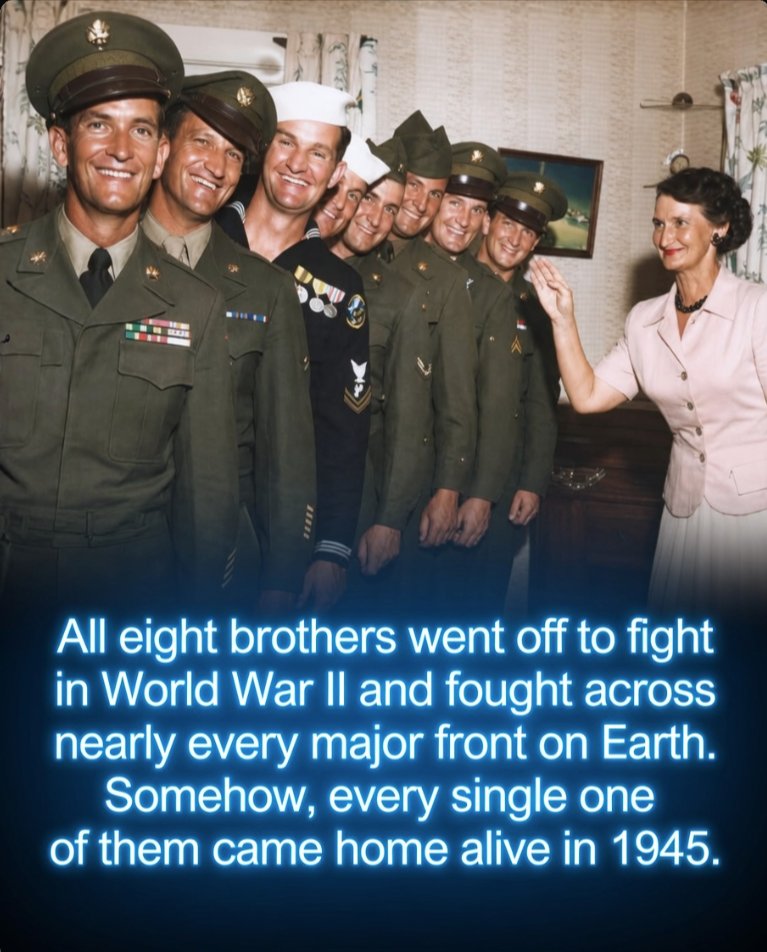
Eight brothers from the Fedele family of Rochester, New York, went off to fight in World War II. Against extraordinary odds, every single one returned home alive.
They served in the Army, Navy, Marines, and Army Air Forces. Their service took them across Africa, Europe, and the Pacific.
One brother survived the attack on Pearl Harbor. Another was wounded on Okinawa. One lived through a military training plane crash. Some of the brothers even crossed paths thousands of miles from home, with reunions in Africa and on Iwo Jima.
Their parents, Philip and Angelina Fedele, endured years of uncertainty while eight of their sons faced danger around the world.
In 1945 the unimaginable occurred. All eight brothers came home safely.
The story of the Fedele brothers remains a powerful reminder of courage, family bonds, and the remarkable fortune that brought every son home.
The Australian pink robin looks like a tiny ball of cotton candy
Native to southeastern Australia, this tiny bird is best known for its brilliant pink plumage and shy nature, often staying hidden in dense forests
Taken on April 8th, 2025
Screenshot of the magnificent tusker, One Ton taken at Ol Donyo Lodge in Kenya.
The Legend has recently passed of natural causes.
RIP old boy.
Taken on April 8th, 2025
Screenshot of the magnificent tusker, One Ton taken at Ol Donyo Lodge in Kenya.
The Legend has recently passed of natural causes.
RIP old boy.
Taken on April 8th, 2025
Screenshot of the magnificent tusker, One Ton taken at Ol Donyo Lodge in Kenya.
The Legend has recently passed of natural causes.
RIP old boy.
Few things feel more East African than a sundowner with friends, especially when elephants are nearby.
This #WorldGinDay, we’re raising a glass to Elephant Gin, whose support helps protect elephants, rangers, communities, and wild landscapes.
Maisha marefu! 🐘🍸
May 15, 1963.
Astronaut Gordon Cooper climbed into a capsule barely larger than a phone booth and launched into space aboard Faith 7.
The mission was simple on paper:
Orbit Earth 22 times.
Stay in space for a full day.
Come home alive.
For most of the flight, everything worked perfectly.
Then, on the 19th orbit, the warning lights came on.
First, a faulty sensor falsely reported reentry.
Then the electrical system failed.
One by one, the automated controls died.
Guidance system: dead.
Orientation system: dead.
Reentry calculations: dead.
At 165 miles above Earth, Gordon Cooper suddenly had no functioning instruments to bring him home.
And reentry is unforgiving.
Too shallow, and the capsule skips off the atmosphere into space forever.
Too steep, and friction turns it into a fireball.
The difference between life and death was fractions of a degree.
Mission Control could only watch.
So Cooper became the computer.
He drew reference marks on the capsule window with a pen.
He stared at the stars he had memorized before launch and used them to orient the spacecraft by eye.
He strapped a wristwatch to his arm and timed everything manually.
Then he did the math in his head.
No autopilot.
No navigation system.
No backup computer.
Just a man, a watch, and the stars.
At exactly the right second, Cooper fired the retrorockets manually.
The capsule dropped into Earth’s atmosphere.
For several minutes, communication vanished as plasma wrapped the spacecraft in fire.
Nobody on Earth could contact him.
Then the parachutes opened.
Faith 7 splashed down just 4.4 miles from the recovery ship USS Kearsarge — the most accurate splashdown of the entire Mercury program.
Later, Cooper described it simply:
“I used my wristwatch for time, my eyeballs out the window for attitude.”
That’s it.
In one of the most dangerous moments in early spaceflight history, a human being outperformed the machines.
We live in a world obsessed with automation and software.
But Gordon Cooper’s flight is a reminder that when everything breaks, the final backup system is still the human mind.
Calm under pressure.
Thinking clearly.
Making the call when nobody else can.
It was true in 1963.
It still is.
America knew him as the man who couldn't outsmart a pig. The Marines knew him as the man who drove into hell 47 times to bring them home.
For six seasons, Eddie Albert made millions laugh as Oliver Wendell Douglas on Green Acres — the eternally optimistic city lawyer hopelessly lost on a farm. He argued with tractors. He lost battles to chickens. Each week, he faced absurd defeat with unshakable dignity. The show climbed to number six in the ratings. He became a household name.
But two decades before Hooterville, Eddie Albert stood in the bloodstained waters of the Pacific, pulling dying men from the surf while machine-gun fire tore through the air around him.
November 20, 1943. Tarawa. Betio Island.
The assault became a massacre within minutes. Coral reefs trapped landing craft hundreds of yards offshore. Marines abandoned their boats and waded through chest-deep water in full combat gear — completely exposed. Japanese machine guns opened fire instantly. Men fell by the dozens. The wounded floated helplessly, too injured to move, waiting to drown or be executed by snipers.
Eddie Albert was a Navy lieutenant assigned to the USS Sheridan. His orders didn't include rescue operations.
He didn't wait for orders.
He commandeered a Higgins boat and drove straight into the gunfire.
Japanese forces fired from fortified pillboxes, destroyed vehicles, and the pier. Bullets punched through his hull. Water erupted in deadly geysers around him. Albert kept going. Trip after trip, he loaded wounded Marines onto his craft while enemy snipers tried to kill him. When his boat filled, he turned around and went back for more.
47 Marines. That's how many he personally pulled from death. He coordinated the rescue of 30 more.
The U.S. Navy awarded him the Bronze Star with Combat "V" — a medal reserved exclusively for valor under direct enemy fire.
Afterward, when people asked about Tarawa, he never spoke about himself. He only mentioned the men who didn't make it home.
After the war, Albert returned to acting. He earned an Oscar nomination in 1953 for Roman Holiday with Audrey Hepburn. He built a respected career in serious dramatic films throughout the 1950s and 60s.
Then in 1965, he made a decision that baffled Hollywood: he accepted the lead in a television sitcom about a lawyer who abandons New York City to become a farmer.
Green Acres became a cultural phenomenon. For six years, America watched Oliver Wendell Douglas lose every argument with rural logic, his wife, and a pig named Arnold. The show was absurd, surreal, and wildly popular. It ran 170 episodes before CBS cancelled it in 1971.
Most actors would have been typecast forever.
Not Albert. In 1972, he earned his second Oscar nomination for The Heartbreak Kid. He worked for three more decades. He became a passionate environmental activist, dedicating his later years to conservation causes.
Eddie Albert died in 2005 at age 99.
Here's what haunts me.
Millions watched him as a gentle, perpetually defeated optimist who couldn't keep chickens out of his living room. They laughed at a man who seemed permanently overwhelmed by life's absurdities.
They never knew that same man had driven a fragile boat into a hurricane of machine-gun fire — not once, but 47 times — refusing to leave until every wounded Marine within reach was safe.
Oliver Wendell Douglas never surrendered, no matter how impossible the odds. He stayed kind. He kept trying. He refused to quit even when everything screamed at him to stop.
Eddie Albert didn't need to study that character.
He'd already become him on the bloodiest beach of the Pacific War, when the only thing that mattered was bringing one more man home alive.
That wasn't acting.
That was his soul.
@NatureUnedited@KarenMarieHart There used to be a pelican that hung around the docks in West Palm Beach.
It would walk around begging for food.
Whenever a private fishing boat pulled in he would start limping as he walked to the boat.
People felt sorry for him and he got lots to eat then walk away wo the limp
I’m not sure if anything is going through. If anyone has any ideas how I can get things back id be grateful. I have so much art to put out and promote but I can’t access it . I’m miserable
Fabulous Art Deco period bathroom
@Rainmaker1973@aleolivieris The spot where three different worlds come together for one iconic photo.
The lioness appears to be chilling and enjoying her day at the beach.
Great photo Ale!