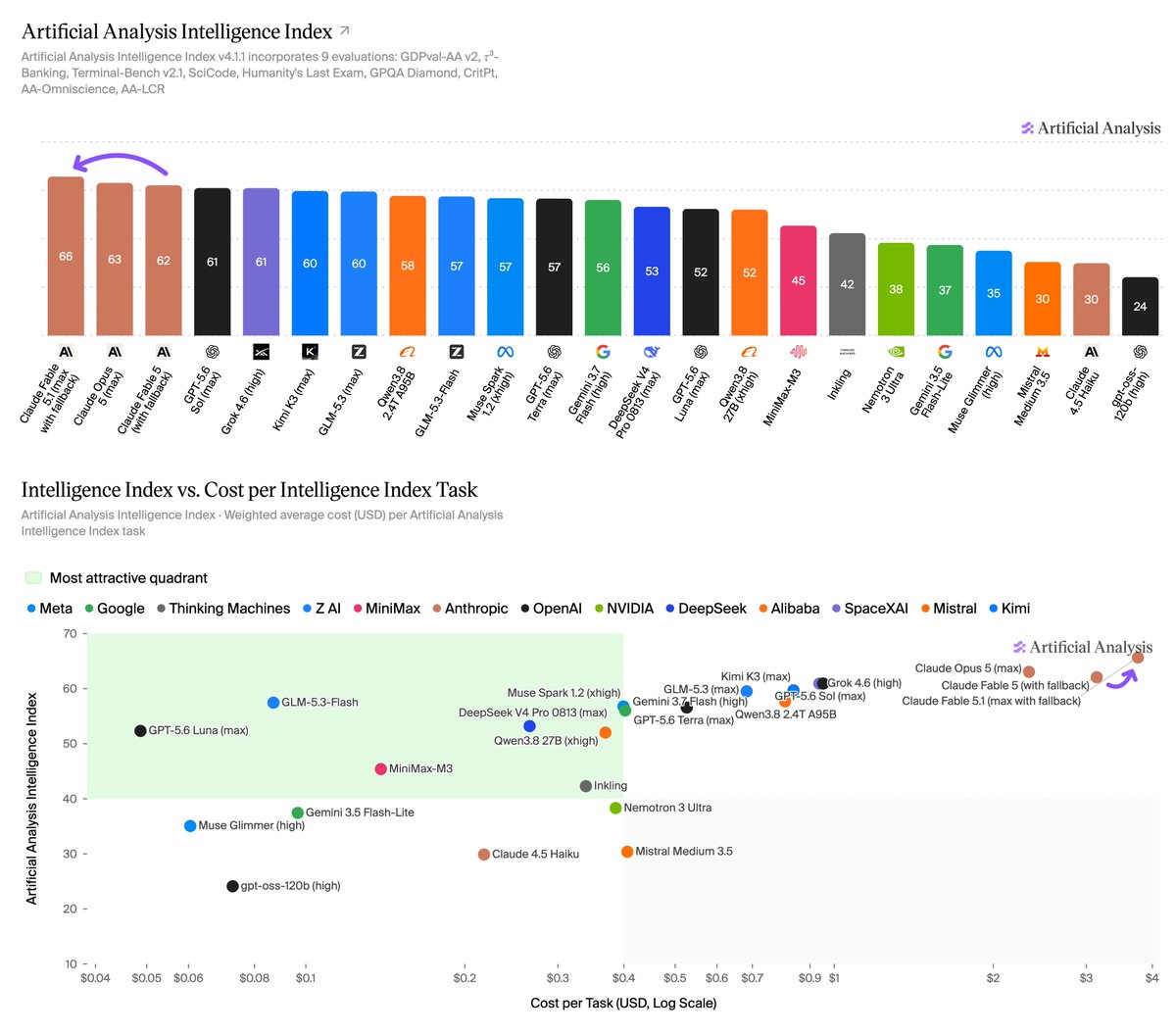
K2 Horizon 375B A23B, a new open weights model from UAE's MBZUAI, scores 47 on the Artificial Analysis Intelligence Index, with relatively strong agentic performance and a 30 point jump over its predecessor
K2 Horizon 375B A23B is an open weights Mixture-of-Experts model with 375B total and 23B active parameters from @IFM_MBZUAI, MBZUAI's Institute of Foundation Models. It scores 47 on the Intelligence Index, alongside models such as MiniMax-M3 (45, also a MoE with 23B active parameters), and a large upgrade from its predecessor K2 Think V2 (17, 70B dense model). It leads nearby open weights models on agentic evals and has a low hallucination rate, but trails on knowledge and the hardest reasoning evals. K2 Think V2 ranks among the most open models on our Openness Index; MBZUAI is updating the supporting documentation and code for K2 Horizon and we expect to add it to the Openness Index soon.
Key takeaways:
➤ Strong on agentic tasks, weaker on knowledge and deep reasoning. MiniMax-M3, a recent model that is close to it on the Intelligence Index, makes the cleanest comparison: K2 Horizon 375B A23B leads on GDPval-AA, our real-world knowledge work benchmark (Elo 1430 vs 1380), and on τ³-Banking (34.2% vs 15.3%), but trails on GPQA Diamond (87.3% vs 92.9%) and Humanity's Last Exam (32.0% vs 39.0%)
➤ Low hallucination rate, driven by abstention rather than knowledge. K2 Horizon 375B A23B attempts only 40% of AA-Omniscience questions, declining the remaining 60% rather than guessing. The result is a 26% hallucination rate, among the lower rates we have measured, while accuracy is 18%, essentially unchanged from K2 Think V2
➤ A new architecture over its predecessor. K2 Horizon 375B A23B is a 375B parameter Mixture-of-Experts model with 23B active, succeeding the 70B dense K2 Think V2, and extends context from 262K to 512K tokens. Its 23B active parameters match MiniMax-M3 (428B total, 23B active)
Key model details:
➤ Architecture: Mixture-of-Experts, 375B total parameters, 23B active
➤ Context window: 512K tokens
➤ Multimodality: Text input and output only
➤ Pricing and availability: Yet to be announced
➤ Licensing: Open weights (license details to be announced)
Exciting day for NVIDIA and @huggingface.
Open models strengthen safety and cybersecurity, accelerate innovation and diffusion, and enable sovereignty. They allow every developer, startup, university, industry and country to build with, customize and benefit from AI.
Thank you @ClementDelangue for coming to me.
NVIDIA is going to be a great home for Hugging Face, its community and the future of open models. 🤗
https://t.co/q8Om2Xc5ye
Five frontier drops in recent weeks. Two more loading.
Released:
• Anthropic - Fable 5.1 + Mythos 5.1
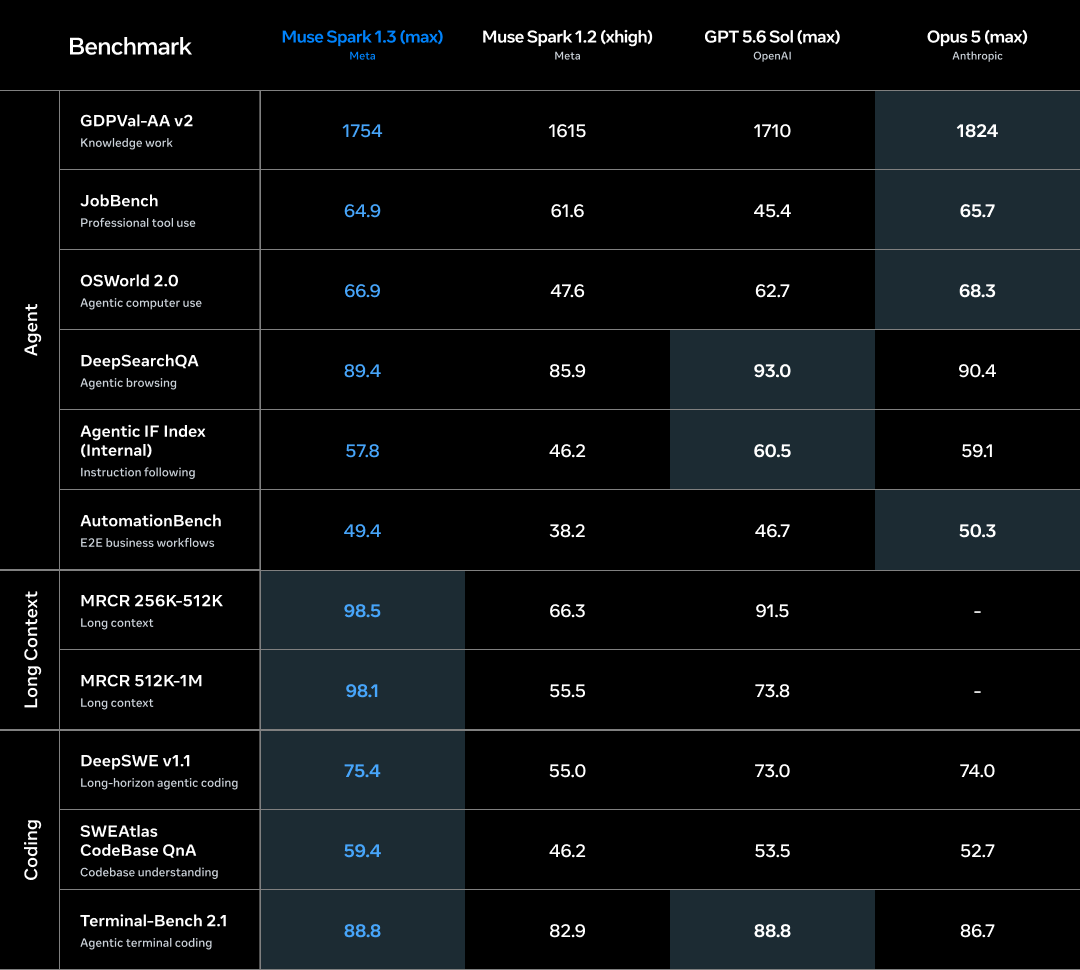
• Meta - Muse Spark 1.3
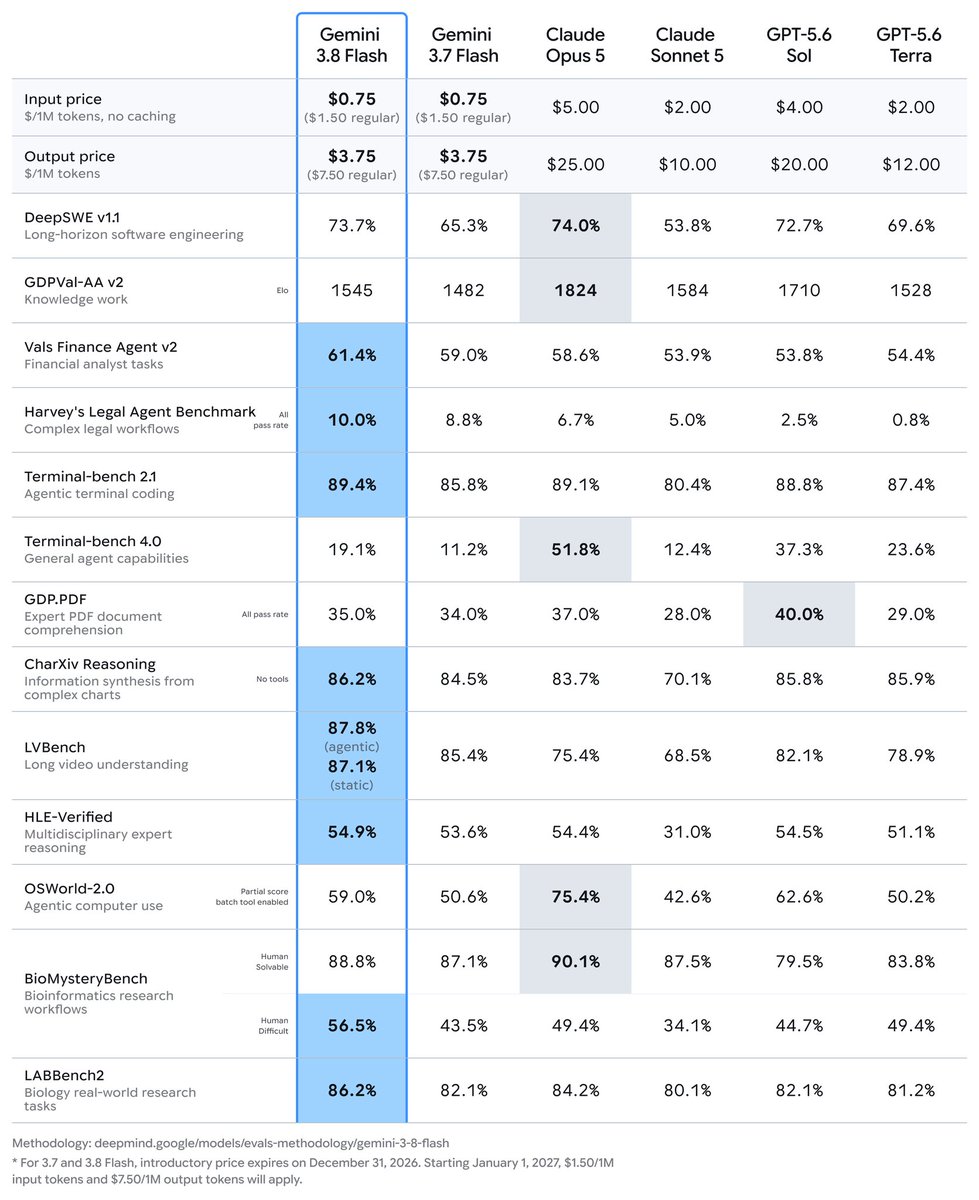
• Google - Gemini 3.8 Flash
• https://t.co/pMa7I3kyCy - GLM 5.3 Flash
Loading:
• OpenAI Astra - soon
• xAI Grok 4.7 - 10 days
September is going to be loud.
We’re excited to release Muse Spark 1.3 with improved performance on agentic and coding tasks, and a focus on real-world usability.
Key capabilities:
→ Sustains longer-horizon work across multiple workflows in a single thread
→ More actively collaborates with users: it asks clarifying questions, flags when it's stuck, confirms before consequential actions
→ Better calibrated on its own limits instead of hallucinating outcomes
→ ~20% fewer tool calls and ~25% fewer tokens vs. Muse Spark 1.2 in internal comparisons
Introducing Gemini 3.8 Flash, another jump in Gemini's agentic + coding capabilities, and our 3rd updated Flash model in only 6 weeks...
This model has been a ton of fun to work with, excited to see what you all think!
Introducing Atlas:
The world's first multimodal world model that generates image and video frames with pixel-perfect camera control and reconstructs them in 3D.
Model the world, move the camera, and simulate space & time.
Claude Fable 5.1 tops the Artificial Analysis Intelligence Index but costs 20% more per task than Fable 5 despite a 75% cache read price cut
We supported @AnthropicAI with pre-release evaluation of Claude Fable 5.1. At max effort it scores 66 on the Artificial Analysis Intelligence Index, the highest score we have measured, ahead of Claude Opus 5 (max, 63), Claude Fable 5 (max, 62), GPT-5.6 Sol (max, 61) and Grok 4.6 (high, 61). We evaluated the model with Anthropic's ‘default’ server-side fallback, which routes safety-flagged requests to Claude Opus 4.8 or Claude Opus 5; fallback served ~4% of output tokens across the Intelligence Index.
Key takeaways
➤ Frontier Intelligence with improvements across benchmarks: Fable 5.1 gains +4 points on the Intelligence Index over Fable 5. On HLE, Fable 5.1 scores 59.1%, ahead of the previous best of 55.5% from Claude Fable 5. It posts the narrowly highest scores we’ve seen on Terminal-Bench v2.1 (91.4%) and SciCode (62.0%), and on τ³-Banking it gains 9 points over Fable 5
➤ 75% cache read price cut, but Fable 5.1 still costs more per task: Anthropic has cut the cache read price from $1 to $0.25 per 1M cached input tokens, with standard pricing unchanged at $10/$50 per 1M input/output tokens. Fable 5.1 (max) costs $3.76 per Intelligence Index task, 20% more than Fable 5 (max), because it uses ~1.7x the output tokens. The cache cut saves ~$1.40 per task, concentrated in the agentic evaluations where the majority of input tokens are cache reads. At xhigh effort Fable 5.1 scores 65 at $2.72 per task, $1.04 less than max, but still above Claude Opus 5 (max, 63) at $2.34
➤ Claude Fable 5.1 holds the upper end of the Intelligence vs Output Tokens per Task Pareto frontier: every model variant scoring higher than GPT-5.6 Sol (medium) on the Intelligence Index is matched or beaten by a Fable 5.1 effort level on both intelligence and token usage
➤ Highest scores on agentic work tasks, but effectively tied with Opus 5: Fable 5.1 sets the highest scores we have measured on GDPval-AA v2 (1,853 Elo, +130 over Fable 5) and AA-Briefcase (1,694 Elo, +122 over Fable 5), our agentic knowledge work evaluations. Against Claude Opus 5 the GDPval-AA v2 lead is within the confidence interval and AA-Briefcase (1,685) is effectively tied, with Fable 5.1 ahead on analytical quality and rubric correctness, but behind on presentation
Other model details:
➤ Context window: 1 million tokens, supporting image and text inputs as with Anthropic’s other recent launches
➤ Pricing: Fable 5.1 retains the $10/$50/$12.5 input, output, and cache write prices per million tokens from Fable 5, but cache hits have been reduced to $0.25 per million tokens, a 75% relative reduction from before that will materially reduce agentic workload costs
Claude Fable 5.1 is now available in Cursor!
It's the most capable model we’ve run on CursorBench 3.2, scoring 73.4% at max effort.
We found it especially skilled at verifying its own work, allowing it to take on difficult coding tasks from start to finish.
use case: a Grok Bot that runs the front of my dad’s car finance and sales lot. We’re building the online inventory + finance app so buyers can browse cars, see EMI options, share a listing, and request a call. The bot’s actual job this week: take a buyer inquiry, pick the 3 cars that fit, generate the down payment / EMI / tenure, draft the follow-up message, and put tomorrow’s call list in a sheet before we open.
@clairevo@bot Best use case for me is my dad’s car marketplace.
When a customer messages us with a budget or a car they want, the bot picks the matching cars from stock, works out the EMI, replies to them, and writes tomorrow’s call list before the shop opens.
This week I would build a Grok Bot to help my dad’s car marketplace. When a customer messages us about budget, down payment, or a car they want, the bot would pick the suitable cars from inventory, gather the EMI and downpayment details, reply to them, and put the next day’s call list in a queue before we open.