My 9-year-old built a comic with AI this weekend.
Then he caught the AI's mistakes: a missing cape logo, a misplaced speech bubble.
He couldn't name one way AI fails before. Now he can.
Build with AI, and know when it's wrong. That's the real skill.
Reply BUILD for plan 👇
We’re opening early customer onboarding for FieldProof.
If your team manages field staff, site visits, inspections, maintenance, or project tracking, comment “FieldProof” or DM me for a walkthrough and early access.
https://t.co/1mPhBtdImg
From GPS tagged site proof to attendance tracking, session management, and watermarked documentation, the goal was simple.
Looking for feedback from operations teams, construction companies, facility management teams, and field service businesses.
Building with AI, GenAI, RAG, agents, or automation?
DM me “AI” or comment “INTERESTED” if you want help with product strategy, architecture, MVPs, or implementation.
Book a call: https://t.co/arVUA1yJmr
AI drafted the script. AI generated the voiceover. Code animated the scenes. I watched my own website become a 30 second cinematic walkthrough.
I built a pipeline that transforms simple app screenshots into branded 3D product videos.
Field photos aren't proof.
WhatsApp strips the location. Send-time isn't capture-time. Any photo can be edited after the fact.
So when a client disputes the invoice — it's your word vs theirs.
I'm building FieldProof to fix that. 👇
Your restaurant cameras are watching, but are they actually working for you?
We built an AI monitoring system where you simply tell it what to watch for, and it alerts you the moment something’s wrong.
Speak your rule. Set the severity. Get the alert. That’s it.
🎥 Demo video,
In case 1:
4.89 stars, 162 reviews > 5.0, 24 reviews
In case 2:
4.5 stars, 189 reviews > 4.9, 24 reviews
The statistical way to compare reviews is by using the lower bound of the Wilson score confidence interval for a Bernoulli parameter.
This evergreen post explains why:
THE GEN AI ARCHITECTURE STACK:
LLMs AND PROMPT LAYERS - The reasoning engine.
EMBEDDINGS AND VECTOR STORES - How knowledge is stored and compared.
RETRIEVAL PIPELINES RAG - Moving the right context at the right moment.
ORCHESTRATION AND GATEWAYS - Managing flow and choosing the right model.
AGENTS AND TOOL USE - Moving from conversation to action.
GUARDRails AND EVAL - Checking quality in a non deterministic world.
THE PRACTICAL SHIFT:
BUILD SOMETHING SMALL - A tiny RAG project shows real limits fast.
TREAT PROMPTS AS ARCHITECTURE - A prompt behaves like an API call with variable outputs.
TRY AGENTS - Let a model call a function and observe where it fails.
ADD OBSERVABILITY - You cannot debug an LLM like code, scoring and review loops matter.
Traditional software was built for certainty, predictable inputs, controlled logic, clear paths. Gen AI changes this. System behavior now depends on context, reasoning, and probability rather than fixed rules.
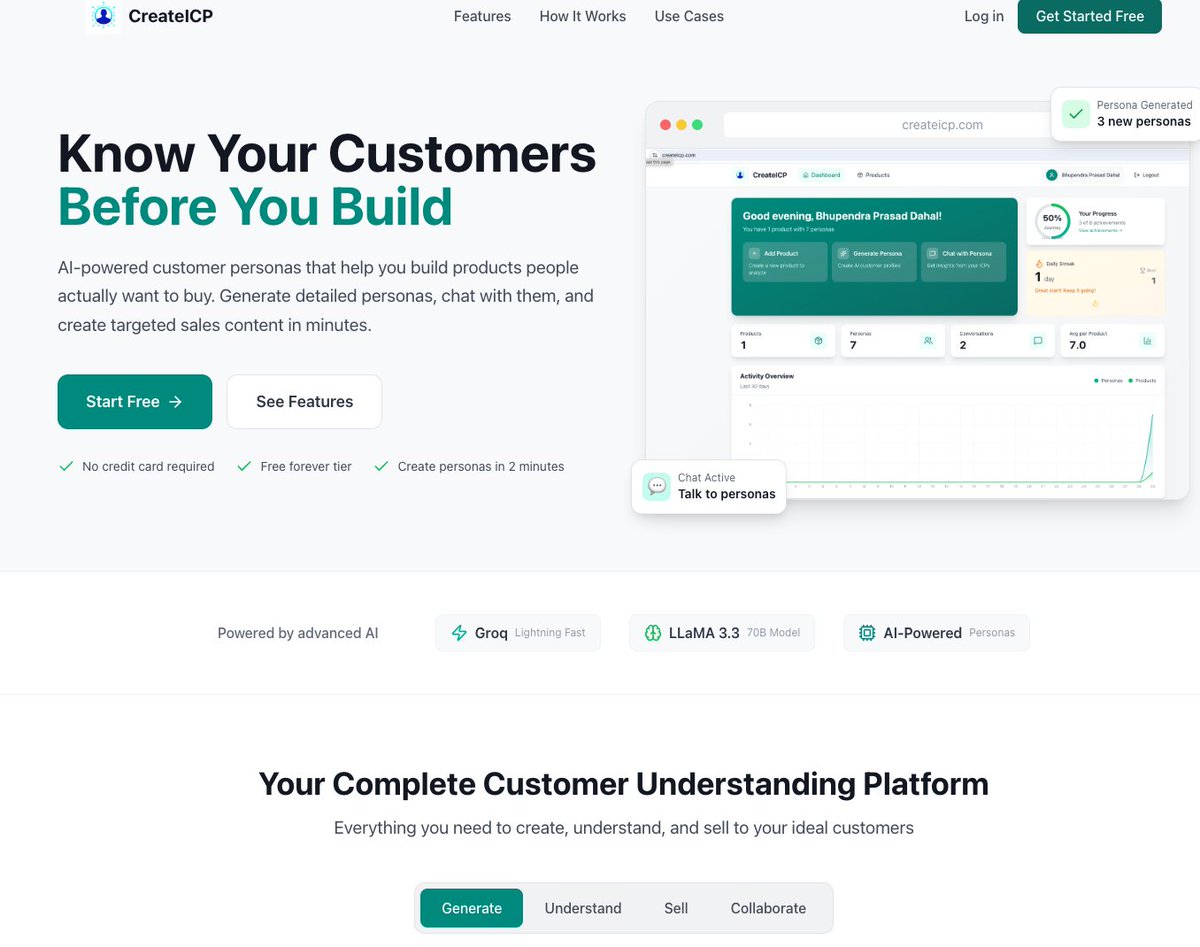
@theresanaiforit CreateICP gives you AI personas for your product and your competitors, then lets you compare them so you can shape your messaging, find gaps, and sell with more clarity.
https://t.co/vWmpunb7aq
Your competitors aren't just selling a product. They're selling to a persona.
Most businesses obsess over competitive features: "They have X, we need X too." But here's what they miss, understanding who your competitor is targeting and why their messaging resonates.
If you don't know your competitor's ideal customer better than they do, you're fighting blind.
That's why we built competitor persona generation into CreateICP.
Here's how it works:
1️⃣ Add your competitor's product
2️⃣ We generate their ideal customer personas (AI-powered, detailed)
3️⃣ Compare them side-by-side with your personas
Now you can see:
🎯 Where your audiences overlap (and where to differentiate)
🎯 Their customers' pain points (and how to address them better)
🎯 Messaging gaps you can exploit
Plus, you get:
✅ AI-generated email templates per persona
✅ Objection handling scripts
✅ Message resonance insights
✅ PDF exports for your team
Stop copying features. Start understanding customers better than your competition does.
Writing a book is turning out to be a very interesting journey for me. You think you understand a topic well and you can talk about it easily, but the moment you try to put it into a book everything changes. You suddenly realise you need more depth, more clarity, and a better way to explain ideas to the right audience.
It also requires careful research and a clear sense of balance. You need to decide what to include, how much detail to cover, and how to arrange everything so it is not too shallow and not too heavy. All of this has to flow in a proper sequence.
I just finished the first chapter and I am now editing the first draft. The process is enjoyable but also quite tiring at times. Still, it is giving me a strong learning curve and making me think in new ways about how to teach and communicate ideas.
If you have ever written a book or are in the process of writing one, would love to know how you handled this phase.
The current wave of AI coding tools still needs some work before they reach production grade for every use case, but they are already strong enough to help you build real apps for your daily work.
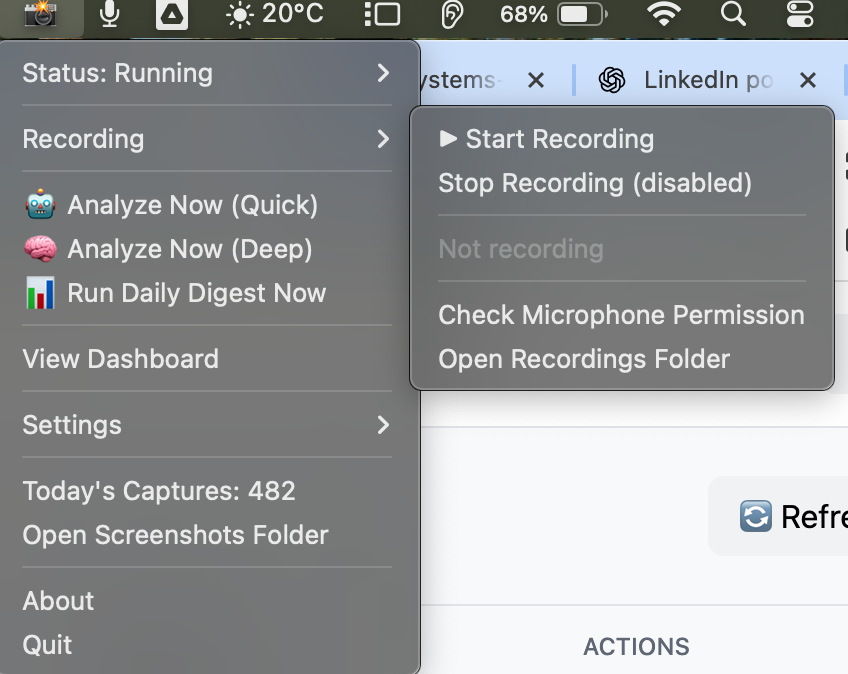
As an example, I recently created a recording app that captures a screenshot every sixty seconds and sends it to a vision model running on my own VM with a GPU. I then enhanced it to record my screen during meetings and generate summaries, action points, and key observations automatically.
This kind of rapid building was not possible for many of us a few years ago. The speed at which we can create and refine our own tools today is incredible.
If you are not experimenting with this new way of building, you might be missing out on one of the biggest shifts in personal productivity and software creation.