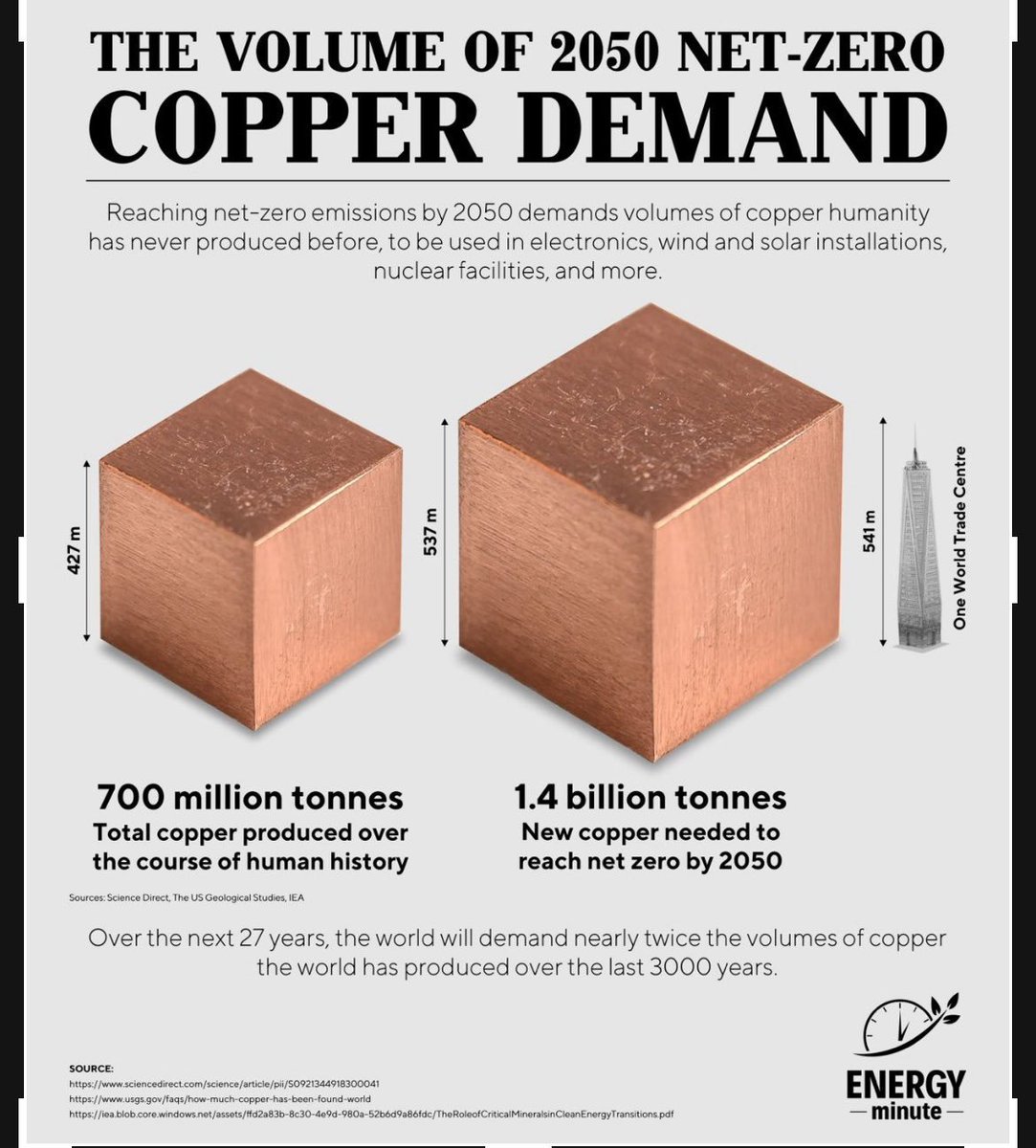
The world consumes roughly 28 million tonnes of copper every year—a mass equivalent to five Great Pyramids of Giza.
Yet that refined metal is just the tip of the iceberg of a far more monstrous physical reality. Beneath those 28 million tonnes of copper sits a massive geological footprint: billions of tonnes of blasted rock, colossal volumes of chemical tailings, vast energy expenditures and trillions of litres of water. This is all fresh, relentless demand.
Crucially, up to 75% of that copper never enters individual turbines, solar panels or electric vehicles. It goes into the invisible grid infrastructure required to link everything together and make it function. When you trace 28 million tonnes of copper backward into the Earth, the true scale and cost is staggering.
The drive to overhaul the global energy structure rests on a profound misunderstanding of physics: it treats energy supply as a 'software' problem while ignoring the devastating raw material gridlock caused by manufacturing billions of solar panels and over a million wind turbines, with hundreds of thousands more in the pipeline.
When an energy system shifts from reliable, high-density fuels—hydrocarbons and uranium—to low-density, intermittent sources like wind and solar, the physical apparatus needed to capture, convert, stabilise and transmit that diffuse flux just explodes.
It becomes an absurd trade-off: expending colossal amounts of finite, high-grade fossil fuels upfront simply to dig up materials for low-density generators—generators that can never run a steel mill, power an ocean cargo vessel or sustain international air travel.
Mining is already a vast consumer of continuous energy. As global copper ore grades decline—frequently dropping to 0.5% or lower—the mass of rock that must be dug, hauled, and crushed grows exponentially per unit of recovered metal.
Crushing rock alone accounts for roughly 3% to 4% of total global electricity consumption. Demanding billions of additional tonnes of processed metal creates a self-defeating loop: huge volumes of reliable, baseline power are consumed just to extract the raw materials needed to construct weather-dependent hardware.
Yet the primary metals drain does not come from the turbines or arrays themselves. It stems from the enormous physical web needed to transport that energy across vast distances. Diffuse generators located hundreds of kilometres from cities require unprecedented volumes of step-up transformers, substations, high-voltage transmission lines and regional grid overhauls.
The heavy overhead wiring looping across the landscape regularly dwarfs the metal required to build the turbine in the first place. Because two centuries of industrial civilisation have already extracted the highest-grade deposits, meeting future demand forces miners to dig deeper, crush harder and manage billions of tonnes of toxic slurry.
This is a twin crisis: the escalating physical cost of ore recovery on the front end, and an unprecedented tsunami of industrial e-waste bound for landfills on the back end. The physical limits of this model are not dictated by how much metal remains in the crust, but by the soaring energy penalty required to dig them up and refine them.
Heavy industrial processes—blast furnaces, chemical synthesis, cement production and deep-shaft mining—all need continuous, high-temperature thermal energy and uninterrupted high-voltage power. Intermittent turbines and panels cannot reliably deliver that dense power to sustain heavy industry, let alone an entire national economy.
The ultimate irony is that the staggering industrial muscle needed to build, maintain, and periodically replace these diffuse energy systems relies entirely on the coal, oil and gas they were meant to replace.
The dream of a fully weather-dependent industrial grid ignores physical reality. It overlooks a looming nightmare of endless ore extraction, refining bottlenecks, and perpetual grid expansion.
"If we really did 'just stop oil', hundreds of millions could be dead or dying within five years. Without fossil fuels to make fertiliser, food production collapses – and then the real chaos begins."
@RichardLyon_ on the Sceptic.
Full episode 👇
The world has spent $7 trillion on wind and solar. That global fleet produces an average of around 630 GW.
The same $7 trillion could have built roughly 1,400 modern nuclear reactors, producing around 1,400 GW on average -- so more than twice the power.
Wind and solar generally last around 20 years (a lot less by some estimates), whereas nuclear plants can operate for 80 years or more.
Over 80 years, wind and solar must be built four times -- a cost of $28 trillion to maintain 630 gigawatts.
The same $28 trillion spent on nuclear would deliver roughly 5,600 gigawatts -- nearly nine times the power.
Also, nuclear produces this regardless of the weather, whereas wind and solar require 24-7 backup (usually gas, not included in these calculations).
Summer has failed to arrive in the High Arctic.
Danish Meteorological Institute data show June 2026 averaged -2.2C (28F), by far the coldest June in record books extending back to 1958.
And the cold continued through July.
By July 27, the monthly mean stood at just 0.01C, effectively freezing. Temperatures repeatedly fell below 0C during what should be the warmest part of the Arctic year, when readings normally climb to 2C or higher.
A review of the DMI archive reveals no colder summer run, with 2026 tracking at the bottom of the entire 69-year series.
While headlines warn of an overheating Arctic, the region north of 80N has been the coldest we've ever known it in archives dating back to 1958.
𝗠𝗲𝘁 𝗢𝗳𝗳𝗶𝗰𝗲 𝗥𝗲𝗺𝗮𝗶𝗻 𝗦𝗶𝗹𝗲𝗻𝘁 𝗔𝗯𝗼𝘂𝘁 𝗧𝗵𝗲𝗶𝗿 𝗢𝘄𝗻 𝗥𝗲𝘀𝗲𝗮𝗿𝗰𝗵 𝗧𝗵𝗮𝘁 𝗨𝗻𝗱𝗲𝗿𝗺𝗶𝗻𝗲𝘀 𝗧𝗵𝗲𝗶𝗿 𝗔𝗴𝗲𝗻𝗱𝗮
The Met Office is staying silent on their own research showing Europe's hot summers are driven by reduced aerosol emissions, not greenhouse gases from fossil fuels.
Their Hadley Centre scientist co-authored the paper, but the agency has ignored it on their site and feeds for weeks.
This directly clashes with their claims that human-induced warming caused thousands of recent heat deaths.
Why the blackout?
Read the full article:
https://t.co/4CLv5cTIcU
Daily Telegraph covers the proximal origin scandal well:
The messages that show Covid scientists secretly suspected a lab leak
Authors of influential Nature Medicine paper privately admitted ‘we can’t rule it out’
Sarah Knapton Science Editor. Eric Williams News Reporter
Published 24 July 2026 6:00am BST
1600
Scientists who were instrumental in shutting down the Covid lab-leak theory admitted in private “we can’t rule it out”, newly released messages show.
In March 2020, a group of influential virologists published a paper in the journal Nature Medicine arguing that an animal spillover event probably caused the pandemic.
The article, known as “The Proximal Origin of Covid”, concluded “we do not believe any type of laboratory-based scenario is plausible” and was hugely persuasive in stifling debate globally.
But messages obtained and published by US senator Rand Paul show that behind the scenes the scientists voiced concerns that the Wuhan Institute of Virology (WIV) had been carrying out experiments on coronaviruses at insufficient biosecurity levels.
The virus emerged eight miles from WIV laboratories and was seemingly pre-adapted to infect humans.
Three months after the paper was published, one of the authors, Prof Kristian Andersen, of the Scripps Institute, California, wrote on Slack, the communication platform: “At the end of the day, we really don’t have any hard evidence one way or the other – and especially given some of the recent evidence, we also can’t rule out that somebody actually put it in there.
“That’s obviously not to say that somebody ‘did’ but we can’t rule it out. Our paper was pretty strong in saying ‘there’s no way’, but I have less confidence in that statement at this stage.”
In the Nature Medicine paper, the authors had argued that bat coronavirus manipulation was carried out across the world, so it was unfair to point the finger at WIV, but Prof Andersen privately admitted that was not the case.
“That isn’t true, it has exclusively been going at WIV,” he wrote, adding that he believed both a natural and a lab-origin scenario were “equally probable”.
He also warned that the paper had claimed manipulation of viruses was hard, and that the virus could not emerge through cell evolution experiments. But he said both those arguments had been proven untrue.
Prof Andersen said that a lab leak was 30 per cent likely while co-author Prof Eddie Holmes of the University of Sydney put the probability at between 10 and 20 per cent.
Viscount Ridley, the author of Viral: The Search for the Origin of Covid-19, said: “These messages confirm that the Proximal Origins authors continued to believe a lab leak was possible.
“So why did they not correct or retract the paper that misled the world?”
The messages also reveal that authors were aware that Dr Shi – the lead bat virus scientist at WIV – was herself worried that Covid had been caused by a lab accident.
In September 2021, it emerged that before the pandemic Dr Shi had applied for a grant to insert a furin cleavage site (FCS) into bat coronaviruses – the very addition that made Covid-19 so infectious to humans.
Although the US Defense Advanced Research Projects Agency dismissed the grant because it was too dangerous, Slack messages showed that scientists feared the work had gone ahead anyway.
Prof Andrew Rambaut of Edinburgh University wrote that “it isn’t beyond plausibility that someone went ahead and tried some of this stuff”, adding, “We just need to re-convince ourself it is coincidence.”
Prof Holmes added that it was “striking” that a bat-derived coronavirus with a furin cleavage site turned up in a city with a lab “proposing to muck around” with FCSs in bat coronaviruses.
WIV planned the bat research in collaboration with EcoHealth Alliance, founded by British zoologist Peter Daszak and the American virologist Dr Ralph Baric of the University of North Carolina.
Prof Rambaut told his co-authors they would need to talk about the “Baric/Daszak s---show” and come up with a strategy “so we don’t get associated with these f---ers”.
He also warned colleagues to “stay off email” or “carefully curate some emails” in case of Freedom of Information requests.
Although the virologists claimed publicly that most scientists agreed on a natural origin for the pandemic, privately they admitted this was not the case.
Prof Andersen said he had been “pretty surprised” to learn that “most scientists I talk to believe there is a likely connection to the lab”.
Prof Richard Ebright, a molecular biologist at Rutgers University, who has called for a lab leak scenario to be fully investigated, said: “The claim repeated literally thousands of times by journalists that most scientists favour a natural origin of Covid and oppose a lab origin of Covid always was a lie.
“And almost always was a deliberate lie.”
The scientists were also dismissive about journalists, politicians, commentators and other experts who supported a lab leak theory, calling them “idiots” “tw--s” “clueless” “deranged” and “morons”, making up disparaging nicknames for experts.
Senator Paul said: “Behind closed doors, the scientists who authored the Proximal Origin paper privately questioned their own conclusions.
“Publicly, however, they shamed, attacked, and censored those who raised legitimate questions – all in the name of damage control.
“We deserve accountability for every effort to keep the public in the dark.”
The Telegraph has approached the scientists for comments.
The 1970s Ice Age scare was very much real.
In 1971, NASA scientists Rasool & Schneider warned in Science that rising air pollution could cool the planet by up to 3.5C. Enough, they said, to trigger an Ice Age.
Three years later, Time magazine ran its famous "Another Ice Age" article, noting three decades of global cooling.
The New York Times and Boston Globe echoed the same fear, that pollution could obliterate the sun and freeze the northern hemisphere.
The Ice Age scare wasn't a myth. It was mainstream.
Even Leonard Nimoy narrated a 1978 TV documentary called In Search of the Coming Ice Age, warning that global cooling could devastate civilization.
The same institutions now predicting catastrophic warming once told of a looming crippling freeze.
𝗖𝗮𝘃𝗲 𝗗𝗶𝘀𝗰𝗼𝘃𝗲𝗿𝘆 𝗥𝗲𝘃𝗲𝗮𝗹𝘀 𝗧𝗼𝗱𝗮𝘆’𝘀 𝗗𝗲𝘀𝗲𝗿𝘁 𝗖𝗹𝗶𝗺𝗮𝘁𝗲𝘀 𝗪𝗲𝗿𝗲 𝗥𝗲𝗰𝗲𝗻𝘁𝗹𝘆 𝗙𝗮𝗿 𝗪𝗮𝗿𝗺𝗲𝗿, 𝗪𝗲𝘁𝘁𝗲𝗿, 𝗧𝗲𝗲𝗺𝗶𝗻𝗴 𝗪𝗶𝘁𝗵 𝗟𝗶𝗳𝗲
Deserts like Fuerteventura were up to 7°C warmer and wetter just 9,000 years ago, teeming with water birds and forests where now there's only sand.
This cave find smashes the idea that our climate is spiraling into uncharted territory.
How did a lush paradise turn into a barren wasteland? The answers are eye-opening.
Read the full article:
https://t.co/Ji9E34ZGxZ
This is why we need to ditch the word "renewable". Wind and solar hide behind the word pretending to be useful when they are defined by being "unreliable". Hydro and biomass have major and economic and environmental problems but at least they are reliable and don't need back-up.
"When the climate science community chose to organize itself as a political movement behind a charismatic preacher, that helped turn many institutions of climate science into what Barkun described as part of the “New Apocalypticism” — a secular eschatology, in which science exists not to advance understandings in all of their complexities, but instead to confirm Manichean belief."
𝗔𝗻 𝗜𝗻𝗰𝗼𝗻𝘃𝗲𝗻𝗶𝗲𝗻𝘁 𝗧𝗿𝗲𝗲: 𝗨𝗻𝗰𝗼𝘃𝗲𝗿𝗲𝗱 𝗜𝗻 𝗔𝗹𝗽𝘀… 𝗘𝘂𝗿𝗼𝗽𝗲 𝗠𝘂𝗰𝗵 𝗪𝗮𝗿𝗺𝗲𝗿 𝗧𝗵𝗮𝗻 𝗧𝗼𝗱𝗮𝘆 𝟲𝟬𝟬𝟬 𝗬𝗲𝗮𝗿𝘀 𝗔𝗴𝗼
A massive tree log unearthed in the Alps dates back 6,000 years and proves Europe was warmer then than today—yet no such trees grow there now because it's too cold. This single find smashes the myth that human activity is the only driver of climate change. Why are alarmists ignoring history's natural cycles? Dive into the debate.
Read the full article:
https://t.co/TxmD6CCKnG
People sometimes claim that I am motivated to champion the lab leak theory of Covid origin by financial interest because I co-wrote a book about it.
But in the book we covered both sides of the debate.
And publishers paid me less for that book than any other I have written in decades.
I then halved that by sharing the authorship with @Ayjchan.
And I gave half of the remaining proceeds away to charity.
If money was my motivation I would never have written that book.
But if they really think money is such a motivator perhaps they could look into the far larger grants that those opposing the lab leak have received, and reflect on how those would have been at risk if they had gone against Anthony Fauci's insistence that the lab leak is a conspiracy theory.
Yes, the implications are yet to sink in.
Open the bleeding windows in hospitals and schools.
Meet outdoors where possible.
Never lock people in their homes again.
Freedom can also be lost little by little, by what the Fabians call the doctrine of gradualness. A little more taxation here, a little more government expenditure there, year after year until the people are no longer the masters of the state but its servants.
There are always, it seems, good reasons advanced for the state to have more power. But rarely for the state to divest itself of power.
Each new problem becomes an excuse for more government intervention and less individual responsibility.
𝗖𝗵𝗮𝘀𝗶𝗻𝗴 𝗧𝗵𝗲 𝗘𝗹𝘂𝘀𝗶𝘃𝗲 𝗖𝗹𝗶𝗺𝗮𝘁𝗲 𝗦𝗲𝗻𝘀𝗶𝘁𝗶𝘃𝗶𝘁𝘆
While the IPCC insists doubling CO2 could warm the planet by 3°C, Willis Eschenbach's crunch of satellite data shows it's likely just 0.76°C. That's a fraction of what they've been claiming! How does real-world evidence flip the script? You need to see this.
Read the full article:
https://t.co/BgKdyYNpRd
Remember “telegraph global health security” is a team of non journalists paying to place propaganda in the mainstream media for gates foundation and WHO.
Here they support a flimsy attempt to find support for China’s popsicle origin theory in a single social media post!