🎉 Our paper “BluRef: Unsupervised Image Deblurring with Dense Matching References” has been accepted to #CVPR2026!
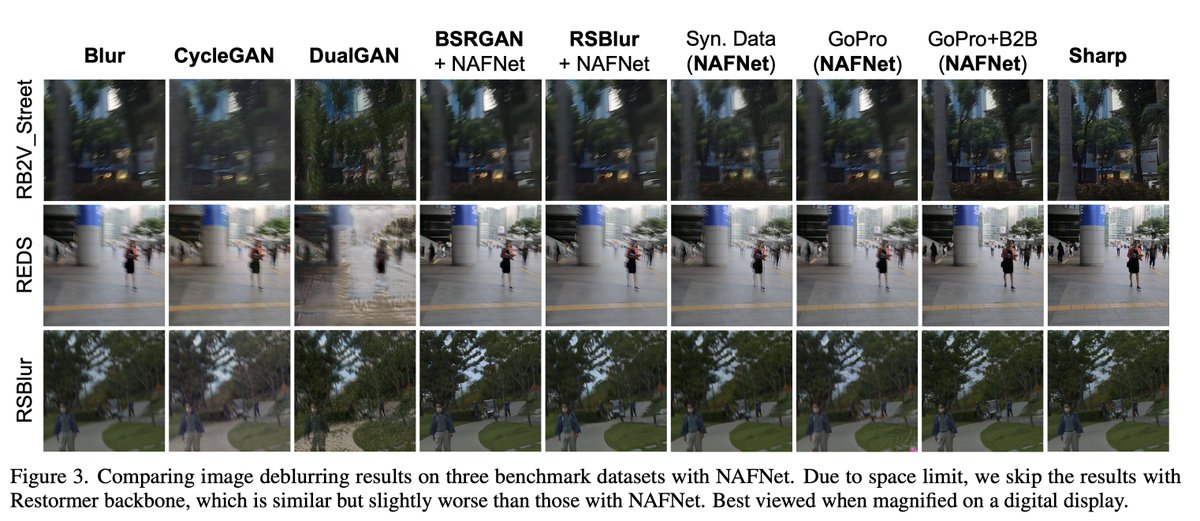
We introduce an unsupervised deblurring approach that learns directly from unpaired blurry and reference images within the target domain.
📌 Paper coming soon!
🚀 HPC-AI is heading to #CVPR2026! Find us at Booth 237 from June 3–7! Whether you're building AI Agents or hunting for top-tier compute, we’ve got you covered.
🎁 The Ultimate CVPR Swag & Perks:
1️⃣ Limited Swag: Grab custom caps, canvas bags 🧢 🛍️
2️⃣ Top-up Reward: 💰$15 = GPU Hour + Model APIs + Summer mini-fans / Bluetooth speaker (Only 20 set)🔥
3️⃣ Accepted Author Special: Top up $40 Get $20 voucher 💰
4️⃣ Survey Gift: Just do a quick survey, choose your refrigerator magnets 🧲
Stop by, talk tech, and claim your rewards! 🤝
📍 Booth 237 | June 3–7 | Colorado Convention Center
#CVPR2026 #HPCAI #AI #MachineLearning #GPU #ModelAPIs
Everyone in deblurring agrees on one rule: high quality results require paired blurry and sharp images for training.
WE BROKE THAT RULE. And beat the supervised baseline anyway.
🚨 BluRef (CVPR 2026 - Main Track)
First truly reference-based unsupervised method
How we did it 👇
(2/n) At test time? Standard single-pass network. No references. No extra inference cost.
And the pseudo-GT we generate is architecture-agnostic — same data trains NAFNet, Restormer, or a tiny mobile model.
Most unsup methods can't say that.
(1/n) Forget pairs. Just grab a few unpaired sharp shots near your blurry one (different time, different angle, doesn't matter). A dense-matching model finds pixel-level correspondences → instant pseudo-sharp targets. Then we iterate: deblurrer + pseudo-GT co-evolve every epoch
You can now give your agent deep knowledge of millions of papers in one line with #paperclip!📎
>8 million papers natively indexed for agents.
Much more thorough + often 10x faster than standard deep research.
Just add the paperclip mcp (instruction below).
@mengweir Hi Mengwei, I’ve sent my resume via email. My work aligns closely with your projects, and I’m hopeful for an opportunity to collaborate with your team! Thank you
⚡ Ray Tracing + 3D Gaussians = New Possibilities!
Gaussian splatting is limited by rasterization—our #SIGGRAPHAsia2024 paper shows how to ray trace instead, enabling reflections, shadows, fisheye cameras, and more. The most important (and hardest!) part is making it fast. (1/N)
I know it’s a bit late, but I wanted to share that I’m attending #CVPR 2024 in Seattle. Here’s a video of our performance at Pike Place Market, captured on a mobile phone today. For more, visit my poster session.
Code & Paper: https://t.co/rNDtGnDrqG
Blur2Blur converts images from an unknown blur into a known blur. This version retains the original content while applying a different blur kernel that has been effectively trained and captured by supervision deblurring models.
Paper: Blur Conversion for Unsupervised Image Deblurring on Unknown Domains
Link: https://t.co/nyFCJmdDKj
Project: https://t.co/aAeTm1ZFq8
#AI #AI美女 #LLMs #deeplearning
@ducha_aiki Thank you for sharing, @ducha_aiki! 😊 For more detailed insights and qualitative results from our work, feel free to explore here: https://t.co/rNDtGnCTB8
Blur2Blur: Blur Conversion for Unsupervised Image Deblurring on Unknown Domains
Bang-Dang Pham, Phong Tran, Anh Tran, Cuong Pham, Rang Nguyen, Minh Hoai
tl;dr: you first convert blurred image to another, "canonical" blurred image, and then deblur. Wow.
https://t.co/QcOL4H57Mm
A bit late to share my work, "Blur2Blur: Blur Conversion for Unsupervised Image Deblurring on Unknown Domains," has been accepted to #CVPR2024 🥰 This paper addresses the challenge of Unsupervised Truly Blind Image Deblurring for specific cameras.
Page: https://t.co/rNDtGnCTB8