@TakingHisTime@barakgila Yes, but besides medical, the SFFD does those things very, very infrequently. Every objective study of resource allocation vs need the city has done has shown that they're way out of balance, but the FFs fight any rebalancing. They use their political untouchability to rent-seek.
@Beylin@barakgila Read the blog post he linked at the bottom. Where real fires actually happen is very non-random and we could get the same amount of safety for a lot less money but the FFs don't want that and use their political untouchability to rent-seek. Abolish is not right but we can reduce.
@RachaelRad Yes, when friends ask me how I think Lurie is doing my answer is "he's hired good people and they're (mostly) implementing the right policies." They've basically done what was covered here in a response to @Noahpinion about how to fix blue city governance https://t.co/qwGq4P4SRQ
@zachcoelius He is not right. His proposal is a political impossibility and without the money the system will shut down in 2028. BART is so operationally efficient, cutting service cuts most revenue so it won't be able to safely operate. This is not how to get unions to the bargaining table.
@coryfromphilly It's expensive to live in the BA and we pay municipal employees well and provide them significant benefits. You could call that inefficiency, but it's in the eye of the beholder. Our FD's budget is $570M and 90% salary, 20% more than Philly for a city half the size. Inefficiency?
@sp6runderrated TYFYS! We have excellent municipal employees in San Francisco. Most things people complain about have to do with government processes, structures, or programs that "The People" wanted. Housing (as you know) is the best example of this.
@noahlt@m_adams Yuuup, most of what Daniel was complaining about is the result of the preferences of the people and not incompetent governance per se. In San Francisco we got extremely burdensome, convoluted, expensive, process-heavy housing policy because that's what most SF voters wanted
@mwseibel The narrow point is true, but fully moving treatment / post-treatment elsewhere in or outside SF is not currently financially, legally, or politically feasible. The City is trying this on Treasure Island on a limited basis, but the aforementioned barriers prevent broad expansion
@brezina To do this you'd need to convince 5 of the 9 BART Board directors to mostly or completely end service to their districts. Also the SFFD's budget is ~$570M and is 90% staffing cost. You think we can run a regional train system for the price of 1 fire department?
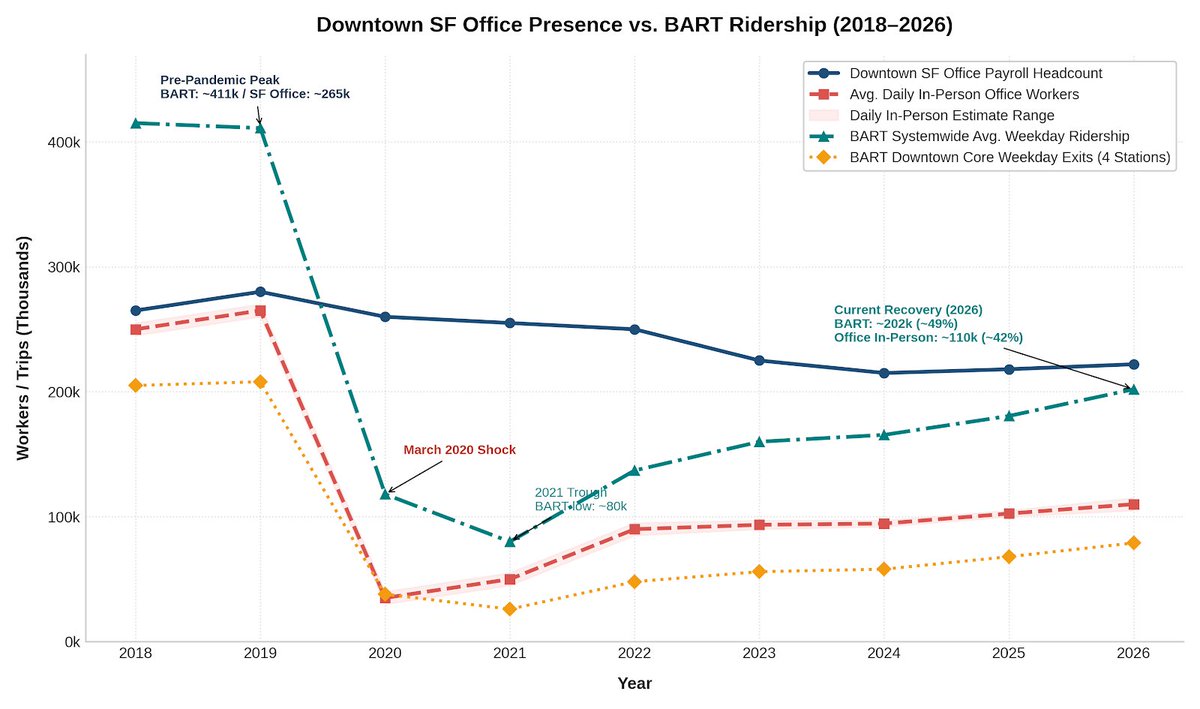
@Itsjoeco@hdb9865@davidcrawshaw If anything this would be a worse measure. We'd expect people to substitute into driving with relatively less traffic. There's good data around stop usage, office vacancy rates, etc. that indicate the ridership deficit is 60-80% from WFH. Ask your favorite model for details.
If you want a better sense of how politics works, interest groups don't "buy" influence, they get it - and change policy outcomes - by developing outside influence and then making threats. Policymaking is basically navigating the landscape of these threats https://t.co/DGyNVI3sYq
.@PalmerLuckey says Anduril’s first prototype, a firefighting tank, now sits under a tarp because unions shut it down:
“It could carry several tons of fire retardant and be used to protect critical infrastructure.”
“We built two fully working prototypes.”
“There were really strong unions that didn’t want robots to automate their jobs.”
“The governor was told if they funded this and procured it, the union would oppose him in the upcoming election.”
@Noahpinion Regular ridership of public transit is heavily correlated with socioeconomics and many of those riders are subsidized. Agree that disorder needs to be dealt with but that won't transform ridership. Until the BA is denser PT will continue to be largely seen as an essential service
@DavidKlion A part of the PMC tried to live up to those ideals and pursue the kinds of high standards and effort from schools being called from via TFA / the reform movement and then the rest of the PMC, partially motivated by ideas like those espoused by the old NHJ, decided they were bad
@pitdesi Our transit systems are not poorly run; pre-pandemic BART was the gold standard for fare-box recovery and MUNI is at ATHs in customer satisfaction. The problem is inflation and healthcare costs + WFH fundamentally shifting commute patterns. Letting BART die is not the answer.
@jakeonrails@bilalmahmood It's not about staff, it's the combination of precious SF residents needing to provide input anything that touches their neighborhood plus the use of public works as vehicles for supporting labor interests plus a lack of political courage to give staff cover to do the right thing
@coryfromphilly Don't blame the bureaucrats, they just implement the rules, and the rules are the ones San Franciscans have wanted. SF is full people who are entitled and precious about development. That's why they're throwing a fit as some of these rules get removed.
@mwseibel The people using these drugs often complex behavioral health issues and often need *a lot* of clinical, mental health, and material support to get their lives "on track." Providing that kind of support to ~37,000 people using is *exceptionally* expensive. https://t.co/A9x1i57UqT
@mwseibel Post-Prop 36 we're coercing people into treatment at a much higher rate, but that has maxed out our jail, court, and treatment capacity. Once people get out of treatment they often go back to their former circumstances and relapse. (pic from the civil grand jury report on jails)