Global warming is cutting the production of phytoplankton in the North Atlantic, undermining the entire food web and limiting its ability to soak up carbon, a new study reveals. Looks serious….
https://t.co/IEbKlIhzN2
The world just paid $2 trillion for a rocket company that lost $4.9 billion last year. And the rockets are not why it lost the money. They are the only part making any.
SpaceX went public Friday, the largest IPO in history. Up 19%, a $2 trillion valuation, Elon Musk the first trillionaire. Then you open the filing.
Three businesses sit inside it. Starlink, the satellites, brought in $11.4 billion, 61% of all revenue, and $4.4 billion in profit. It is the only piece that earns a dollar. The rockets that land themselves run a small loss reinvesting in Starship. And the AI arm, Grok plus the app once called Twitter, folded in this February, lost $6.4 billion in a single year on $12.7 billion of spending.
Read that again. The satellites pay for everything. The AI loses more than the satellites make. And the AI is the part the market fell in love with.
It gets bolder. The prospectus claims a total market of $28.5 trillion, the largest any company has ever put in a filing. Larger than the GDP of the United States. That is the number underwriting a $2 trillion price tag built on a division bleeding $6 billion a year.
Now the structure. About 4% of the company trades. That sliver sets the price for all of it. Musk is locked up for 366 days and holds roughly 80% of the votes. The public bought a company they cannot steer, priced on the one segment losing the most.
This is the whole year in one ticker. The profit is satellites. The story is AI. The market bought the story.
The rockets were never the risk. The risk is a $2 trillion price resting on the one bet that has yet to make a cent.
Crows (especially American crows) are highly intelligent and have remarkable abilities to recognize individual human faces, remember negative experiences with specific people for years (up to 17 in some studies), and socially transmit that information to their offspring and other crows, even those who never directly experienced the original incident.
Researchers wore distinct masks while trapping and banding a small number of crows (a stressful but non-harmful experience for the birds). The crows quickly learned to associate that specific "dangerous" face with threat and responded by scolding, mobbing, and dive-bombing anyone wearing it.
Offspring and other crows picked this up through observation: young birds (fledglings born later) would join in or react independently after seeing their parents' alarm calls and behavior. This "knowledge" spread through the local crow population via social learning, turning a personal grudge into a community warning.
[Cornell, H. N., Marzluff, J. M., & Pecoraro, S. (2012).
Social learning spreads knowledge about dangerous humans among American crows.
Proceedings of the Royal Society B: Biological Sciences, 279(1728), 499–508.
DOI: 10.1098/rspb.2011.0957]
Region Nino 3.4 sea-surface temperatures are in record territory, approaching 3 standard deviations above the 1982-2011 mean, an anomaly that has never happened before in recorded history.
The Climate 8-ball says: "four!"
Breaking News!
Car Soup Alert!
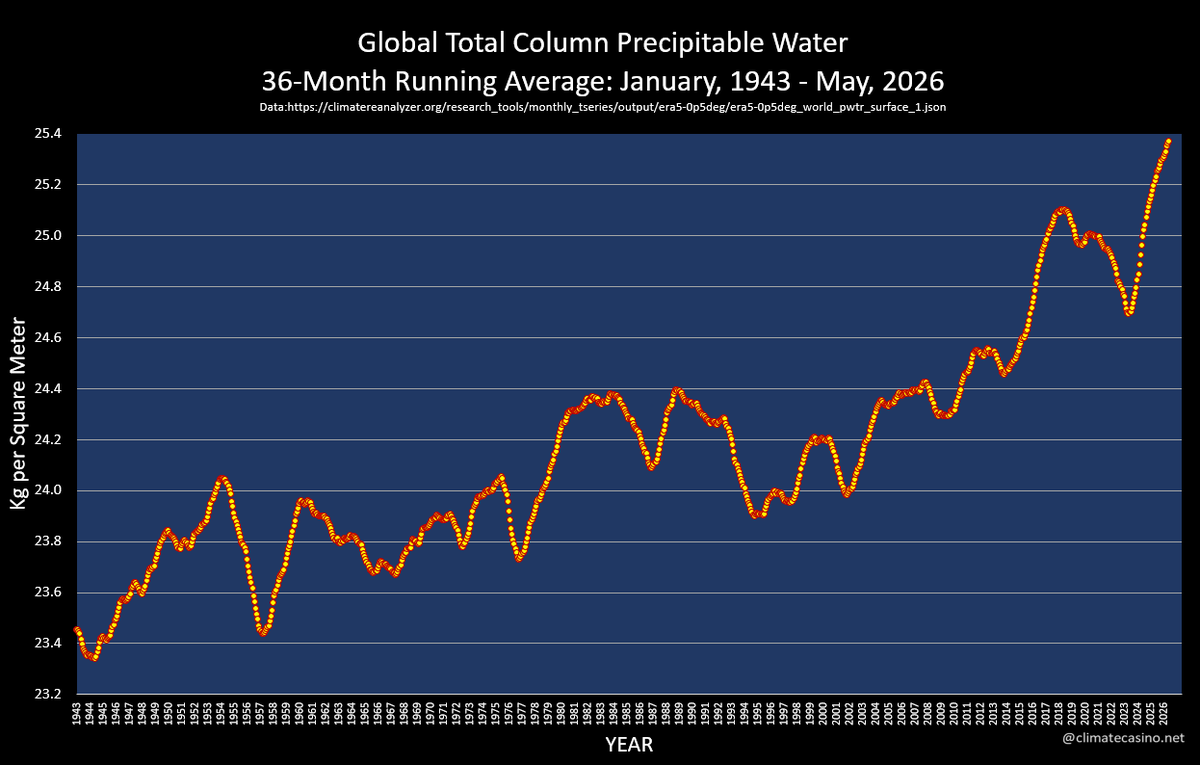
In May, the 36-month running average for "global total column precipitable water" set a new record high ... for the 20th month in a row.
I’ve been thinking a lot about the extraordinary outbursts of the President of the United States against female journalists... well, actually against journalists in general and journalism. But it feels like he saves his most childlike behavior and irrational language for female reporters, calling them all kinds of names that kids in kindergarten are given times out for. It’s stunning to me to witness such behavior from any leader, any CEO, any person of influence or importance. I’ve never witnessed someone like this raging, this weekend with @meetthepress host @kwelkernbc, just last week in the Oval Office with @cnn’s @kaitlancollins, calling women stupid or piggy, telling them to “smile”, calling them darling, demeaning their credibility. Every good man should denounce this behavior. Every person should be able to stand up for their colleagues and say “No more.”
Imagine this man screaming like this at your daughter, your wife, your sister, your mother... would you stand for it? No, you wouldn’t! And neither should any of us. It’s unacceptable and undignified. Period. End of story.
The Nashville Zoo has launched a public campaign to block construction of a proposed 69,000-square-foot AI data center that would sit directly adjacent to habitats for endangered animals, including vulnerable clouded leopards.
Zoo officials warn that the facility’s constant noise, bright artificial lighting, and electrical hum could seriously disrupt animal behavior, stress levels, and long-established breeding programs. The zoo is home to more than 3,700 animals representing over 350 species and maintains one of the most important collections of rare and endangered wildlife in the United States.
This conflict highlights a growing backlash against the rapid expansion of data centers driven by the AI boom. These facilities require massive amounts of electricity and operate 24 hours a day, prompting communities nationwide to raise concerns about energy consumption, water use, noise pollution, and environmental impacts. Wildlife conservation groups are now joining the resistance.
More than 180,000 people have already signed a petition opposing the project.
The developer behind the data center states that it will use waterless cooling systems, meet all local noise regulations, and comply with environmental standards. However, zoo leaders argue that the location itself, immediately next to sensitive animal habitats, makes the project unacceptable regardless of technical mitigations.
The dispute underscores a broader challenge of the AI era: how to build the vast digital infrastructure needed for artificial intelligence without placing undue pressure on local communities, ecosystems, and wildlife.
Karen Newton, 65, from Hertfordshire in England, left home in late July 2025 for the road trip of a lifetime through the United States with her husband Bill. Valid passports. Valid visas. Weeks on the road through California, Nevada, Wyoming and Montana. Then they tried to cross into Canada and things fell apart. Canadian officials said Bill didn’t have the right paperwork to bring the car across the border. When the couple turned back to the American side, U.S. border agents found that Bill’s visa had expired. 
Karen’s tourist visa was valid. Her British passport was valid. She has no criminal record. None of it mattered. She was handcuffed, shackled, and spent the night sleeping on the floor of a locked cell before being driven 12 hours through the night to an ICE detention centre. She and her husband spent the next six weeks there. 
She is now warning anyone planning to visit the United States that the situation is “totally out of control” and advises people not to go while Donald Trump is in office. 
A British grandmother. A valid visa. Six weeks in chains.
I’m not comparing him to Hitler, but I want to remind people of something.
When the generals told Hitler there wouldn’t be a thousand-year Reich, but he didn’t accept defeat gracefully.
He told them to flood the coal mines and bring down the electrical grid around Berlin.
His rationale was: If I can’t have it, nobody gets it.
That’s Donald Trump’s psychology with the Republican Party.
He doesn’t quietly want them to win after he’s gone.
His whole identity is built on the narrative that you were nothing before I got here and you’ll be nothing when I leave.
He’s not going to campaign for his successor. It’s not in his personality. It never will be.
Watch what happens.
“A mythomaniac is a clinical and literary term for an extreme pathological liar. It describes someone whose lies are grand, deeply embedded in their identity, and told with complete, unbenched confidence.”
What is happening is way beyond IPCC projections. The rate of warming has accelerated by half over the last two decades. Warming has reached 1.5°C, and with approaching El Nino, 2026-27 is likely to get to 1.7°C. https://t.co/865viViIam
🚨 WOW! Erin Brockovich completely destroys the AI data center narrative. She confirms these massive facilities emit a non-stop, 24/7 deafening noise that is literally driving local residents crazy!
She exposes the total lack of environmental oversight. Pure corruption!
Data centers powering artificial intelligence are projected to consume roughly twice as much electricity and water by 2030 as they do today, according to a new report from United Nations researchers.
Although AI is often perceived as intangible cloud-based technology, every query, image, or video relies on a massive physical infrastructure of servers, cooling systems, power grids, chips, land, and water.
In 2025, global data centers used approximately 448 terawatt-hours (TWh) of electricity, more than the total consumption of Saudi Arabia. AI accounted for about one-fifth of that demand. These facilities also consumed around 1.2 trillion gallons (4.5 trillion liters) of water and emitted roughly 189 million tons of carbon dioxide.
By 2030, researchers forecast that annual electricity consumption by data centers will rise to 945 TWh, roughly equivalent to Japan’s current total electricity use, with AI expected to drive 40% of the total. Water consumption is projected to double to about 2.5 trillion gallons (9.3 trillion liters) per year. The physical land footprint could also expand from roughly 2,664 square miles (6,900 km²) today to more than 5,600 square miles (14,500 km²).
The surge stems from the immense computational demands of training and running advanced AI models, which require powerful chips running continuously and generate substantial heat that must be managed through energy- and water-intensive cooling.
The report emphasizes that AI is not inherently unsustainable. The technology offers potential benefits for optimizing energy systems, reducing waste, and improving efficiency across industries. However, the rapid pace of AI infrastructure development risks outstripping environmental planning, particularly in regions already facing resource constraints. Massive new data centers could intensify competition for electricity and water with communities, agriculture, and natural ecosystems.
[Aczel, M., Chamanara, S., Matin, M., Farsi, A., Marwala, T., & Madani, K. (2026). Environmental Cost of AI’s Energy Use: Carbon, Water and Land Footprints. United Nations University Institute for Water, Environment and Health (UNU-INWEH)]
They told you the planet is dying… and you’re the problem.
Your food.
Your habits.
Your existence.
Meanwhile, behind closed doors, something else is growing.
AI data centres in the UK alone could pump out 123 million tonnes of carbon emissions — the equivalent of millions of human lives over a decade.
But where’s the outrage?
Instead, they blame cows… tax farmers… and squeeze the people who actually feed you.
While tech giants expand quietly… signing deals… building systems that never sleep… and never get questioned.
Different rules.
Different targets.
Same script.
So let me ask you…
Why are everyday people being punished…
while the biggest emitters keep getting rewarded?
Is this really about saving the planet…
or controlling who pays the price?
Drop your thoughts below — I want to hear what you think.
And if this made you stop and think for even a second… share it.
More people need to see this.
Even the glaciers that have so far resisted global warming are now starting to collapse.The hitherto stable ones of the Pamir mountains in Central Asia lost massive amounts of ice last year. How many more warnings do we need?
https://t.co/lCaZuI9nqm


![Rainmaker1973's tweet photo. Crows (especially American crows) are highly intelligent and have remarkable abilities to recognize individual human faces, remember negative experiences with specific people for years (up to 17 in some studies), and socially transmit that information to their offspring and other crows, even those who never directly experienced the original incident.
Researchers wore distinct masks while trapping and banding a small number of crows (a stressful but non-harmful experience for the birds). The crows quickly learned to associate that specific "dangerous" face with threat and responded by scolding, mobbing, and dive-bombing anyone wearing it.
Offspring and other crows picked this up through observation: young birds (fledglings born later) would join in or react independently after seeing their parents' alarm calls and behavior. This "knowledge" spread through the local crow population via social learning, turning a personal grudge into a community warning.
[Cornell, H. N., Marzluff, J. M., & Pecoraro, S. (2012).
Social learning spreads knowledge about dangerous humans among American crows.
Proceedings of the Royal Society B: Biological Sciences, 279(1728), 499–508.
DOI: 10.1098/rspb.2011.0957]](https://pbs.twimg.com/media/HKm0tEKWsAAMt7h.jpg)






![Rainmaker1973's tweet photo. Data centers powering artificial intelligence are projected to consume roughly twice as much electricity and water by 2030 as they do today, according to a new report from United Nations researchers.
Although AI is often perceived as intangible cloud-based technology, every query, image, or video relies on a massive physical infrastructure of servers, cooling systems, power grids, chips, land, and water.
In 2025, global data centers used approximately 448 terawatt-hours (TWh) of electricity, more than the total consumption of Saudi Arabia. AI accounted for about one-fifth of that demand. These facilities also consumed around 1.2 trillion gallons (4.5 trillion liters) of water and emitted roughly 189 million tons of carbon dioxide.
By 2030, researchers forecast that annual electricity consumption by data centers will rise to 945 TWh, roughly equivalent to Japan’s current total electricity use, with AI expected to drive 40% of the total. Water consumption is projected to double to about 2.5 trillion gallons (9.3 trillion liters) per year. The physical land footprint could also expand from roughly 2,664 square miles (6,900 km²) today to more than 5,600 square miles (14,500 km²).
The surge stems from the immense computational demands of training and running advanced AI models, which require powerful chips running continuously and generate substantial heat that must be managed through energy- and water-intensive cooling.
The report emphasizes that AI is not inherently unsustainable. The technology offers potential benefits for optimizing energy systems, reducing waste, and improving efficiency across industries. However, the rapid pace of AI infrastructure development risks outstripping environmental planning, particularly in regions already facing resource constraints. Massive new data centers could intensify competition for electricity and water with communities, agriculture, and natural ecosystems.
[Aczel, M., Chamanara, S., Matin, M., Farsi, A., Marwala, T., & Madani, K. (2026). Environmental Cost of AI’s Energy Use: Carbon, Water and Land Footprints. United Nations University Institute for Water, Environment and Health (UNU-INWEH)]](https://pbs.twimg.com/media/HKIPLTCW0AAbfGu.jpg)


