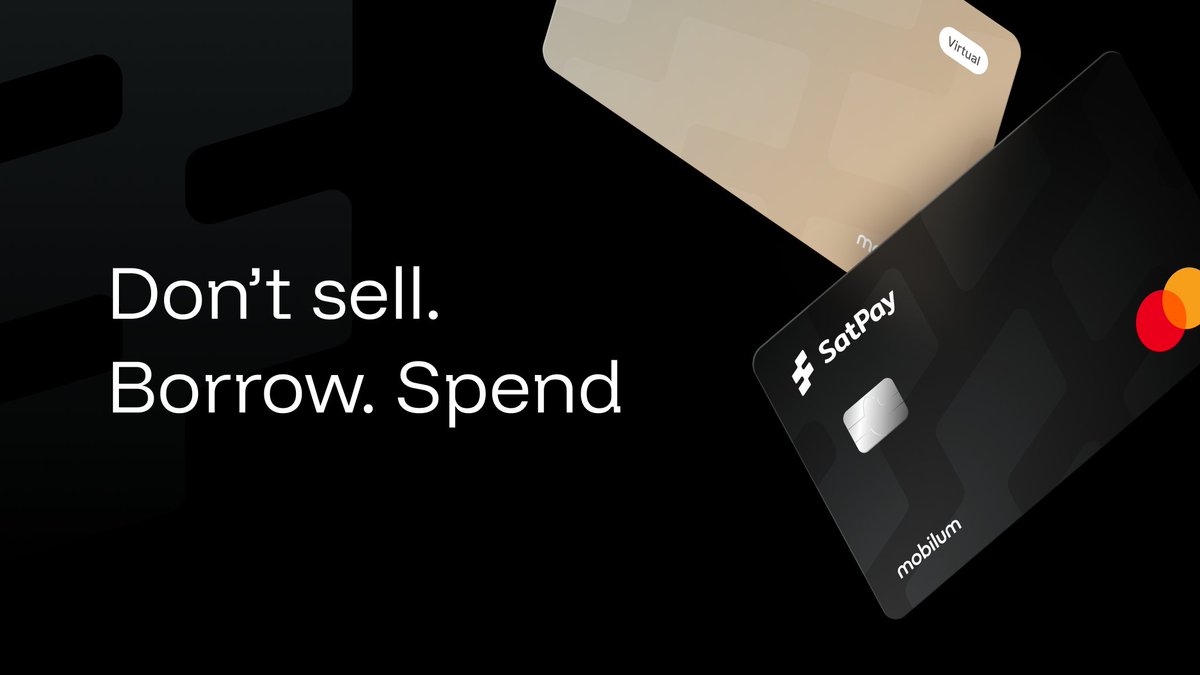
A Bitcoin neobank needs more than a good idea.
It needs payments infrastructure.
Compliance.
Card rails.
Operational experience.
That's why SatPay is powered by @mobilumofficial
Watch Pi Founder Nicolas Kokkalis speak in the Consensus 2026 panel “How to Prove You’re Human in an AI World (Without Doxing Yourself)”.
The discussion focused on how digital trust and identity verification systems must evolve as AI makes it possible to generate bots, agents, and synthetic identities that closely resemble real human behavior at scale.
The panel explored a core question for the AI era: how systems can continue to verify real human participation without requiring unnecessary disclosure of personal information.
A key theme was that proof of humanity is context-dependent, with different systems requiring different levels of verification depending on use case and risk.
The importance of privacy-preserving design was also highlighted, ensuring verification can scale while remaining usable for real users.
As AI lowers the barrier to building and interacting online, the harder challenge may be connecting digital systems to real users, trusted participation, and meaningful utility.
Pi’s Layer 1 blockchain, identity verification, payments infrastructure, non-custodial wallets, smart contracts, and engaged global community are all part of Pi’s ongoing work to address that challenge.
Watch the full presentation now!
https://t.co/nFCz9nF7RR
With this matter behind us, our full focus returns to the work ahead: advancing the Core network and expanding the Bitcoin finance stack alongside the builders, validators, and ecosystem partners driving real growth.
Forward. 🔶
Every bank will custody Bitcoin.
The harder question is what they let users do with it.
Core Alpha will be how users and institutions can start to earn safely on their Bitcoin. 🔶
Most people think staking is just “lock tokens, earn yield.” That’s the shallow version.
What @Coredao_Org is building feels closer to a real financial system. Different lock periods. Different reward curves. A structure where time itself becomes part of the incentive model.
At first, I didn’t fully understand why that mattered. Then I realized longer commitments don’t just increase yield. They create stability.
- Less circulating supply.
- More predictable capital.
- Stronger alignment between users and the network.
It starts behaving less like speculation and more like infrastructure.
The smart part is psychological too. It rewards patience instead of constant movement.
I’ve learned that markets become fragile when everyone thinks short term. Durable systems are built when incentives reward people for staying through uncertainty.
That’s how conviction stops being a slogan and starts becoming economics.
The target for 26 is always 1 million #CORE forever.
Most AI systems still need good human input.
Automated training can scale.
But it struggles with:
Ambiguity
Nuance
Real-world judgment
That’s why human-in-the-loop systems still matter.
Not as a fallback. But as a core layer.
The challenge isn’t whether human input is needed.
It’s how to get it:
At scale
With quality
From real people
That’s the bottleneck, and Pi Network has already built the solution: the large-scale, globally distributed workforce of identity-verified human participants already active inside the Pi ecosystem.
https://t.co/uB1vllBMJU
Institutions are not looking for another crypto product.
They are looking for Bitcoin yield infrastructure that can meet their requirements.
That is the market Core Alpha is being built for. 🔶
Frontier labs are building the intelligence. @_zprotocol is building the interaction layer.
Inference, execution, and ownership in one environment built for agents, entirely private.
All powered by Satoshi Plus. 🔶
.@Coredao_Org's Satoshi Plus just got its first franchise chain.
@_Zprotocol is building the interaction layer for the agentic internet.
Private inference, economic rails, and end-to-end tooling.
Satoshi Plus now covers the three most important parts of crypto: Bitcoin, privacy, and the agentic future.
Did you know that @Coredao_Org uses a tiered reward structure that incentivizes Bitcoin holders to acquire and stake $CORE tokens alongside their $BTC.
The Fact: Under Dual Staking, there are four yield tiers for Bitcoin staking based on the proportion of #CORE staked relative to Bitcoin staked (Base → Boost → Super → Satoshi). Solo Bitcoin stakers receive the lowest (Base) tier.
How It Works: Tier thresholds are dynamic and adjusted via governance votes based on network conditions. Higher tiers require progressively higher CORE:BTC ratios to unlock boosted yields.
The Unique Angle: This system turns passive Bitcoin holders into active #CORE participants, creating one of the strongest economic alignments between a Layer-1 token and Bitcoin in the entire industry.
DROPS E35: @Coredao_org - Bitcoin yield without giving up your Bitcoin
@richrines is one of the initial contributors to Core DAO, the leading Bitcoin scaling solution. He's also a long-time Zcash holder and early backer of @_zprotocol , a new privacy chain built on Core's Satoshi Plus consensus. We talk Bitcoin yield, financial privacy, AI surveillance, and why the next big move in crypto might not be where most people are looking.
We talk about:
- How Core DAO lets you earn yield on Bitcoin by time-locking it - without ever giving up custody
- Why borrowing against Bitcoin makes sense now
- OG Bitcoiners rotating to Zcash - what "transition" actually means and whether it's bad for Bitcoin
- Z Protocol as the DeFi layer for private money
- Why AI has made financial surveillance trivial - and why that accelerates privacy adoption
- How Agents are leaving full financial fingerprints - and why privacy needs to be default on at the chain level
And much more...
Timestamps:
0:00 - Introduction
2:05 - What does Rich Rines do?
3:00 - Financial Freedom
4:09 - Journey from Bitcoin to Zcash
6:40 - Zcash Philosophy
8:38 - Transition to Zcash
11:20 - Who is Rich Rines?
11:46 - Bitcoin as Pristine Collateral
14:28 - Criticisms of Borrowing Strategy
16:52 - Explaining CORE
18:58 - Bitcoin Yield Story
20:29 - Misconception regarding CORE
22:08 - Time Lock
23:34 - Risk of using CORE
24:37 - Strategies used by CORE
26:42 - What Bitcoin Holders Want?
28:46 - Bitcoin Yield
30:10 - CORE Alpha
32:44 - SatPay
34:19 - Power Grid Thesis
35:37 - Satoshi Plus
37:07 - What is Z?
38:12 - Benefits of long-term Zcash Holder
40:01 - Vertical Integration
43:12 - Privacy for Agents
44:41 - Faux Privacy
46:14 - Privacy vs Government
49:01 - Zcash’s Future
50:01 - Conclusion
Most Bitcoin apps stop at storage.
SatPay is built for utility.
Keep your Bitcoin.
Access liquidity when you need it.
Use a product designed for real financial life.
Institutions don't want a protocol. They want a partner that builds custom yield infrastructure for their clients.
That's what Core is doing. Staking architecture, yield engines, collateral models.
All built directly with institutions. 🔶