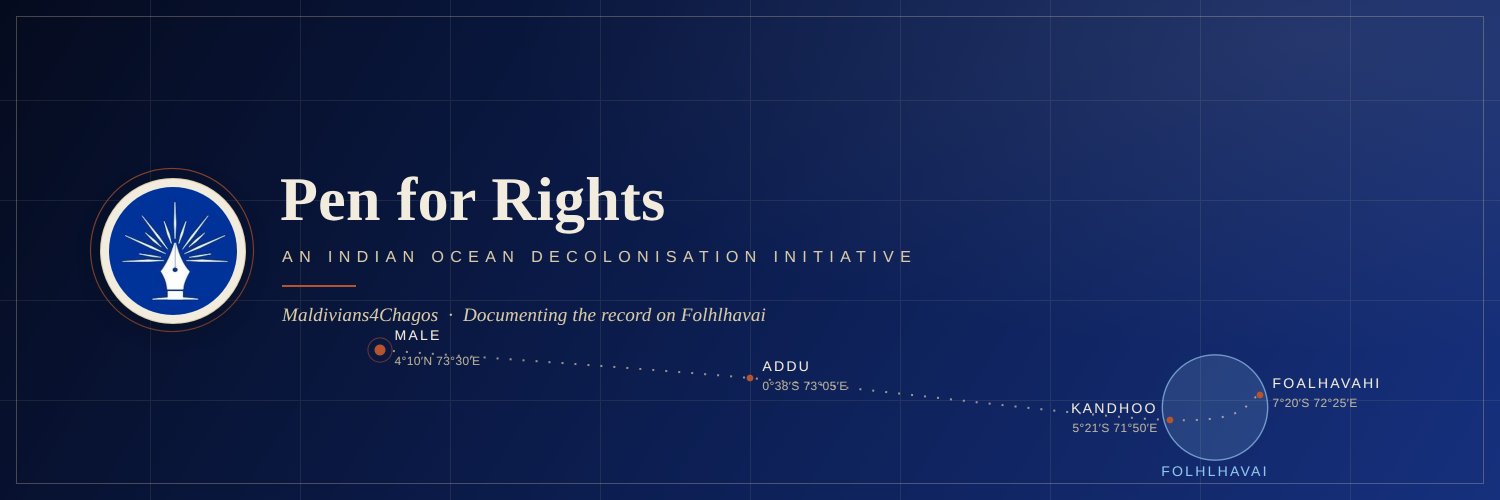
The Unexamined Legitimacy of French Acquisition of Folhlhavai (Chagos Archipelago) and the Maldivian Claim
Abstract:
The legal history of Folhlhavai (Chagos Archipelago) is usually told as a colonial chronology. In that account France discovered the islands in the eighteenth century and administered them from Île de France, and Britain occupied them in 1810 and received them by cession in 1814. That chronology documents administration. It does not establish how France acquired sovereignty. The plan bearing the name Chagas is annotated as a copy and dated by the Bibliothèque nationale de France to after 1744, and the journal-derived tradition places Lazare Picault near the Amirantes on the relevant date. Earlier European sources also carried a separate family of southern Maldivian names. Barros placed Candú and Adú at seven degrees south, and an Amsterdam chart of 1792 distinguished Chagas from Camdu (Kandhoo), I. de Gamo (Gan or Gamu), Adu (Audhoo), Caudu (Gaudhoo or Gaadhoo) and Pollowois or Polvara (Foalhavahi), names with proposed Dhivehi correspondences in the southern Maldivian geographical tradition, apart from Chagas. Later French nomenclature may have obscured those distinctions. A defect in French acquisition would not settle title, but it must be examined before 1814 can be treated as transmitting anything. https://t.co/iHQY4SFbWi
Folhlhavai Research Watch: Only one new item passed our evidentiary threshold this week. The UK Parliament briefing confirms that the UK–Mauritius treaty is not in force, and neither the ICJ nor ITLOS awarded sovereignty to Mauritius. This aligns closely with our research position. Legal colleagues: please read and share your views.
https://t.co/YxH78s46Zn
President Trump at #UNGA81:
“There is no human right to illegal immigration, but there is a right to remain a sovereign nation, and we want to remain a sovereign nation, and so should you.”
Precisely. Sovereignty matters. So does a nation’s historical heritage.
For the Maldives, that principle should include the courage to place its own historical record concerning Folhlhavai before the international community and insist that its antecedent claim is heard rather than presumed away.
#Folhlhavai #Maldives #UNGA81
PRESIDENT TRUMP: There is no human right to illegal immigration, but there is a right to remain a sovereign nation. We want to remain a sovereign nation, and so should you.
The rights and history of the Chagossian community deserve full respect, particularly their right of return and meaningful participation in decisions affecting their homeland. But those rights should not automatically be equated with a right to determine sovereignty over Folhlhavai (Chagos Archipelago).
The community developed there during the colonial period. Its rights cannot, by themselves, extinguish an antecedent territorial title asserted by another State. Maldives can strongly support the return and rights of Chagossians while maintaining that the underlying question of sovereignty over Folhlhavai must be determined separately on its historical and legal merits.
Interesting to see the Maldives also affirming that the history of the Chagossian people must be respected. What matters most is that the majority of Chagossians want self-determination and want Chagos to remain British 🇮🇴🇬🇧.https://t.co/ISgj8UUbhv
Perhaps the more important question is not who the “North London lawyers” are, but how much of the Folhlhavai (Chagos Archipelago) policy has been driven by legal and Foreign Office orthodoxy rather than independent political scrutiny. Philippe Sands KC represented Mauritius in the international proceedings. That history deserves scrutiny, especially when Britain is proposing an irreversible territorial transfer.
'I'm amazed that Burnham didn't choose this moment to distance himself from the North London lawyer mob who are driving this.'
Former Chancellor of the Exchequer, Kwasi Kwarteng suspects the Foreign Office and 'the machinery of Government' are pushing the Chagos Islands deal.
An Open Letter to the Prime Minister of the United Kingdom on Folhlhavai (Chagos Archipelago) and the Unanswered Question of Antecedent Title https://t.co/OTkqYRVpuF
Who Audits the Experts? Why Order Matters in the Folhlhavai Sovereignty Case
Who audits the experts? The President may entrust the Folhlhavai sovereignty project to international counsel, the Attorney General, foreign-affairs specialists and other advisers. Each possesses authority within a particular field. Professional authority, however, leaves a larger question unanswered. Who determines whether their separate advice actually forms one coherent sovereignty strategy?
The Maldives National Territory & Sovereignty Office has responsibility for research, oversight and coordination on territorial matters.1 Competent civil-society research organizations can support that function through independent research and scrutiny. They need not replace the specialists to examine the architecture connecting their work.
We describe one approach to such scrutiny as theoretical inquiry. The Folhlhavai strategy should be judged not only by the authority of its specialists but by whether the evidence, assumptions and sequence connecting their work withstand rigorous examination.
https://t.co/FFOPgNuVgG
Silence Is Not a Deed of Surrender: Why Estoppel and Acquiescence Do Not Foreclose the Folhlhavai (Chagos) Claim
The most convenient objection to an antecedent Maldivian claim over Folhlhavai is also the most seductive. If these islands were Maldivian territory, why did Maldives remain silent for sixty years? Add the language of acquiescence and estoppel, and political silence begins to sound almost like a deed of surrender. International law is not quite so accommodating. Before silence can extinguish an earlier title, one must establish what that title was, whose sovereignty Maldives supposedly accepted, and when circumstances actually arose that required Maldives to protest.
Those questions have become more urgent because the future sovereignty of Folhlhavai is unsettled. Britain has sought to transfer sovereignty to Mauritius while retaining the UK-US military facility on Foalhavahi. Maldives has formally objected. Mauritius has responded by suspending diplomatic relations with Maldives. The question is therefore no longer merely why previous Maldivian governments failed to formulate an antecedent claim. The immediate question is whether Maldives should remain silent while other States determine the future of territory for which historical evidence indicates an antecedent Maldivian title. https://t.co/ui422sGlK7
Britain says no question of Chagossian self-determination arises because Folhlhavai (Chagos Archipelago) has “no permanent population”. Yet Britain itself acknowledges that Chagossians were removed from the islands. Can displacement itself be relied upon to deny the rights of the displaced?
@UNHumanRights@UN_Spokesperson@USUN@TessaClarkeLive@Nigel_Farage@ChagossianVoic2@ChagosUK@ChagosTrust
Read more: https://t.co/GpSMRKgmML
The FCDO has now put its disagreement with CERD on record over Folhlhavai (Chagos Archipelago), stating that the UK “does not agree with the approach CERD has taken.” That deserves international scrutiny, particularly following CERD Decision 1 (2025).
@UNHumanRights@USUN@TessaClarkeLive@ChagossianVoic2@ChagosUK@ChagosTrust
Read more: https://t.co/GpSMRKgmML
UK Foreign Office responds to Pen for Rights on Folhlhavai (Chagos Archipelago): Britain maintains sovereignty is solely a UK–Mauritius matter, despite no Maldivian historical-title claim ever having been adjudicated. The question remains: when and how was any prior Maldivian title extinguished?
@TessaClarkeLive@Nigel_Farage@ChagossianVoic2@ChagosUK@ChagosTrust
Read more: https://t.co/GpSMRKgmML