@YingjunWu The bet is not that everyone has good intentions because that was never true in open source in the first place. The bet is that you should give good actors all the tools to fight the bad actors. Controls only favor the bad ones, which will find ways around them.
I released dwim 0.4, a coding agent that's local by default.
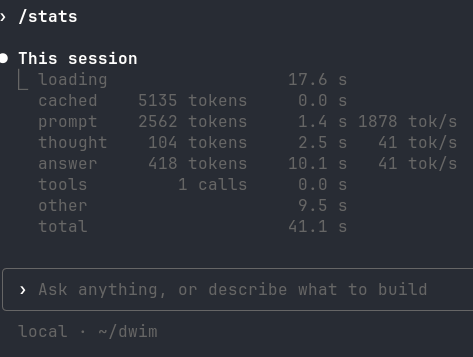
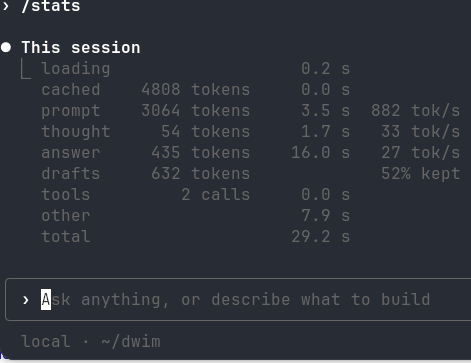
This release switches from Qwen3.8-27B to Inkling 2 Mini as the model. In my evals, Inkling was faster than Qwen on DGX Spark and Apple M5, with a similar SWE-Bench Verified Mini score.
👇
https://t.co/ttnVNF5Gb2
The moat in software is getting it right. My agents have been busy this weekend getting Inkling 2 Mini going in my harness. But oh boy will there be work in the coming weeks to perfect it!
@_marcobambini Oh, hope you like it! Happy to sign it if we bump to each other somewhere! Any interesting conferences you are planning to attend next year, for example?
Inkling 2 Mini has 2.5x higher prefill and 2x faster decode compared to Qwen3.8-27B on Macbook Pro M5 and 32 GiB. Next, lets see how well this does for coding tasks!
@Zeez0321 One hour of DGX Spark is like $0.80 or something like that. The model I am using for this is Qwen3.8-27B, which is the model I am using for local coding tasks exclusively for now
@JosepiBuildsIt I actually only pretty recently have gotten dwim to a point where you can just run it. https://t.co/ugf62bHgrn is one example where it improved itself autonomously. Most of my focus has been on performance and deep debugging, where I use bigger models like Fable
Inkling 2 Mini looks promising, so I'm adding support for it in dwim! One lesson from getting Qwen3.8-27B running, though: there's a big gap between the immediate reaction ("I built a three.js game with it!") and how these models actually perform as coding agents on real work.