🚀 Check out our new paper on Native Unified Multimodal Models!
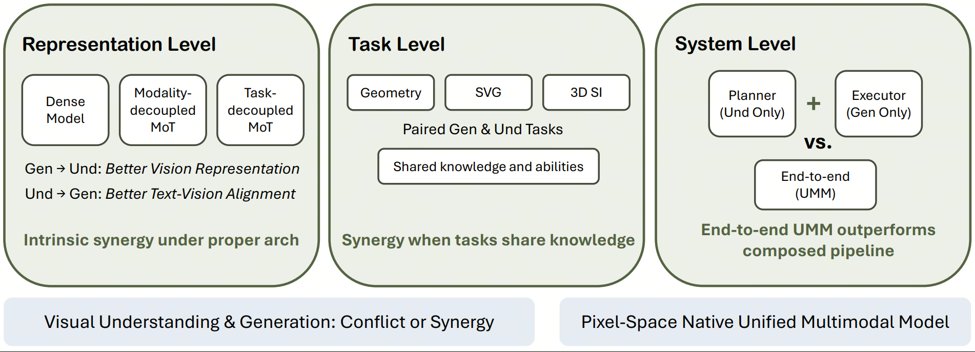
Uncovering Understanding–Generation Synergy in Native Unified Multimodal Models: From Representation, Task to System
📄 arXiv: https://t.co/ZWPIferOsk
Do visual understanding and generation actually help each other in UMMs?
We study this from representation → task → system, and find that the answer is: yes, but only under the right conditions.
At the representation level, generation can enrich the visual representations learned for understanding, while understanding improves the vision–language alignment of generative representations. Beyond representations, the two capabilities can mutually reinforce tasks that share underlying knowledge. And at the system level, the unified model outperforms modular planner→executor systems when learned end-to-end for complex tasks that require both visual understanding and generation.
The key is knowing what to share and what to specialize.
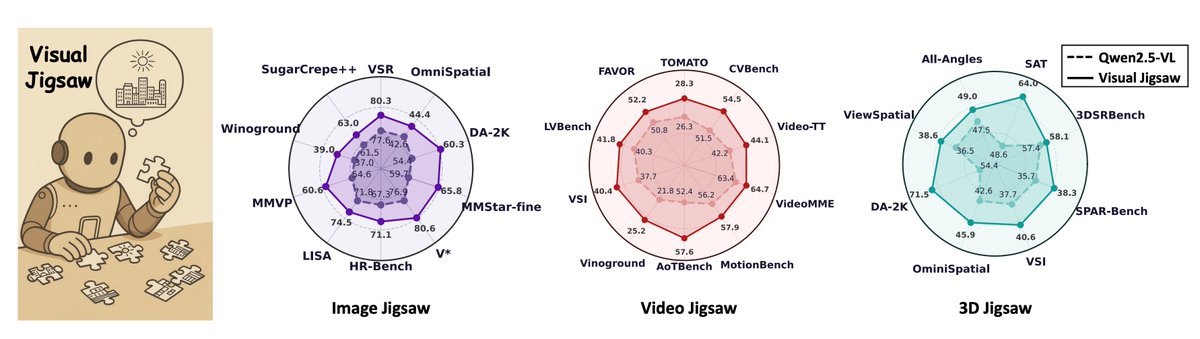
🔥Making AI solve jigsaw puzzle is a generic post-training paradigm🔥
🧩Visual Jigsaw🧩 is a *vision-centric self-supervised RL post-training framework* to strengthen MLLM's capability across image, video and 3D
- Project: https://t.co/Gw99dGYcmG
- Code: https://t.co/XNFZJE0Jzu
🚀 Excited to present our paper ProxyV at #ICML2025!
📍 East Exhibition Hall A-B #E-2608
🗓️ Thu Jul 17, 4:30–7:00 PM PDT
Come check out our poster and chat with us!
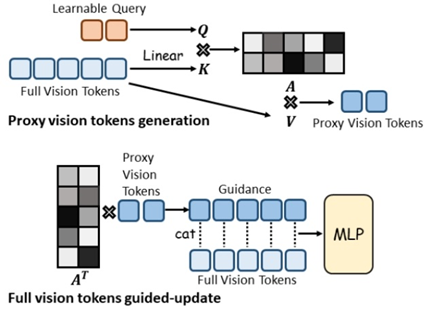
🧵[1/n] Our #ICML2025 paper, Streamline Without Sacrifice - Squeeze out Computation Redundancy in LMM, is now on arXiv! Orthogonal to token reduction approaches, we study the computation-level redundancy on vision tokens within decoder LMM.
Paper Link: https://t.co/GxuYznjhgo
🧵[1/n] Our #ICML2025 paper, Streamline Without Sacrifice - Squeeze out Computation Redundancy in LMM, is now on arXiv! Orthogonal to token reduction approaches, we study the computation-level redundancy on vision tokens within decoder LMM.
Paper Link: https://t.co/GxuYznjhgo
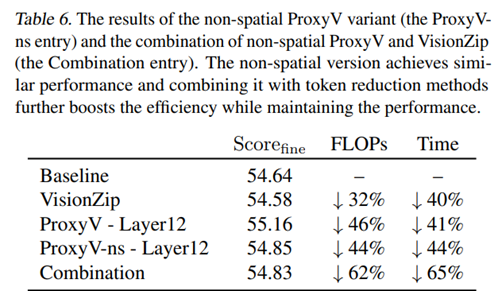
[8/n]
A non-spatial variant of ProxyV
We also design a non-spatial variant to remove the requirement of a spatial prior so that this alternative can be flexibly combined with token reduction methods or non-spatial vision features.