Yu Jun, a Chinese product thinker, has two useful ideas: a product is a trade of value, and a user isn't a person, it's a bundle of needs.
in personal agents, you trade permission for utility and the company earns reputation.
so you make money from reputation, not attention.
and because a user is a bundle of needs, a general personal agent won't work.
you have to get one bundle reliably right before anyone trusts you. what we'll end up with is a bunch of temp workers, different agents built for specific slices of your to-dos.
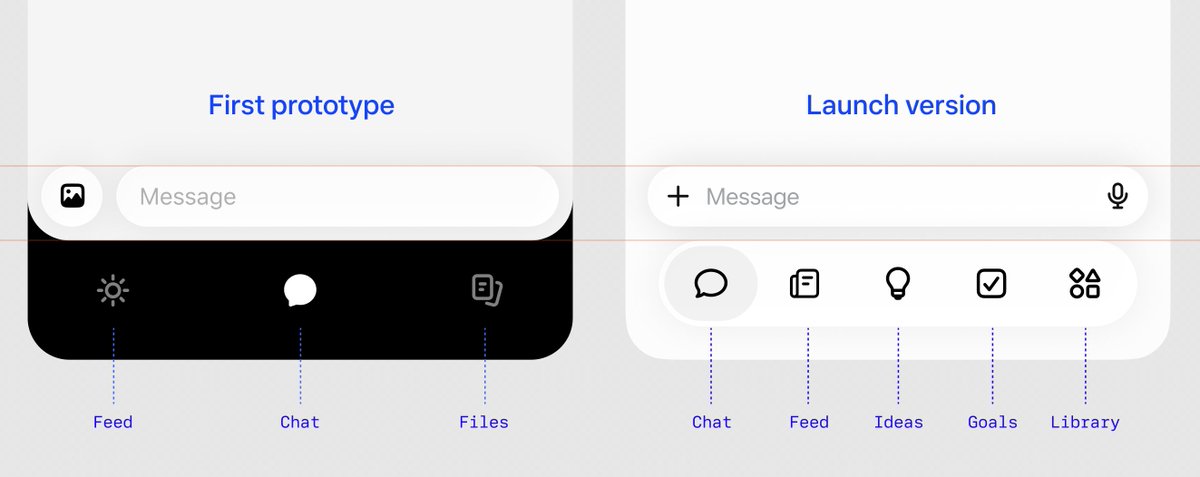
A distinctive feature of Muse is the tab bar. It was one of the first things in the initial prototype, and it felt like a foreign addition for an AI app. So foreign that I recall leaving on PTO early on and leaving one instruction: "do not remove the tab bar," knowing how tantalizing it would be to simplify the app by removing it.
Beyond ergonomics, the tab bar’s core benefit is framing. Agents are capable of more than people realize – the tab bar provides the surface area to expose that functionality and make it conceptually (and physically) accessible. Each tab does this in its own way.
Ideas is the most literal example. True to its name, the Ideas tab lists ideas from your Muse about how it can help you. This is a great way to learn about the many things Muse can do, especially for people who aren’t technical. At first the ideas are universal, but as your Muse gets to know you, its ideas become much more personalized and update frequently.
If Ideas shows you what Muse could do, the Goals tab shows you what Muse is doing – whether it’s helping you with a goal or keeping track of something. Muse does so many things that it helps to visualize it all as a kind of mutual to-do list where you can monitor status. Again this serves both a practical and conceptual benefit.
More thoughts to come, but I’m glad we kept the tab bar and I’m excited about how it will evolve time.
I believe Traces are the essential new primitive of software development and agentic evolution.
Git changed the world by helping us collaborate around the delta unit of code.
Traces are even more powerful than that. They capture the upstream intent, prompts, reasoning, skills and tools use. They are your intelligence.
You should, of course, own and make full use of your intelligence. You start by securely capturing your traces. Then, set up the recursively self-improving systems based on the learnings they contain: friction, latency, outcomes.
Excited to build this future with Tarun and team!
Good morning!
Today @paper launches Remote MCP
This may change the industry forever.
Use Paper anywhere you work:
• Cloud agents: Grok Bot, Muse, Devin, etc
• CI: update Paper on every commit
• Design from your phone
Any agent, any time, any place
Start in the thread 🧵
@humphreybc look at it from the switching side. adding something to a call costs a team nothing, moving off google docs costs a lot
so the meeting part is the wedge and the apps are mostly where its output lands. i doubt they expect teams to leave their stack for them
we've had everyone's personal agent sitting in on our calls for a while now
we're in 3 time zones so someone always misses it. their agent gets the tasks from the agents who were there, and they keep bugging each other till it's done
kinda forgot what chasing people felt like
Introducing Claude Meetings: add Claude to your team’s video call and it builds docs, whiteboards, and other artifacts with you while you’re still talking.
Starting to roll out in beta on Team and Enterprise plans.
@robj3d3 half this list has been sending a bot into calls for years. what made it click for us was agents that remember who's on what.
CONTEXT is very important
@mattpiccolella@triketora@Flomerboy@omarmihilmy congrats, looks great. curious if it'll know who to go to? the pa we hacked together internally know the team, so when someone mentioned the pricing sheet mid-call, mine knew whose it was and pinged her agent before we hung up :)
@coreyganim re 5: the in-call part is great. what changed things for us was everyone having their own context... after a call the agents work out who takes what between themselves
we've had everyone's personal agent sitting in on our calls for a while now
we're in 3 time zones so someone always misses it. their agent gets the tasks from the agents who were there, and they keep bugging each other till it's done
kinda forgot what chasing people felt like