@LicandroOscar Las negociaciones entre el MLN-Tupamaros y los militares a comienzos de los 70's (antes del golpe), confirman la afinidad de valores "democráticos" que ambos grupos profesan.
@ONVentura Voy a demandar al Estado porque fui al casino y aposté mi casa, mi auto y mis ahorros porque el casino me dijo que podía ganar mucho dinero si apostaba allí. El Estado estuvo omiso en controlar que no me fuera a quedar en la ruina si lo apostaba todo y perdía. Exijo justicia!
Esto es una tremenda injusticia hacia los que no tuvimos nada que ver y que somos los que vamos a pagar el pato de la boda. Quienes estuvieron en el MGAP y en el BCU desde el primer damnificado hasta ahora son los que deberían responder con su patrimonio personal. Repostéenlo.
@ONVentura Cuando vivía en la Unión, MVD, puse un farol de colgar, de metal muy lindo. Me lo robaron. Puse uno de plástico. Igual. Puse uno más berreta. Igual. Puse bombita bajo consumo. Igual. Puse incandescente de 75W, igual. Puse una de 25W. Caput. Bichicomes de alma. Uruguayez total.
@ONVentura Ojo que puede haber caníbales allí por Nueva Guinea! Calculo que debe estar previsto en los seguros de viajero, que obviamente, los contribuyentes solventaremos con todo gusto. Todo sea por el medio ambiente...
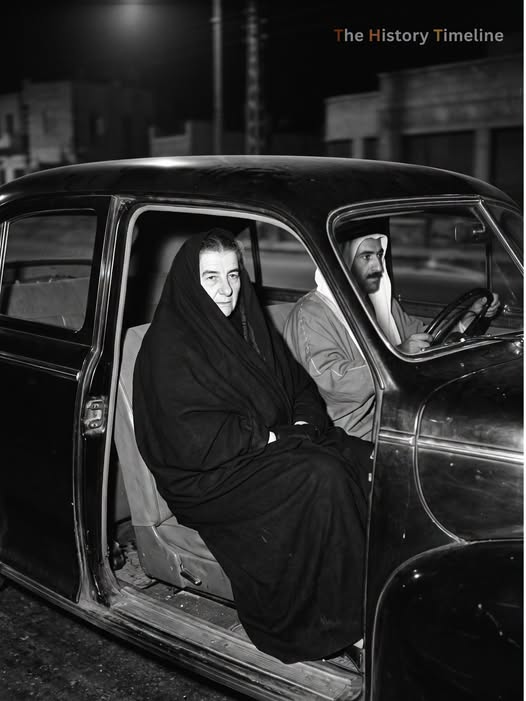
"May 1948. Haifa.
Golda Meir sat in a car leaving the city in darkness, wrapped in the wide dark robes of a Muslim woman. She did not speak Arabic. Her companion, Ezra Danin, a Haganah intelligence expert who did, was dressed as an Arab man. Together they posed as a married couple, moving through checkpoints into Transjordan, heading toward a secret meeting in Amman with King Abdullah I.
The windows of a second car had been covered with heavy black fabric so she could not be identified. The king had refused to come to the border. He had refused to alert his Arab Legion that Jewish guests were coming. If anything went wrong, she was on her own. C*pture meant interrogation. The implications beyond that were clear.
She went anyway.
This was not their first meeting. In November 1947, she had traveled to Naharayim on the banks of the Jordan River for a clandestine meeting with Abdullah, no disguise required that time. At that meeting, Abdullah had given his word. If the United Nations voted to partition Palestine, he would not att*ck the Jewish state. He promised.
Six months later, word reached the Jewish leadership that Abdullah had joined the Arab League and was preparing to march.
On May 11, 1948, four days before Israel would declare independence, Golda Meir traveled to Amman in secret to ask him directly. Would he keep his promise?
She found a different man from the one she had met in November. Pale, tense, and depressed. He explained that he had spoken to her as a man alone. Now he was """"one of five,"""" bound to Syria, Egypt, Lebanon, and Iraq in a coalition he could no longer break from.
He asked her to accept a proposal: Palestine would not become a Jewish state. Jews would receive autonomy within a unified Jordan and after a year the whole territory would be merged under his rule with Jewish representation in his parliament.
She refused immediately.
He asked why the Jews were in such haste to declare a state. She told him they had been waiting two thousand years. He told her the Arabs could not wait longer. She told him that if he turned his back on his promise, w*r was inevitable because the Jews would resist.
The meeting ended. The w*r came anyway, five days later, on the morning after Israel declared independence on May 14, 1948.
But Golda Meir had already been shaping that moment for months.
In January 1948, with the pre-state leadership desperately short of funds and w*r visibly approaching, she had been sent to the United States to raise money. The treasurer of the Jewish Agency believed they might collect seven or eight million dollars if they were fortunate. Meir aimed for twenty-five million.
She spoke at the General Assembly of Jewish Federations in Chicago, a speech she later described as unscheduled, unrehearsed, and unannounced, and the response was unlike anything the room had experienced. She raised twice the requested amount in that tour alone, ultimately bringing back more than thirty million dollars.
After independence was declared she returned to the United States on a second fundraising mission and raised approximately fifty million dollars more. In total, her two tours brought in around ninety million dollars, roughly a third of the entire cost of Israel's W*r of Independence.
David Ben-Gurion, who would become Israel's first Prime Minister, wrote in his diary: """"Someday when history will be written, it will be said that there was a Jewish woman who got the money which made the state possible."
On May 14, 1948, Golda Meir stood in a room in Tel Aviv and signed her name to Israel's Declaration of Independence. She was one of two women among the signatories. She later recalled: """"When I studied American history as a schoolgirl and I read about those who signed the Declaration of Independence, I couldn't imagine these were real people doing something real. And there I was sitting down and signing a declaration of establishment. She wept.
The decades that followed built one of the most consequential political careers of the twentieth century. She served as Israel's first Ambassador to the Soviet Union, as Minister of Labor overseeing the construction of 200,000 apartments, and then as Foreign Minister for a decade. In 1969, at age seventy, she became Prime Minister.
She was also, by then, secretly fghting cncer, diagnosed in the mid-1960s with a lymphatic condition she kept entirely hidden. She governed Israel and managed international crises while battling a terminal illness she had decided no one needed to know about. The country's needs, she had concluded, were larger than her own.
The wr she had spent her life trying to prevent came anyway in a different form on a different day. On October 6, 1973, Egypt and Syria launched a coordinated surprise attck on Israel on Yom Kippur, the holiest day in the Jewish calendar. The intelligence failure was catastrophic. In the first hours, Meir made decisions her military commanders later credited with preventing total disaster: authorizing the mobilization of reserves against cautious advice and refusing to collapse under the weight of what was happening.
Israel survved. But the political aftermath was merciless. In April 1974, Golda Meir resigned, not because she was found personally responsible, but because she understood that democratic leadership sometimes requires absorbing institutional failure regardless of individual blme.
She ded on December 8, 1978, in Jerusalem, at the age of eighty, survved by her children, grandchildren, and a nation she had helped bring into existence, fund into survval, and govern through its most dngerous years.
She had carried her illness in secret for more than a decade. She had crossed into enemy territory disguised as another person to try to stop a w*r with words. She had raised the money that by any honest accounting made the state possible.
When asked what she thought of being called a great woman, she reportedly said she had worked to be a great leader. The adjective, she suggested, was beside the point.
She was right about the point.
She was both things anyway."
@ONVentura Es un atropello hacerlos trabajar un poco más y cortar el rascado de higo del personal, altamente estresado debido al movimiento de aviones de Carrasco, similar al aeropuerto de Atlanta o de Dallas-Forth Worth
Tom Jones screamed with emotion, David Gilmour made the Stratocaster weep with every note of Purple Rain… A cover that not only sounded great but also painted the sky purple. 32 years later, it still gives you goosebumps. What do you think?
📍Cuando te hablen mal de la policía…muestra este video.
🇺🇾🚨#SALTO
En medio del temporal “héroes Policías” salteños rescataron una bebé y a un niño de 5 años que necesitaba ser conectado a respiración asistida.
🎦 Video de @Pedroolivera000
Mientras Salto intentaba sobreponerse a uno de los temporales más destructivos de los últimos años, con cuantiosos daños materiales y una víctima fatal, un grupo de efectivos policiales protagonizó una historia que refleja el verdadero sentido del servicio. Acudieron de urgencia a una vivienda donde el techo había sido arrancado por el viento y un niño de cinco años, que depende de asistencia respiratoria, había quedado en una situación crítica tras el corte de energía eléctrica.
En medio del caos, cuando las ráfagas arrancaban techos, derribaban árboles y dejaban a cientos de familias sin suministro eléctrico, hubo quienes eligieron correr hacia el peligro en lugar de alejarse de él.
La emergencia se desencadenó cuando una familia pidió ayuda desesperadamente. El temporal había volado el techo de su vivienda y, como consecuencia del apagón, un niño de cinco años que depende de un sistema de respiración asistida quedó sin la energía necesaria para mantener en funcionamiento el equipo que lo ayuda a vivir. Cada minuto era determinante.
Junto al pequeño también se encontraba una bebé de apenas dos años. La desesperación de la familia crecía a medida que pasaban los minutos, mientras el viento y la lluvia continuaban castigando la zona.
Fue entonces cuando efectivos policiales llegaron al lugar y actuaron con rapidez, comprendiendo que no se trataba únicamente de asistir a una familia afectada por el temporal, sino de una verdadera carrera contra el tiempo para preservar la vida del menor. Su intervención permitió brindar apoyo inmediato y colaborar para que el niño pudiera volver a contar con el sistema respiratorio indispensable para su supervivencia.
En una jornada marcada por la tragedia, con importantes destrozos materiales y la confirmación del fallecimiento de una persona como consecuencia del fenómeno meteorológico, el accionar de los funcionarios policiales dejó al descubierto una faceta que muchas veces pasa desapercibida.
Porque, además de combatir el delito, los efectivos son quienes llegan primero cuando la desesperación golpea una puerta. Son quienes, en medio del miedo, el frío y la incertidumbre, toman decisiones que pueden marcar la diferencia entre la vida y la muerte.
La historia de esta familia es una de las tantas que dejó el devastador temporal en Salto, pero también es un recordatorio de que, detrás de cada uniforme, hay personas dispuestas a arriesgarlo todo por los demás.
En una noche donde la naturaleza mostró toda su fuerza, estos policías demostraron que el verdadero heroísmo muchas veces se escribe en silencio, lejos de los aplausos, pero cerca de quienes más los necesita.
"El comunismo habla de liberación, pero desconfía de la libertad. Cuando Fernando de los Ríos preguntó a Lenin cuándo llegarían la libertad de prensa, de asociación y de expresión, la respuesta fue: '¿Libertad, para qué?'. Esa respuesta resume una concepción entera del poder."
Antonio Escohotado-
@ONVentura Jajajaja! Me hizo acordar de la famosa anécdota de Warren Buffet cuando su primera esposa había perdido su tarjeta de crédito! https://t.co/dec1vsAzUj
@ONVentura No existirá periodista serio y no politizado en Uruguay que les haga a los entrevistados, esas simples preguntas? Parece que lo único que hacen esos, llamémosle periodistas, es levantar centros para que cabeceen al arco sin golero...