@Lupita_Serena@DarinaMarty@seelser Mi caso es parecido, yo escogí farmacia, físicas e historia. Nada que ver una con la otra. Estudié farmacia e hice mucha físico-química, por ahí me quité algo de gusanillo. Pero historia, sigo con las ganas… en cuanto pueda vuelvo a la uni
@todomejorqenada De verdad que sí. Es que yo recuerdo ir a matricularme a 1o de BUP yo sola (y mis compañeros igual, no recuerdo padres en esas colas). Así que para cuando la selectividad y la uni, imagínate!
Estaban contentos, la niña estudia, aprueba y va a ir a la universidad, ya está
Los españoles en gral tienen más conocimiento metodológico de investigación cuali y cuanti que los trabajadores del M de Sanidad. Muestra no segmentada, grupo demográfico clave no incluido, sesgo de respuesta no mencionado… y no hablo de conclusiones, que me entra la risa floja
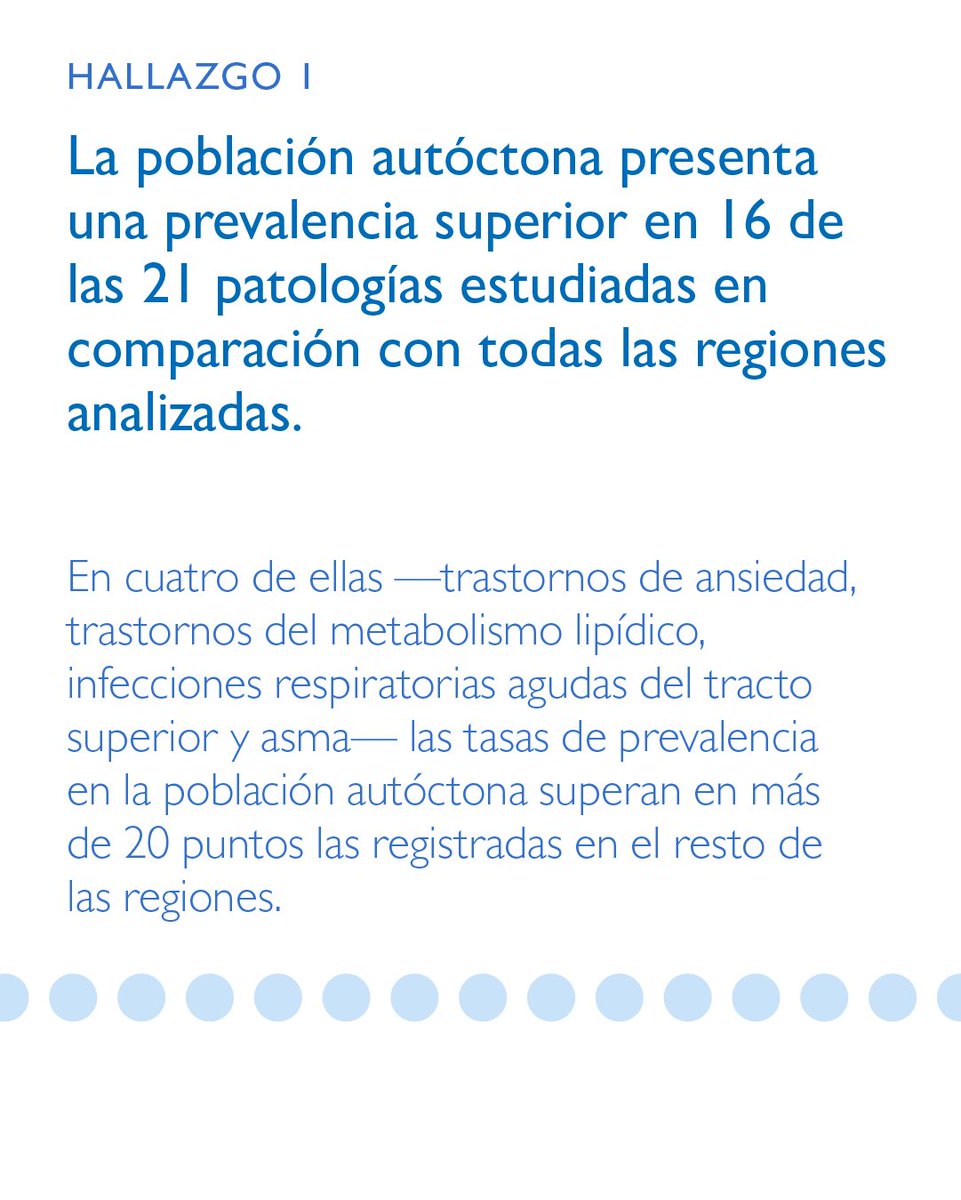
Los migrantes están más sanos y consumen menos recursos sanitarios que los españoles.
Publicamos el informe "Estado de salud y uso del sistema sanitario por la población migrante en España" 👇
@Thea_Pandia@Elzenutrio Eso que decís también. Encima ofensivo. Pero es que el informe tiene una calidad metodológica tan mala. Piensan de veras que somos tan tontos?
@Elzenutrio@sanidadgob La población española tiene más conocimiento metodológico de investigación cuali y cuanti que los trabajadores del M de Sanidad. Muestra no segmentada, grupo demográfico clave no incluido, sesgo de respuesta no mencionado… y no hablo de conclusiones, que me entra la risa floja
@JoseInaki2002@DarinaMarty@manukord Pues precisamente no estoy de acuerdo en eso. Su generación (la mía) hizo un cambio profundo en machismo, religión y otros temas estructurales del franquismo. Claro que existe machismo en España (y con un repunte preocupante), pero su mensaje es pura ideología
@DarinaMarty Existe algún plan de estudios no superiores en América/Europa que incluya historia subsahariana? Es que falta de cultura total, creo. Cierto que los afroamericanos de USA deberían tener un poco de interés, que son sus antepasados…
spain needs a different growth model.
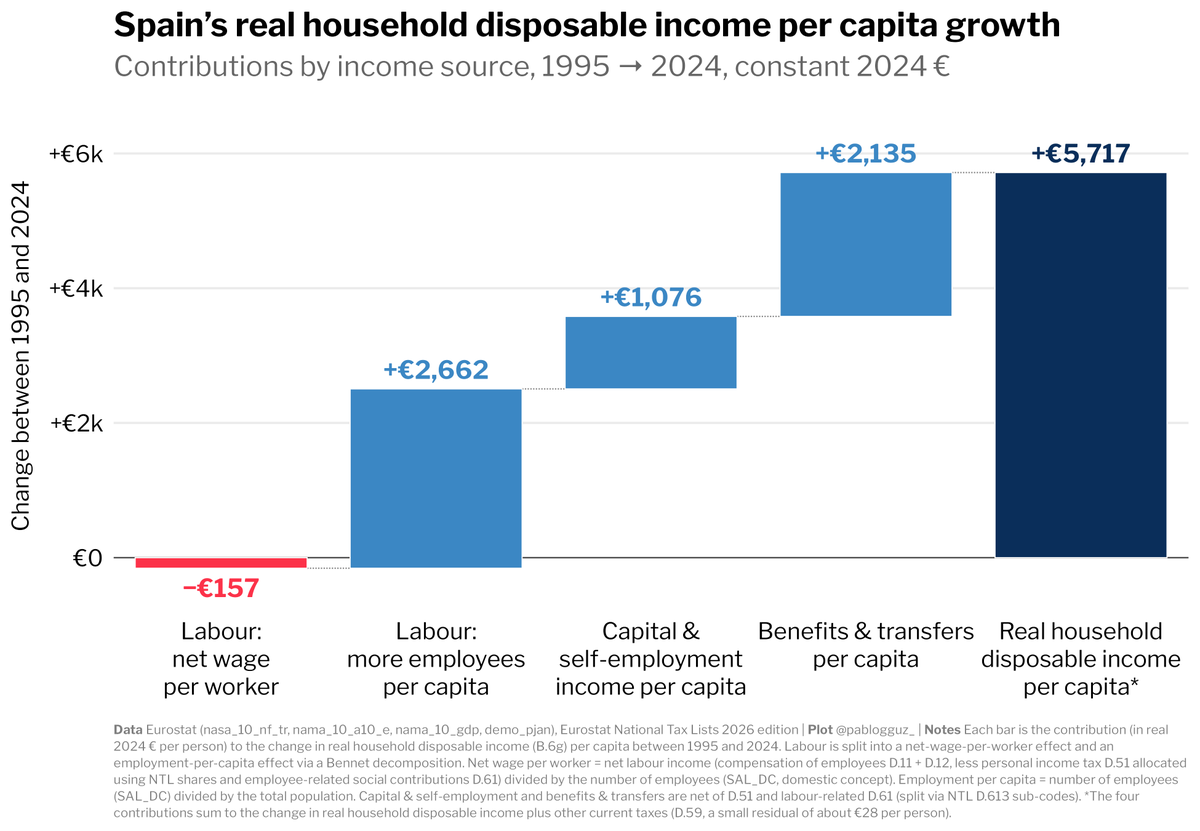
in the last 30 years, real household disposable income per capita has grown by roughly 38% in real terms (around €5.7k per person at 2024 prices). this can be decomposed into growth in net labour income per capita (+16.7 pp), cash benefits such as pensions (+14.2 pp), and capital and self-employment income per capita (+7.2 pp).
however, the labour contribution came entirely from the extensive margin (pulling more people into employment) rather than from higher real wages per worker. in fact, the average spanish employee takes home slightly less in real terms today than in 1995!
going forward, this model is unlikely to keep working. the extensive-margin gains came from two channels, both of which leaned on favourable conditions that are (most likely) not going to repeat. the first is that the working-age population grew faster than the total population during the 90s and 2000s, mainly because of the favourable age structure left behind by spain's baby boom (the large cohorts born in the 1960s and 1970s moved into prime working age while the cohorts behind them were smaller), but also because of immigration waves that were disproportionately working-age. this is what demographers often call a demographic dividend, which lifts the employment-to-population ratio purely by composition (even with no change in how much any given working-age person works). the second channel is that, within the working-age population, the employment rate rose substantially, from below 50% in the mid-1990s to around two-thirds today.
of course, none of this is bad, but there is only so much further either channel can go. the demographic dividend is already reversing: the baby boom cohorts are now moving into retirement, the cohorts replacing them are much smaller, and ageing will push the working-age share of the population down. the employment rate itself is approaching a natural ceiling -- there is still a gap relative to the average advanced european economy but it is not large, and closing it would only buy spain a few more years of compositional growth.
immigration, often raised as the way out, cannot realistically offset the demographic drag ahead. the scale of net inflows required to offset ageing on a sustained basis is multiples of any plausible figure consistent with social and political constraints in european countries, and even if such flows materialised, immigrants themselves age and accrue the same retirement pension entitlements as natives. in other words, sustaining the current demographic structure would require a permanent inflow large enough to offset both the ageing of the native population and that of past migrant cohorts, indefinitely. fertility, however, is now falling across virtually every region of the world, and the global working-age population is projected to peak within a few decades and then decline. there is simply no migrant pool waiting to be drawn from on the scale spain would need.
this is also why cash benefits cannot keep doing what they have been doing. it is worth being explicit about why retirement pensions, specifically, are at the centre of all this. spain runs a defined-benefit, pay-as-you-go public pension system: pensions are not the actuarial outcome of what each worker contributed, but a function of years contributed and final wages, paid out of the contributions of those currently working. the current system promises retirees an internal rate of return on their contributions that is significantly higher than anything the payments into the system can plausibly grow at. and because the payments into the system are, mechanically, the number of contributors times the average wage on which they contribute, a gap of that kind is sustainable only as long as the contributing base keeps expanding fast enough relative to the receiving one. the same demographic dynamics that enabled the extensive-margin growth of the last three decades are what allowed this to (sort of) work, but these are now reversing. on top of that, the system already runs a structural deficit: only about three-quarters of contributory pension expenditure is covered by social contributions, and the rest is financed out of general taxation paid by the entire population.
and pensions are not an independent source of household income. they are funded by taxes, and taxes have to be levied on income generated somewhere in the economy. in spain, as in any developed country, that income is overwhelmingly the wage bill: personal income tax and social contributions on labour. so the real question is whether labour income per worker is growing.
gross compensation per worker (including social security contributions) has in fact risen slightly in real terms since 1995, by around 5%. but the entire gain (and a little more) has been absorbed by a widening fiscal wedge, so that the take-home wage is marginally lower today than it was thirty years ago. in other words, the modest productivity gains the spanish economy has managed to deliver have not reached workers. they have been routed, in their entirety, into financing the rising weight of transfers.
one could argue, of course, that if wages eventually start growing, the additional income can simply be taxed away to keep financing rising benefits. but that is just another way of saying that the take-home pay of the average spanish worker is supposed to stay flat for the foreseeable future, and that whatever productivity gains eventually arrive will be routed straight through to retirees. i will leave it to the reader to judge what kind of social contract that describes.
thirty years of stagnant wages is already a long experiment in that direction. either policymakers start taking productivity growth seriously or the bill comes due on a model that was always going to run out of room.
@DarinaMarty@fmcarreno Ok, mi visión está sesgada por lo que veía en la clase media y clase alta entre la población del sudeste asiático, aún británicos de varias generaciones, y los blancos ingleses de siempre
@FPJ_Loretta Hay ciertos problemas estructurales que parecen que vayan a ser crónicos. Y una clase política no preparada para resolverlos. Y sin interés en ello que la política es otra cosa hoy. Nosotros teníamos horizonte. Hoy los jóvenes que son pobres con trabajo se ven así toda la vida
@DarinaMarty@fmcarreno Y no es muy británico ese rasgo? No soy historiadora ni socióloga ni nada. En mis años viviendo en Inglaterra, flipaba de lo mal visto y poco frecuentes que los matrimonios mixtos estaban. En USA eso mezclado con su historia de esclavitud más el tema evangélico, es pura distopia
@elderfel@UserM1HA@ignmun Un senior manager en una empresa de mas de 100mil empleados como el BBVA no toma decisiones estratégicas ni maneja ninguna P&L