🚨 Hims & Hers is entering the peptide market.
And the timing is interesting.
On November 9, the telehealth company confirmed plans to launch its Peptides+ offering this month.
The initial lineup includes:
• Sermorelin
• Glutathione
• NAD+
BPC-157 and TB-500 are planned for later, when permitted.
But there's a bigger regulatory story behind this move.
On October 30, HHS published an interim policy covering the compounding of six peptides, including BPC-157, TB-500, KPV, MOTS-c, Semax and Epitalon.
Under specified conditions, HHS does not intend to take enforcement action against qualifying compounders.
⚠️ But enforcement discretion is NOT FDA approval.
These compounds still raise important questions about clinical evidence, safety and product quality.
What's changing is the regulatory environment around access, not the scientific evidence itself.
The bigger question:
Will established healthcare platforms bring more transparency to the peptide industry, or create new challenges?
Sources:
Hims & Hers: https://t.co/FmAB0EoMbu
HHS: https://t.co/t5VAF6W9D3
🚨 46.5% vs. 6.8%. New Phase 2 results reveal an interesting development in peptide-assisted drug delivery.
And this has nothing to do with weight loss.
On November 10, PepGen announced new results from its FREEDOM2-DM1 trial of PGN-EDODM1, an experimental treatment for myotonic dystrophy type 1 (DM1).
DM1 is a genetic disease that affects muscle function and other organs. One underlying problem involves abnormal RNA interfering with how cells process genetic instructions.
🔬 WHAT DID RESEARCHERS FIND?
In the latest treatment cohort:
• 46.5% mean correction of abnormal RNA splicing at Week 13 (6 treated participants).
• 6.8% mean correction in a pooled placebo comparison group (4 participants).
• 5 of 6 treated participants exceeded 20% splicing correction.
• 4 of 6 exceeded 50%.
Researchers also reported an improvement of 3.9 seconds in a timed hand-opening test at Week 16, a measure related to muscle stiffness.
WHY DOES THE PEPTIDE MATTER?
PGN-EDODM1 isn't simply a peptide drug.
It's an oligonucleotide treatment attached to a cell-penetrating peptide.
The peptide is engineered to help deliver the RNA-targeting molecule into cells, where it can act on the underlying disease mechanism.
That's an important direction for peptide research: using peptides as delivery technology, not just as therapeutic molecules themselves.
⚠️ THE LIMITATIONS
These are early results from a very small cohort, not proof of clinical effectiveness.
Long-term outcomes remain uncertain, and the trial remains under a partial clinical hold in the United States.
THE BIGGER QUESTION:
Could engineered peptides become just as important for delivering genetic medicines as they are for developing new medicines?
Source: PepGen, November 10, 2026.
https://t.co/H9krEAyDs0
A peptide can look promising in a laboratory study and still fail in human clinical trials.
And sometimes, the problem isn't whether the molecule works.
It's whether researchers can get enough of it to the right place, keep it stable long enough, and avoid unwanted effects elsewhere.
That's what makes peptide drug development interesting.
A promising biological mechanism is only the beginning.
Researchers still have to solve:
• Stability and degradation
• Delivery and bioavailability
• Target selectivity
• Safety and tolerability
• Manufacturing consistency
A peptide that works in a cell experiment isn't automatically a viable medicine.
I'm curious:
Which challenge do you think is harder to solve in peptide therapeutics discovering an effective molecule or developing a reliable way to deliver it?
🚨 $1.15 BILLION. For a peptide discovery platform.
And this isn't another GLP-1 weight-loss story.
On November 9, 2026, biotechnology company argenx announced an agreement to acquire Unnatural Products (UNP), a California-based company specializing in macrocyclic peptide discovery.
The deal could reach approximately $1.15 billion.
Here's the breakdown:
• $550 million upfront in cash
• Up to $595 million in development and regulatory milestone payments
• UNP's peptide discovery team will remain in Santa Cruz, California.
🔬 WHY MACROCYCLIC PEPTIDES?
These molecules have ring-shaped structures that can be engineered to interact with challenging biological targets.
Researchers are investigating their potential to combine some advantages of small-molecule medicines with the target-binding capabilities associated with larger biologics.
argenx wants to integrate UNP's peptide discovery technology with its existing antibody engineering expertise.
The companies also see potential for developing oral and longer-acting treatments.
But there's an important distinction:
This is an investment in drug-discovery technology, not proof that any resulting treatment will succeed in clinical trials.
The acquisition remains subject to closing conditions, and the full $1.15 billion depends on future milestones.
THE BIGGER PICTURE
Peptides are attracting attention far beyond weight management.
Drug developers are exploring new ways to target difficult biology, improve delivery, and expand therapeutic options.
A deal of this size highlights the commercial interest in peptide discovery platforms.
💬 What do you think will drive the next major breakthrough: discovering new peptide molecules or improving how they're delivered?
Source: argenx, November 9, 2026.
https://t.co/XIGinfqyy4
🚨 58% vs. 41%. A once-daily oral peptide just passed another major Phase 3 test.
And this time, the results aren't about weight loss or ulcerative colitis.
They're about psoriatic arthritis, a chronic inflammatory disease affecting the joints and often the skin.
On November 7, 2026, Johnson & Johnson announced new Phase 3 results for icotrokinra (ICOTYDE) at the American College of Rheumatology's ACR Convergence meeting.
The findings are particularly interesting because icotrokinra is an oral peptide designed to block the interleukin-23 (IL-23) receptor.
Here's what happened. 🔬
THE PHASE 3 TRIAL
The ICONIC-PsA 1 study evaluated icotrokinra in 552 adults with active psoriatic arthritis who had not previously received biologic therapies.
Researchers compared once-daily oral icotrokinra with placebo.
The primary endpoint was an ACR20 response at Week 16.
ACR20 is a standardized measure requiring at least a 20% improvement in tender and swollen joint counts, alongside improvements in other measures of disease activity.
THE RESULTS
At Week 16:
• Icotrokinra: 58% achieved ACR20
• Placebo: 41% achieved ACR20
The trial met its primary endpoint.
But the researchers reported additional findings worth examining.
MORE THAN THE PRIMARY ENDPOINT
At Week 16:
ACR50 response:
• Icotrokinra: 29%
• Placebo: 16%
ACR70 response:
• Icotrokinra: 13%
• Placebo: 5%
And among participants with qualifying skin involvement:
Clear or almost clear skin:
• Icotrokinra: 57%
• Placebo: 14%
These results suggest effects on both joint and skin manifestations of the disease.
However, these are company-reported findings, and not every secondary comparison carries the same statistical interpretation as the primary endpoint.
HERE'S THE BIGGER DEVELOPMENT.
Icotrokinra is already FDA-approved in the United States for certain patients with moderate-to-severe plaque psoriasis.
But approval for one condition doesn't automatically establish approval for another.
Icotrokinra is not currently approved for psoriatic arthritis.
That's what makes this latest Phase 3 readout important.
Johnson & Johnson is investigating whether the same oral peptide can address additional inflammatory diseases.
And the development program goes beyond psoriatic arthritis, with studies also examining inflammatory bowel diseases.
WHAT ABOUT SAFETY?
Johnson & Johnson reported no new safety signals in ICONIC-PsA 1, with findings consistent with the treatment's established safety profile.
But the announcement doesn't answer every question about long-term effectiveness, comparative performance against existing treatments, or the full benefit-risk profile in this population.
Those questions remain important.
MY TAKEAWAY
One of the more interesting developments in peptide therapeutics is happening outside the obesity market.
Researchers are investigating orally administered peptides for serious immune-mediated conditions.
Icotrokinra's latest Phase 3 results show progress in psoriatic arthritis.
But the distinction remains:
Meeting a clinical trial endpoint is not the same as receiving approval for a new indication.
The next regulatory steps will be worth watching.
💬 Do you think oral peptide therapies will become a major competitor to injectable biologics in inflammatory diseases?
Official source: Johnson & Johnson, November 7, 2026.
https://t.co/ZieEo0BO9L
🚨 A peptide designed to attack bacterial biofilms just reached a major clinical trial milestone in the UK.
And this has nothing to do with weight loss, skin care, or the peptide trends dominating social media.
It's about something far more difficult to treat: infections around artificial joints.
On November 5, 2026, biotech company Peptilogics announced that its investigational antimicrobial peptide, zaloganan (PLG0206), had reached its first international enrollment milestone in the Phase 2/3 RETAIN clinical trial.
The first UK participants were recruited at Leeds Teaching Hospitals NHS Trust.
And the science behind this trial is particularly interesting. 🔬
THE PROBLEM: BACTERIAL BIOFILMS
When bacteria attach to medical implants, they can form protective communities known as biofilms.
These biofilms make infections difficult to eliminate.
Bacteria living inside them may be less susceptible to conventional antibiotic treatment and the body's immune defenses.
For patients with prosthetic joint infections, treatment can require additional surgery, prolonged antibiotic therapy, and sometimes replacement of the infected implant.
According to the Leeds research team, these infections affect approximately 2% of joint replacements.
That's a serious clinical challenge.
ENTER ZALOGANAN (PLG0206).
Zaloganan is an experimental antimicrobial peptide being investigated for its ability to disrupt bacterial biofilms.
Rather than relying solely on conventional antibiotic approaches, researchers are studying whether the peptide can help eliminate bacteria associated with infected implants.
The proposed mechanism involves disrupting bacterial membranes, including those of bacteria protected within biofilms.
But an interesting mechanism isn't proof of clinical effectiveness.
That's exactly what the RETAIN trial is designed to investigate.
WHAT IS THE RETAIN TRIAL?
RETAIN is a randomized, double-blind, placebo-controlled Phase 2/3 study.
It is evaluating zaloganan as an addition to standard surgical treatment for prosthetic joint infections following knee replacement.
Researchers want to determine whether the investigational treatment can reduce treatment failure, including recurrent infection.
The trial's primary outcome evaluates treatment failure through 12 months.
And now the study has expanded internationally.
The Leeds research team reported that its first three patients outside the United States received treatment within 25 days of recruitment beginning.
WHY DOES THIS NEWS MATTER?
Most mainstream peptide discussions focus on metabolic treatments, weight loss, or cosmetic research.
But peptides are also being investigated in infectious diseases.
Zaloganan represents an approach aimed at a problem that conventional treatment can struggle to resolve: bacteria protected within biofilms.
There is another important detail.
The FDA has granted zaloganan Fast Track, Qualified Infectious Disease Product, and Orphan Drug designations for prosthetic joint infection.
These designations support aspects of its development.
They do not mean zaloganan is FDA-approved.
And yesterday's announcement was about international trial progress, not successful Phase 2/3 efficacy results.
The clinical benefit remains to be demonstrated.
MY TAKEAWAY
The most interesting peptide research isn't always happening in the areas attracting the most online attention.
Sometimes it's happening in operating rooms, infection research, and clinical trials addressing serious unmet medical needs.
The RETAIN study is one worth following.
Because the real question isn't whether zaloganan can disrupt biofilms in experimental settings.
It's whether that activity translates into better outcomes for patients.
And the trial needs to answer that.
💬 What area of peptide research deserves more attention beyond obesity treatments: infectious diseases, neurological conditions, or something else?
Sources:
Peptilogics November 5, 2026
NIHR Biomedical Research Centre: Leeds November 5, 2026
Clinical trial: RETAIN (NCT07214311)
https://t.co/wKRVxlxLJw
The research peptide industry has a naming problem. 😂
GHK-Cu.
BPC-157.
TB-500.
KLOW.
GLOW.
Some names identify specific molecules.
Others are commercial names for blends.
And the same blend name doesn't necessarily mean the same ingredient composition across different suppliers.
Here's where things get interesting.
Imagine two research listings both labeled "KLOW."
One contains four specified peptide components.
Another uses the same blend name but lists different quantities.
The names look identical.
The formulations aren't.
And when people discuss the research behind these blends, there's another complication:
A study investigating one individual peptide doesn't automatically tell us what happens when that peptide is combined with three others.
A blend name isn't a chemical identity.
It's a distinction that gets overlooked when product names become more recognizable than the underlying compounds.
I'm curious:
What's the most confusing peptide name or blend you've come across recently?
KLOW? GLOW? TB-500? Something else?
🚨 Novo Nordisk just revealed its next major move in the obesity-drug market.
And this time, it's not another GLP-1-only treatment.
On November 4, 2026, Novo Nordisk announced that it is preparing for a potential U.S. launch of CagriSema in early 2027, subject to regulatory approval.
The announcement came alongside the company's third-quarter financial results.
But the interesting part isn't just the launch timeline.
It's the combination of two different hormone pathways.
WHAT IS CAGRiSEMA?
CagriSema is an investigational combination of:
• Cagrilintide: A long-acting amylin analogue.
• Semaglutide: A GLP-1 receptor agonist, the active ingredient in Ozempic and Wegovy.
These compounds act through different hormonal pathways involved in appetite and metabolic regulation.
The idea is to investigate whether combining amylin and GLP-1 activity can provide additional clinical benefits.
And Novo is now moving closer to a potential commercial launch.
WHAT DID NOVO ANNOUNCE?
In its November 4 update, Novo highlighted two Phase 3 clinical trial findings.
1. REDEFINE 9 Obesity
CagriSema 1.0/1.0 mg was associated with 21% weight loss at week 68.
2. REIMAGINE 5 Type 2 Diabetes and Obesity
At week 60, CagriSema 1.0/1.0 mg achieved:
• 12.4% weight reduction
Compared with:
• 9.1% for tirzepatide 5 mg
The study also demonstrated non-inferior HbA1c reduction for the specified comparison.
These findings are encouraging, but an important distinction remains.
A successful clinical trial doesn't automatically mean regulatory approval.
CagriSema remains investigational.
And the early 2027 U.S. launch is a company plan, not a confirmed approval or launch date.
HERE'S WHY THIS NEWS MATTERS.
The obesity-treatment industry is increasingly investigating combinations of hormonal pathways.
We've seen substantial attention around GLP-1 receptor agonists.
We've also seen growing research interest in amylin analogues and multi-receptor agonists.
CagriSema represents a different strategy: combining two compounds rather than relying on one molecule acting at multiple receptors.
But different mechanisms don't automatically establish better outcomes.
Clinical evidence, safety, tolerability, and regulatory review still determine what can be concluded.
THE BIGGER STORY
Novo already has established products in the obesity market.
Now the company is preparing for what could become another major addition to its portfolio.
If approved, CagriSema could introduce another amylin-based treatment option into the U.S. market.
For researchers following peptide-based metabolic therapies, the next important milestone isn't another headline percentage.
It's the regulatory decision.
And that decision will determine whether Novo's early 2027 launch plans can move forward.
What do you think will shape the next generation of obesity treatments more: single-molecule multi-receptor agonists or combination therapies targeting different pathways?
Official source: Novo Nordisk, November 4, 2026.
https://t.co/769K257DR2
The peptide industry has a strange contradiction.
People want more transparency from peptide vendors.
But some of the most important questions rarely come up in online discussions. 😂
Everyone talks about:
• Which compound is trending
• Which vendor has the biggest selection
• Which research product is getting attention
But here's something I've noticed while looking at how peptide products are presented online.
A vendor can publish a detailed laboratory report.
Another can display a single purity percentage.
A third might provide almost no testing information.
Yet all three can appear in the same conversation as though the available evidence is equivalent.
And that's what makes this industry interesting to study.
We're not always comparing products.
Sometimes we're comparing completely different levels of publicly available information.
There's a distinction worth making:
More documentation doesn't automatically establish higher product quality.
But better documentation can make claims easier to examine.
Those are not the same thing.
I'm curious about the people who follow peptide research and vendor information:
What's one piece of information you wish every peptide vendor made publicly available?
Not a marketing claim.
Something genuinely useful.
🚨 697 retatrutide products seized. 12 enforcement raids. RM341,000 in estimated value.
And the announcement raises a bigger question about the rapidly growing online peptide market.
On November 2, 2026, Malaysia's Health Minister, Dr. Dzulkefly Ahmad, revealed new enforcement figures during a parliamentary session.
The numbers are worth examining.
WHAT HAPPENED?
Malaysia's Ministry of Health reported:
• 12 raids involving retatrutide
• 697 product units seized
• Estimated seizure value: RM341,000 (Malaysian ringgit)
The enforcement activity took place between 2025 and September 2026.
And retatrutide wasn't the only product involved.
Authorities also reported:
• 7 enforcement raids involving illegally sold Ozempic/semaglutide products
• 62 units seized
• Estimated value: RM64,170
Combined, that represents 759 seized product units across 19 raids, with an estimated value exceeding RM405,000.
HERE'S WHY THIS MATTERS.
Retatrutide has attracted enormous attention because of its investigational results in obesity and metabolic research.
But there's a distinction between a compound producing promising results in controlled clinical trials and products being marketed online under the same name.
Retatrutide remains investigational and is not registered for sale in Malaysia.
A clinical trial evaluates a specific investigational product under defined conditions, with controlled manufacturing, eligibility criteria, and safety monitoring.
An online product advertised as “retatrutide” doesn't automatically have the same verified identity, formulation, quality, or clinical oversight.
And that's the larger issue.
THE ONLINE MARKET IS MOVING FASTER THAN REGULATORY APPROVAL.
Malaysia's Health Ministry says it is increasing monitoring of e-commerce platforms and social media to address unauthorized medicine sales.
This isn't simply a story about one molecule.
It highlights the growing challenge regulators face when public interest in experimental treatments expands beyond clinical research settings.
There's also an important limitation to these figures:
The seizures were carried out over a period ending in September 2026. They were disclosed publicly on November 2.
They are not 697 products seized in a single day.
MY TAKEAWAY
Scientific interest, commercial availability, and regulatory approval are three different things.
And as peptide research attracts more public attention, the gap between those categories deserves closer examination.
Do you think tighter enforcement will reduce the unregulated peptide market, or will demand simply move to less visible sellers?
Sources:
Malaysia Parliament, November 2, 2026
BERNAMA, November 2, 2026
https://t.co/Nm9EPy7TaG
The peptide community has a funny way of turning a research question into a popularity contest. 😂
One compound gets mentioned on a podcast.
Someone posts about it on X.
A few creators start discussing its potential.
And suddenly, the conversation shifts from:
"What does the research actually show?"
To:
"Is this the next big peptide?"
But here's what I find interesting.
A compound can be widely discussed without having strong human clinical evidence.
Another compound might have years of published research but barely receive attention online.
And sometimes, the most scientifically interesting findings are the ones that don't produce exciting headlines.
None of this means popular compounds are necessarily ineffective.
It just means popularity and scientific evidence are measuring two completely different things.
Social media tells us what people are interested in.
Clinical research helps us understand what has actually been demonstrated.
Both conversations can be valuable, but they shouldn't be confused.
I'm curious about something.
Which peptide do you think receives the most attention online relative to the amount of human clinical evidence available?
GHK-Cu? BPC-157? TB-500? Something else?
Interested to hear different perspectives. 👀
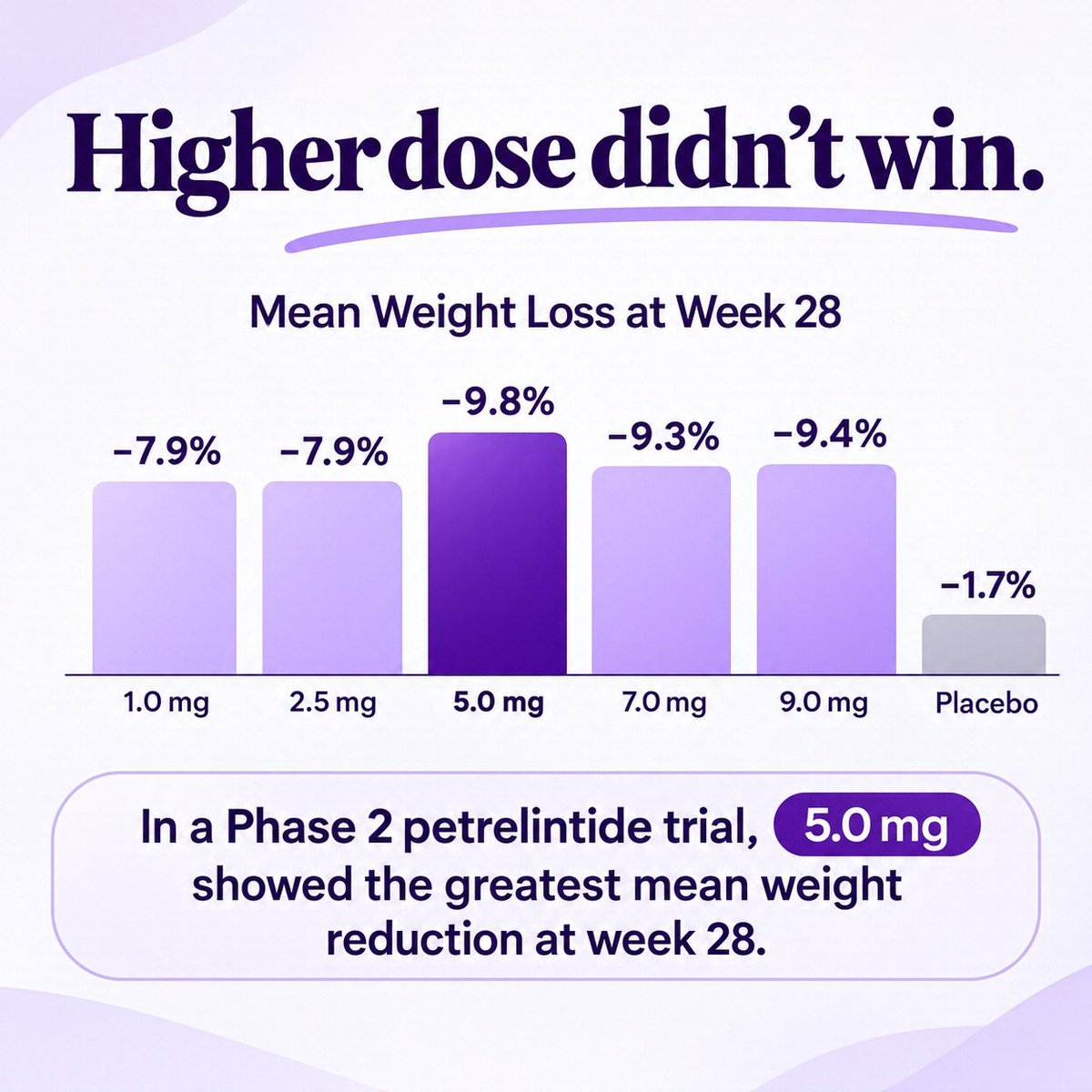
9.8% weight loss. But the highest dose didn't produce the best result.
A Phase 2 clinical trial of petrelintide, an investigational amylin analogue, revealed something interesting about obesity research.
And it's not another GLP-1 or retatrutide headline.
The study, published in The Lancet Diabetes & Endocrinology, investigated a different hormonal pathway involved in appetite and energy regulation.
Here's what the researchers found. 🔬
THE STUDY
The ZUPREME-1 Phase 2 trial randomized 493 adults with obesity or overweight and related health conditions, without type 2 diabetes.
Of those, 485 received at least one dose of the investigational treatment or placebo.
Participants received once-weekly petrelintide or placebo.
The primary endpoint was the percentage change in body weight after 28 weeks.
THE RESULTS
Mean body-weight changes at week 28:
• Petrelintide 1.0 mg: −7.9%
• Petrelintide 2.5 mg: −7.9%
• Petrelintide 5.0 mg: −9.8%
• Petrelintide 7.0 mg: −9.3%
• Petrelintide 9.0 mg: −9.4%
• Placebo: −1.7%
Notice something?
The 5.0 mg group had the greatest mean weight reduction.
Not the 7.0 mg group.
Not the 9.0 mg group.
At least at the primary 28-week endpoint, increasing the dose beyond 5.0 mg did not produce a greater average reduction.
That doesn't establish that 5.0 mg is the optimal dose for everyone, or prove that the higher doses are less effective.
The numerical differences between active-treatment groups are not enough to establish meaningful superiority without appropriate comparisons.
But the pattern is scientifically interesting.
WHY PETRELINTIDE IS DIFFERENT
Petrelintide is a long-acting analogue of amylin, a hormone involved in appetite regulation.
Unlike GLP-1-based therapies, it targets the amylin pathway.
That distinction matters because obesity researchers are investigating multiple biological mechanisms rather than relying on one hormone pathway alone.
But having a different mechanism doesn't automatically make a treatment safer, more effective, or better tolerated.
Clinical trials have to establish those outcomes.
WHAT ABOUT SAFETY?
Nausea was the most commonly reported adverse event:
• Petrelintide groups combined: 20%
• Placebo: 6%
The researchers reported that nausea was predominantly mild and generally occurred during dose escalation.
No deaths were reported in the trial.
However, a Phase 2 study cannot establish the full long-term safety profile of an investigational treatment.
THE BIGGER PICTURE
At week 42, mean weight reductions reached up to 10.7% in the petrelintide groups.
Those results support further investigation, but they don't establish how petrelintide compares directly with semaglutide, tirzepatide, or retatrutide.
Such comparisons require appropriately designed head-to-head studies.
Here's my takeaway:
More receptor activity doesn't automatically mean a better treatment. And a higher dose doesn't automatically produce a better outcome.
The important questions are what a treatment achieves, how consistently it works, and what risks accompany those results.
That's what makes dose-finding trials worth following.
Would you rather see researchers focus on maximizing weight reduction or finding the strongest balance between efficacy and tolerability?
Source: The Lancet Diabetes & Endocrinology, ZUPREME-1, published online September 29, 2026.
https://t.co/Ck7GF1zKxj
@snappeptides Exactly. A COA without clear sample identification and traceability doesn't tell the whole story. Context matters just as much as the result.
One thing that makes peptide discussions surprisingly confusing:
Two people can argue about the SAME peptide for 30 minutes…
And eventually discover they weren't talking about the same thing. 😂
One person is discussing a published clinical trial.
Another is referring to an animal study.
Someone else is talking about a research product listed by a vendor.
And another person is sharing something they heard on a podcast.
Same compound name.
Four completely different conversations.
Here's where it gets interesting.
A compound studied under controlled clinical conditions isn't automatically equivalent to every product advertised under that name.
The formulation, testing, study population, and evidence can be very different.
And a result involving one compound doesn't automatically apply to a combination containing it.
That's why I think one question deserves to come much earlier in peptide conversations:
"Which study or specific preparation are we actually talking about?"
It sounds like a small distinction.
But it can completely change the discussion.
I'm curious: What's the most common misunderstanding you notice in peptide conversations?
The research itself, the products being discussed, or the expectations people bring into the conversation?
6 peptides. One major U.S. policy change. And a detail getting lost in the headlines.
BPC-157, TB-500, MOTS-c, KPV, Semax, and Epitalon are at the center of a significant regulatory development.
On October 30, 2026, the U.S. Department of Health and Human Services (HHS) published a Federal Register notice announcing an enforcement-discretion policy for compounding with certain peptide bulk drug substances.
And the distinction between what this policy allows and what it actually establishes is important.
WHAT CHANGED?
Under the policy, HHS says it does not intend to take enforcement action against certain state-licensed pharmacies, federal facilities, and licensed physicians compounding drugs using the six specified peptide substances, provided the policy's conditions are met.
This applies to a particular category of pharmacy compounding under Section 503A of federal law.
It is not a blanket authorization for every peptide vendor or online research-product seller.
HERE'S WHAT MAKES THIS INTERESTING.
The six substances are:
• BPC-157
• TB-500
• MOTS-c
• KPV
• Semax
• Epitalon
Several of these compounds have generated considerable interest in experimental peptide research.
But the new policy doesn't mean their clinical benefits have suddenly been established.
And it doesn't mean the FDA has approved them as medicines.
THREE IMPORTANT DISTINCTIONS
Enforcement discretion isn't FDA approval.
HHS is describing circumstances in which enforcement action is not intended.
That is different from the FDA evaluating and approving a medicine for safety and effectiveness.
Compounded drugs aren't FDA-approved products.
Unlike FDA-approved medications, compounded drugs do not undergo FDA premarket review for safety, effectiveness, or quality.
This is an interim policy.
HHS says the approach may be reconsidered if safety signals or product-quality concerns arise.
The separate regulatory process for determining which bulk substances can be used under Section 503A is still relevant.
WHY THIS MATTERS FOR PEPTIDE RESEARCH
Regulatory access and scientific evidence are related, but they answer different questions.
A change in enforcement policy can affect how certain products may be compounded.
It doesn't establish that a compound works for a particular condition.
And it doesn't eliminate questions about clinical evidence, manufacturing quality, adverse events, or long-term safety.
This development also highlights a tension in peptide regulation.
Supporters see greater access through licensed compounding as an alternative to less-controlled supply channels.
Critics worry about allowing wider access before adequate evidence of safety and effectiveness is established.
Both perspectives raise questions worth examining.
MY BIGGEST TAKEAWAY
The headline isn't simply that six peptides received different regulatory treatment.
It's that policymakers are changing how certain experimental substances may be accessed while important scientific questions remain unresolved.
That's a development worth following closely.
What do you think should matter most when regulators consider expanding access to experimental compounds?
Clinical evidence, product-quality controls, or patient access?
Official source: HHS, Federal Register, October 30, 2026.
https://t.co/t5VAF6W9D3
Fair point. The triple-agonist mechanism helps explain the difference. But receptor activity alone doesn't tell us the full clinical picture. That's why the head-to-head results, safety, and tolerability data matter. Greater weight loss doesn't automatically mean a better drug overall.
A peptide-related clinical trial found almost no difference in weight loss overall.
But when researchers examined a smaller group of participants, the results looked very different.
And that's where this study gets interesting.
A randomized clinical trial published in the International Journal of Molecular Sciences on October 1, 2026, investigated a standardized pumpkin-seed-derived preparation containing peptide components.
The study enrolled 50 overweight adults and compared the preparation with placebo over 12 weeks.
Here's what researchers found.
THE OVERALL RESULTS
Among participants with evaluable body-composition data, the adjusted difference between the treatment and placebo groups was:
• Body weight: −0.05 kg
• BMI: −0.09 kg/m²
• Total fat mass: +0.30 kg
None of these overall comparisons reached statistical significance.
In other words, the trial did not demonstrate a clear overall benefit for these outcomes.
BUT THEN CAME THE SUBGROUP ANALYSIS.
Researchers examined 13 participants who had higher baseline body fat.
In this smaller group, the adjusted difference in body weight at week 12 was:
−2.30 kg compared with placebo.
The reported p-value was 0.018.
That looks considerably more promising than the overall result.
But here's the important part.
This subgroup wasn't defined in advance.
It was identified through a post hoc exploratory analysis.
And only 13 participants were included.
The formal statistical tests examining whether baseline fat mass modified treatment effects did not reach statistical significance.
The exploratory findings also weren't adjusted for multiple comparisons.
So while the subgroup result raises an interesting research question, it doesn't establish that the intervention works for people with higher body fat.
WHY DOES THIS MATTER?
It's easy to take the most impressive number from a clinical trial and turn it into a headline.
But a subgroup finding and an overall trial result answer different questions.
A promising result in a small, retrospectively defined subgroup needs confirmation in a study designed to test that specific hypothesis.
There's another distinction worth noting.
This study tested a complete pumpkin-seed-derived preparation containing peptide components, not an isolated therapeutic peptide.
The findings cannot be attributed to one particular peptide.
For me, this is a useful reminder of how scientific evidence should be interpreted.
An interesting subgroup result is a reason to investigate further. Not a reason to ignore the overall findings.
And negative or inconclusive findings deserve attention too.
They help researchers understand which hypotheses remain unsupported and what better studies need to investigate.
What do you think gets overlooked more in research headlines: the overall results or the limitations of subgroup analyses?
Source: International Journal of Molecular Sciences, October 1, 2026.
https://t.co/dc2GKIsHFl
The peptide community has a strange relationship with evidence. 😂
Someone shares a promising animal study.
Someone else replies with a human anecdote.
A third person pulls up a clinical trial involving a different compound.
And suddenly everyone is debating the same conclusion using three completely different types of evidence.
Here's the problem:
A laboratory experiment can help explain a biological mechanism.
An animal study can provide useful early evidence.
A personal experience can generate questions worth investigating.
A well-designed human clinical trial can test specific outcomes in a defined population.
But these aren't interchangeable.
And even human trials can disagree because they study different populations, measure different outcomes, or use different designs.
That doesn't make early research worthless.
It means the strength of the conclusion should match the strength of the evidence.
Genuine question:
What's the biggest problem you notice in online peptide discussions?
People trusting anecdotes too much, or people dismissing early-stage research too quickly?
20.9% vs. 9.4% weight loss. Same clinical trial. Two different molecules.
Eli Lilly just released results from a Phase 3 trial comparing investigational retatrutide directly with Ozempic (semaglutide).
And the results deserve attention.
The TRANSCEND-T2D-2 study enrolled 1,298 adults with type 2 diabetes whose blood sugar remained inadequately controlled on existing treatment.
After 80 weeks, Lilly reported:
Average weight loss:
• Retatrutide 12 mg: 20.9%
• Retatrutide 9 mg: 19.5%
• Ozempic 2 mg: 9.4%
Average A1C reduction:
• Retatrutide: 2.2 percentage points
• Ozempic: 1.8 percentage points
Those differences are substantial.
But here's where the discussion gets more interesting.
Greater efficacy came with a trade-off.
Treatment discontinuation due to adverse events occurred in:
• 7.9% of the retatrutide 12 mg group
• 4.8% of the retatrutide 9 mg group
• 2.7% of the Ozempic group
Gastrointestinal side effects were common across groups.
There's another important detail.
These are company-announced topline results, not yet a fully published, peer-reviewed analysis of this trial.
The study was also open-label, meaning participants and investigators knew which treatment was assigned.
And these comparisons used an efficacy estimand that estimates outcomes under continued assigned treatment without certain additional diabetes medications.
That matters when interpreting the percentages.
Retatrutide activates three hormone receptors: GIP, GLP-1, and glucagon. Semaglutide acts on the GLP-1 receptor.
The results strengthen the evidence for investigating triple-receptor agonism in type 2 diabetes.
They do not establish that retatrutide is appropriate for everyone, and the molecule remains investigational and unapproved.
The bigger question:
When an experimental treatment delivers substantially greater efficacy but also higher treatment discontinuation, how should researchers weigh that trade-off?
Source: Eli Lilly, October 28, 2026. TRANSCEND-T2D-2 (NCT06260722).
https://t.co/G2D23COTeB
TWO LAB REPORTS CAN SHOW 99% PURITY AND STILL TELL VERY DIFFERENT STORIES.
Here's why.
Imagine two research samples.
Both reports display:
Purity: 99%
At first glance, the results look identical.
But look closer.
Report A
• Includes a batch identifier
• Identifies the analytical method
• Reports identity testing
• Provides a dated result
Report B
• Shows a purity percentage
• Doesn't identify the tested batch
• Provides limited method information
• Doesn't clearly document identity testing
Same headline number.
Very different levels of documentation.
And there's something else worth remembering:
A purity percentage doesn't automatically establish the quantity of the intended substance.
It also doesn't establish safety or effectiveness in humans.
The lesson?
Don't judge analytical evidence by the biggest number on the page.
Look at what was measured, how it was measured, and whether the documentation supports the conclusion.
Good research requires context.
Peptide Grading | Research Data & Education
The two reports are hypothetical examples.