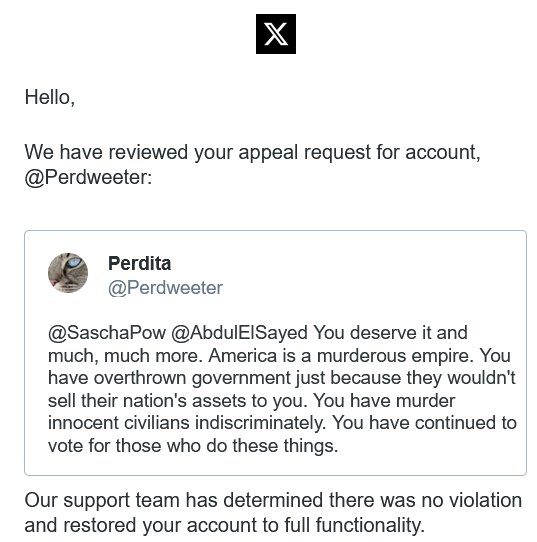
Suck it, pussy bitch who tried to get me banned.
Stating that America deserved 9/11 is legitimate free political speech, and all your snowflake feewings can't change that.
@meenanwallace@henrycooke If you don't like it, you can always move to the genocidal haven for paedophiles that you adore. Literally no one is stopping you from living your anti-democratic fascist dream in the land your God promised you 3,000 years ago.
Off you pop.
@ww5376460157810@henrycooke You want women to be underpaid so you can pay lower taxes?
But you cry if landlords take a minor haircut so we can pay lower rent.
You're just a cunt. Not a rationalist. Not a conservative. Not objective, or smart. You're a self-centred, grasping, cunt.
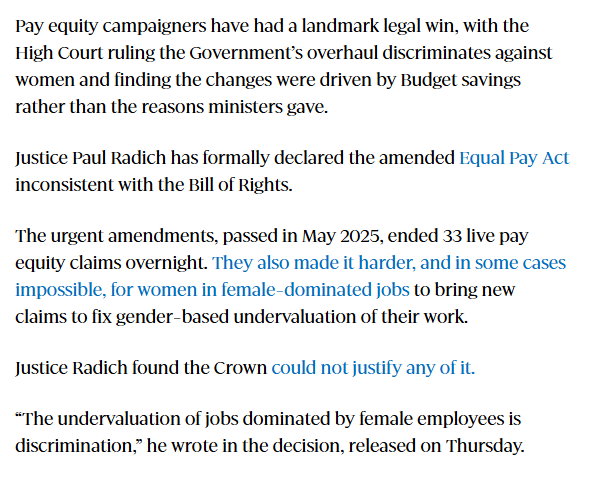
‘The Government breached women's rights when it scrapped dozens of pay equity claims and made it harder to apply in future, the High Court has ruled’
https://t.co/S3uVsdFgUD
Democrats need to acknowledge that Biden’s unconditional support for Israel enabled the mass murder of civilians, crimes against humanity, and yes, genocide. Enough with the bullshit about how he’s a “kind” and “moral” man. He was with Bibi to the very end https://t.co/urx9kpuiGe
@FaithDahdouh@Daisyandboy@nbcsnl Just because you've decided to make yourself the family martyr, doesn't require your sisters to pray at your feet, girl. You're trying to bully them to take on a role they don't want, and you failed. I bet you were always a bully to them this way.
@TruthFairness@Butters09016449@nbcsnl Oh bullshit. Having children is not a home care plan. No children are required to look after their parents. This woman can just as well do nothing like her sister and brother.
I say good on her sister for not allowing herself to be guilted into a role she doesn't want.
@drstexy@shriverist As a non-American: Yeah, sounds about right.
Hey, did you know Obama tried to make medicine more expensive in my country, to benefit your companies? The guy shitlibs consider the best of you, wanted poor people in my country to die, for the benefit of your stockmarket.
EXCLUSIVE: After a months-long investigation, Channel 4 News’s FactCheck team has obtained a dossier of new files on UK arms export licences to Israel.
I invite right bloc voters to examine what actually happened here, and think about the importance of a functional democracy in which people have confidence, over a temporary win for "my team"...
From the New Zealand Law Society's submission on the Electoral Amendment Bill — 11 September 2025. Key excerpts, lightly abridged:
──────────
𝗦𝗲𝗿𝗶𝗼𝘂𝘀 𝗰𝗼𝗻𝗰𝗲𝗿𝗻𝘀 (§𝟮.𝟭)
The Law Society has serious concerns about the proposed electoral amendments. Disenfranchisement — arising from the proposed close of registration 13 days ahead of election day, and the changes to prisoner voting — is the first of them.
The amendments in clauses 4 and 10–12 have the potential to significantly reduce voter participation, effective representation, and consequently public trust and confidence in the election process. That carries collateral risks of undermining democracy and the moral authority of elected governments.
Had the 13-day registration rule applied at the 2023 election, it would have affected over 230,000 special voters.
──────────
𝗡𝗼 𝗽𝘂𝗯𝗹𝗶𝗰 𝗰𝗼𝗻𝘀𝘂𝗹𝘁𝗮𝘁𝗶𝗼𝗻 (§𝟮.𝟮)
Despite proposing changes with potentially significant democratic, social and political impacts, there was no public consultation on the design and drafting of these proposals. Earlier reviews that did consult never even considered closing enrolment so far ahead of election day.
Māori, Pasifika, Asian and young voters are the most likely to be disproportionately affected — and the shortcomings in consultation, particularly with Māori, fail both policymaking best practice and the Crown's Te Tiriti o Waitangi obligations.
──────────
𝗣𝗿𝗼𝗴𝗿𝗲𝘀𝘀𝗲𝗱 𝗮𝗴𝗮𝗶𝗻𝘀𝘁 𝗼𝗳𝗳𝗶𝗰𝗶𝗮𝗹𝘀' 𝗮𝗱𝘃𝗶𝗰𝗲 (§𝟮.𝟯)
Officials identified that alternatives like automatic enrolment updates deliver greater benefits while mitigating the harm to participation — yet this proposal was progressed against their advice, with no evidence it is needed for, or will deliver, a faster vote count.
It is rare for the special vote count to affect government formation in New Zealand. The changes appear harmful to democratic participation, without any appropriate or requisite corresponding gain.
──────────
𝗧𝗵𝗲 𝗯𝗼𝘁𝘁𝗼𝗺 𝗹𝗶𝗻𝗲 — 𝗰𝗹𝗼𝘀𝗲 𝗼𝗳 𝗿𝗲𝗴𝗶𝘀𝘁𝗿𝗮𝘁𝗶𝗼𝗻 (§𝟯.𝟴–𝟯.𝟭𝟬)
No pressing need exists to deliver final results earlier; government formation does not require it in most cases, and New Zealand's experience matches other countries.
An early close of registration is unnecessary given its likely disenfranchising effect. Clause 4(2) and the new definition of "close of registration" should not proceed.
──────────
𝗧𝗵𝗲 𝗯𝗼𝘁𝘁𝗼𝗺 𝗹𝗶𝗻𝗲 — 𝗽𝗿𝗶𝘀𝗼𝗻𝗲𝗿 𝘃𝗼𝘁𝗶𝗻𝗴 (§𝟰.𝟮𝟬–𝟰.𝟮𝟭)
The available evidence does not demonstrably justify the restriction. The proposed ban creates inconsistencies and arbitrary outcomes, contravenes domestic and international norms, and is an acknowledged breach of the Treaty.
The Law Society opposes clause 10(2) and new section 86B — and recommends they not proceed.
──────────
𝗔𝗻𝗱 𝗣𝗮𝗿𝗹𝗶𝗮𝗺𝗲𝗻𝘁 𝗽𝗮𝘀𝘀𝗲𝗱 𝗶𝘁 𝗮𝗻𝘆𝘄𝗮𝘆.
Third reading, 16 December 2025 — 68 votes to 54, coalition parties only. Not one opposition vote. The second reading and committee stages had been rammed through under urgency the week before.
New Zealand has a long-held convention — invoked by both major parties — that the rules of our democracy are changed only with broad cross-party support. It is convention, not law; nothing forces a government to honour it.
Most do, because the alternative is exactly this: one side of the House rewriting the rules everyone must play by — against the advice of its own officials, against its own Attorney-General's Bill of Rights report, and against more than 80 percent of the 2,708 people and organisations who made submissions.
Conventions like this are not enforced by courts. They are held up by decency — by governments deciding that public confidence in the system matters more than a win for "my team".
This one decided otherwise.
──────────
Sources:
NZ Law Society, submission on the Electoral Amendment Bill (11 Sep 2025)
https://t.co/06NKPv9aF8
Justice Committee report on the Electoral Amendment Bill (2,708 submissions; recommendation by majority; >80% of submitters opposed)
https://t.co/fHfHRVvMid
RNZ, "Electoral Amendment Bill passes its third reading in Parliament" (17 Dec 2025)
https://t.co/H2ep28SmGW
All links verified live, 15 November 2026.
I hate when those celebrities want to talk about Palestine and they have to smooth it over with "the children of Gaza deserve to live." No—everyone, men, women, and children of Palestine, deserves to live in their homeland without being bombed. All of them deserve to live
In 1890, the legal age of sexual consent in Delaware was seven years old.
Seven.
In 38 American states, it was twelve or younger.
A man accused of sexually assaulting a little girl could escape conviction by arguing that she had consented.
One woman helped change that.
Her name was Helen Hamilton Gardener.
At a time when most American women couldn't even vote, Gardener joined a movement demanding that lawmakers raise the age of consent and offer girls greater protection against sexual exploitation.
What she discovered was horrifying.
Some legislators resisted reform because they feared girls would falsely accuse men. Others insisted that girls matured early enough to consent to sex.
In Texas, opponents argued that working girls might blackmail their employers. Another argument was that Southern chivalry offered women sufficient protection.
These were actual arguments recorded in an 1895 report on legislative opposition.
Gardener refused to remain silent.
She wrote novels exposing the consequences of sexual abuse, published detailed comparisons of state laws, and publicly identified states that refused to strengthen their protections.
She encouraged Americans to question nearly 9,000 state legislators about their positions.
She also fought proposals that would have denied protection to sexually assaulted girls unless they could prove they had been virgins.
And she challenged the supposedly scientific arguments used to portray women as intellectually inferior to men.
Her campaign was part of a much larger movement involving thousands of women, including suffragists, temperance activists and Black reformers.
By 1900, 32 states had raised their age-of-consent thresholds to between fourteen and eighteen.
Gardener subsequently became an influential campaigner for women's suffrage, helping secure President Woodrow Wilson's support for a federal constitutional amendment.
In 1920, she became the first woman appointed to the United States Civil Service Commission.
She died in 1925.
There is something extraordinary about the women who fought these battles.
They had to ask men for permission to protect children from other men, while those same men denied them the right to participate equally in making the laws.
And some of those lawmakers were more concerned about protecting adult men from accusations than protecting little girls from sexual assault.