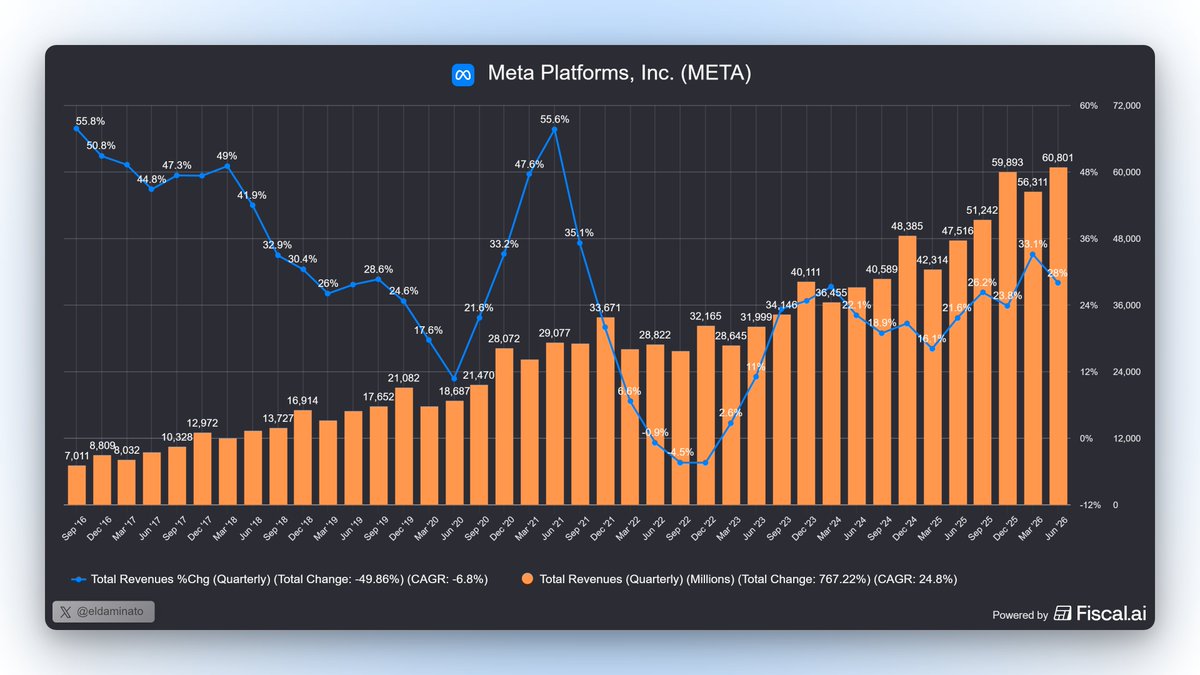
$META 2Q26
Ingresos totales de USD 60.8B (+28% interanual), levemente por encima de expectativas ($60.2-60.3B). - - Negocio de ads creció al 27.5% y/y.
- Ingresos por suscripciones volando 73% y/y ya genera revenue trimestral de USD 1B.
- Reality Labs creció revenue al 17% interanual y quemó operativamente USD 4.6B. Acumula USD 8.6B de pérdida operativa ese negocio en el primer semestre, levemente por debajo que en mismo período del año pasado.
Costos operativos subieron fuerte 55% interanual lo que impactó en una reducción de la ganancia operativa.
Hubo USD 2.4B de gastos legales y USD 1.18B por indemnizaciones por reducción de nómina, ajustando el margen operativo al 30.1% versus 43% del año pasado.
El EPS fue de $ 6.18 (vs. ~$7.14-7.22 esperado) que se redujo ademas por un tax rate del 16% en lugar del 11% como un año atrás.
Cash operativo creció 24.6% interanual pero el Capex aceleró al 82% y/y, consumiendo prácticamente el 95% del cash operativo. Como resultado, el FCF fue apenas positivo por USD 784M. No hicieron recompras, siguen priorizando las inversiones en infraestructura y Data Centers. Destinaron USD 1.35B al pago del dividendo trimestral.
Guidance:
Revenue 3Q26: $61-64B (midpoint por debajo de expectativas de Wall Street ~$63.1B; headwind FX ~1%) que ayudaron al sell off en el after.
Gastos 2026: $165-169B (subieron el piso por los cargos legales).
Capex 2026: $130-145B (estrecharon el rango desde $125-145B). Esperan maximizar capacidad en 2026-2027.
Siguen esperando ganancia operativa de todo el 2026 que sea superior a la del 2025.
Métricas de usuarios y negocio:
-DAP (Family): 3.60 mil millones (+3% interanual).
-Instagram llegó a 2 mil millones de DAU.
-Threads: +500 millones de MAU (crecimiento más rápido de su categoría).
-WhatsApp: récord de 30 millones de mensajes/segundo en la final del Mundial.
-Impresiones de ads +14%, precio promedio por ad +12%.
-Reality Labs: ingresos $431M (+16%), impulsado por anteojos de IA (offset por menos ventas de Quest).
Zuckerberg destacó que la IA ya acelera el negocio core (recomendaciones, ads más relevantes/conversiones, herramientas creativas) y abre nuevas oportunidades:
Personal agents: gran apuesta a futuro (agentes 24/7 que ayuden en vida personal, salud, finanzas, etc.).
Business agents: ya >1 millón de negocios usándolos semanalmente (WhatsApp/Messenger; rollout en Instagram).
Modelos de Meta Superintelligence Labs: Muse Spark 1.1 (agentic/coding) y Muse Image. +60% de interacciones diarias con Meta AI desde la integración.
Posible venta de computo (están recibiendo ofertas con premium).
Hay 9 millones de pequeños negocios usando herramientas creativas de IA para ads.
Visión: IA mejora engagement y ads hoy, y generará nuevas líneas de ingresos (agentes, APIs, enterprise).
Terminaron el trimestre con USD 90.2B en cash y USD 83.6B de deuda de largo plazo.
Negocio está creciendo muy arriba del 20% interanual a pesar de su tamaño y continúa sumando nuevos usuarios activos. Pero deterioró márgenes y sigue demandando alto capex que consume el FCF. Y eso en el corto plazo el mercado no lo premia.
El ROIC se mantiene en tendencia bajista. Era del 25% en el trimestre de marzo y ahora se redujo al 23%. Hace un año era del 35%. La incógnita es si las inversiones actuales permitirán que su ROIC se expanda en el futuro. El management confía en que sí y que será un negocio mucho mas grande, pero el mercado lo sigue poniendo en duda.
La acción derrapó hasta 11% en el after, ahora opera 6.5% abajo en la nocturna.
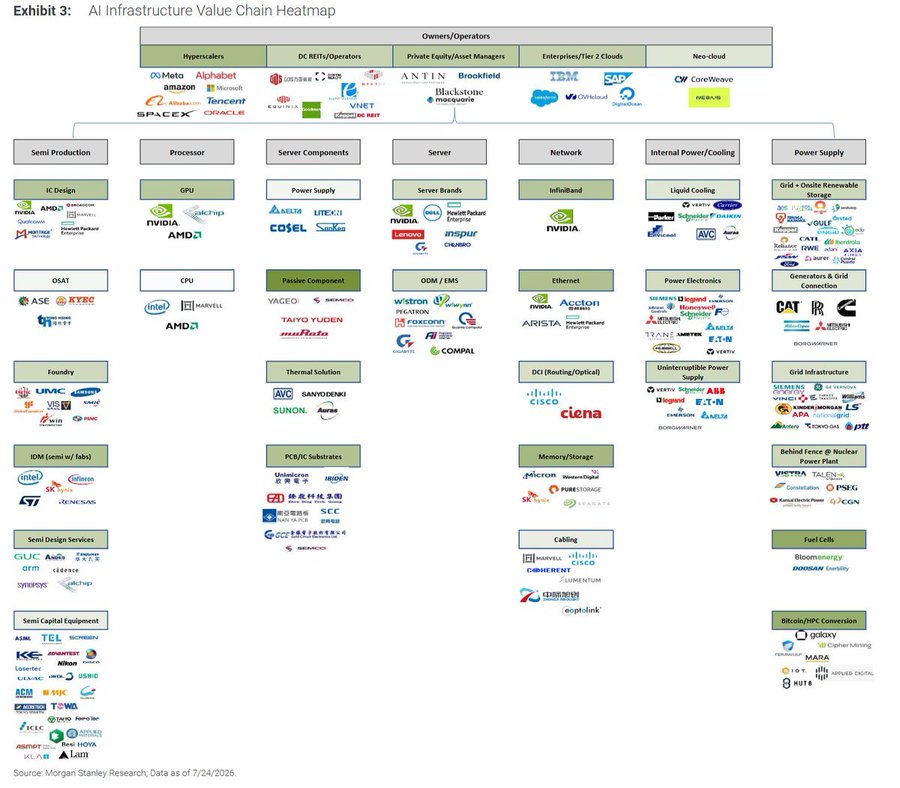
Morgan Stanley just mapped out the entire AI infrastructure supply chain, and it reveals who actually gets paid at every layer of the trillion dollar buildout (Save this).
This heatmap breaks the AI infrastructure value chain into two dimensions those who owns and operates the data centers at the top and what physical and technical components get built underneath to make those data centers function.
At the top sit the owners/operators, the hyperscalers like Meta, Alphabet, Amazon and Microsoft, alongside data center REITs, private equity giants like Blackstone and Brookfield, enterprises and neoclouds including CoreWeave and Nebius.
These are the companies writing the massive capex checks that fund everything below them.
Below that sits the actual build out, split into seven layers, semi production, processors, server components, servers, network, internal power/cooling and power supply.
Semiconductor production is dominated by names your audience already knows well, Nvidia and AMD for GPUs, TSMC adjacent foundries, ASML and Applied Materials for capital equipment, and Micron and SK Hynix under memory/storage.
But the less obvious money is in the physical infrastructure layers most retail investors never look at.
Server components include passive parts from Yageo and Murata, thermal solutions from Sanyo Denki, and PCB substrates from companies like Unimicron.
Network infrastructure includes InfiniBand and Ethernet gear from Nvidia and Arista, plus optical/DCI routing from Cisco and Ciena.
Internal power and cooling is arguably the most underappreciated category here.
It includes liquid cooling specialists like Vertiv and CoolIT, power electronics from Siemens and Eaton, and uninterruptible power supply makers like ABB and Legrand, all companies solving the literal heat and electricity problem created by cramming more GPUs into less space.
So who benefits from all of this?
Everyone in every box benefits in some way but the real insight is that value doesn't concentrate at just the GPU layer anymore.
The hyperscalers at the top are distributing capex across seven distinct physical layers which means the picks and shovels opportunity set has expanded well beyond Nvidia into cooling, grid infrastructure, and power generation.
Milk Road Pro is tracking each one of these layers, come join us for just a dollar using the link below!
Having a wide moat is what allows a company to compound for DECADES.
These are 10 of the most impenetrable stocks in the entire market:
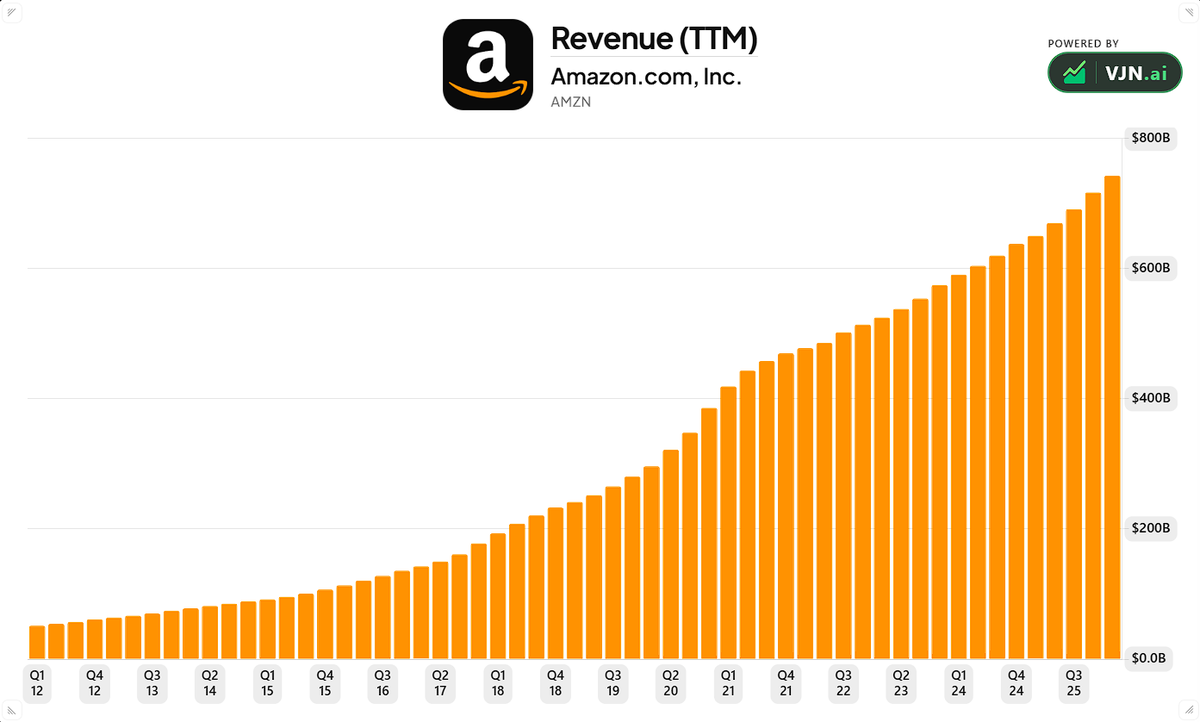
1. $AMZN: A highly diversified business with unmatched scale and continual reinvestment
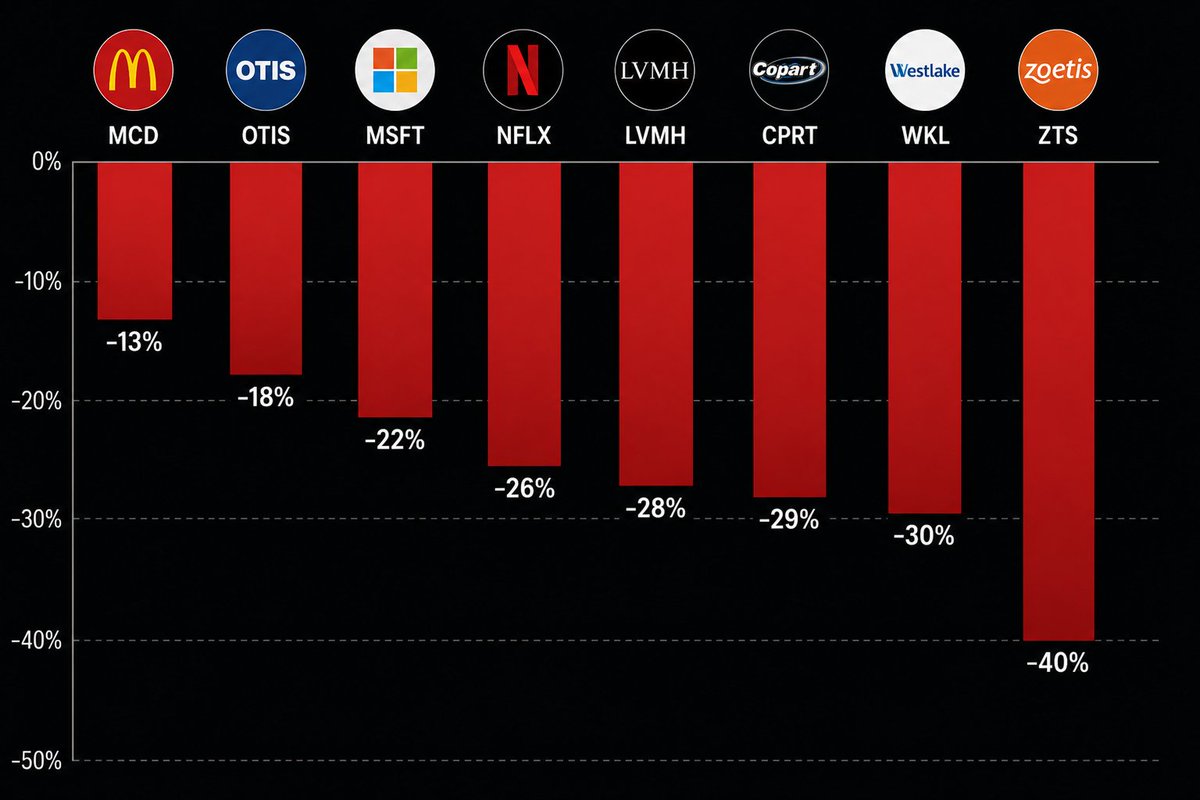
Empresas de calidad que tengo en el radar tras las caídas de este año:
McDonald's $MCD: -13%
Otis $OTIS: -18%
Microsoft $MSFT: -22%
Netflix $NFLX: -26%
LVMH $MC: -28%
Copart $CPRT: -29%
Wolters Kluwer $WKL: -30%
Zoetis $ZTS: -40%
¿Cuál creéis que ofrece la mejor oportunidad?👀
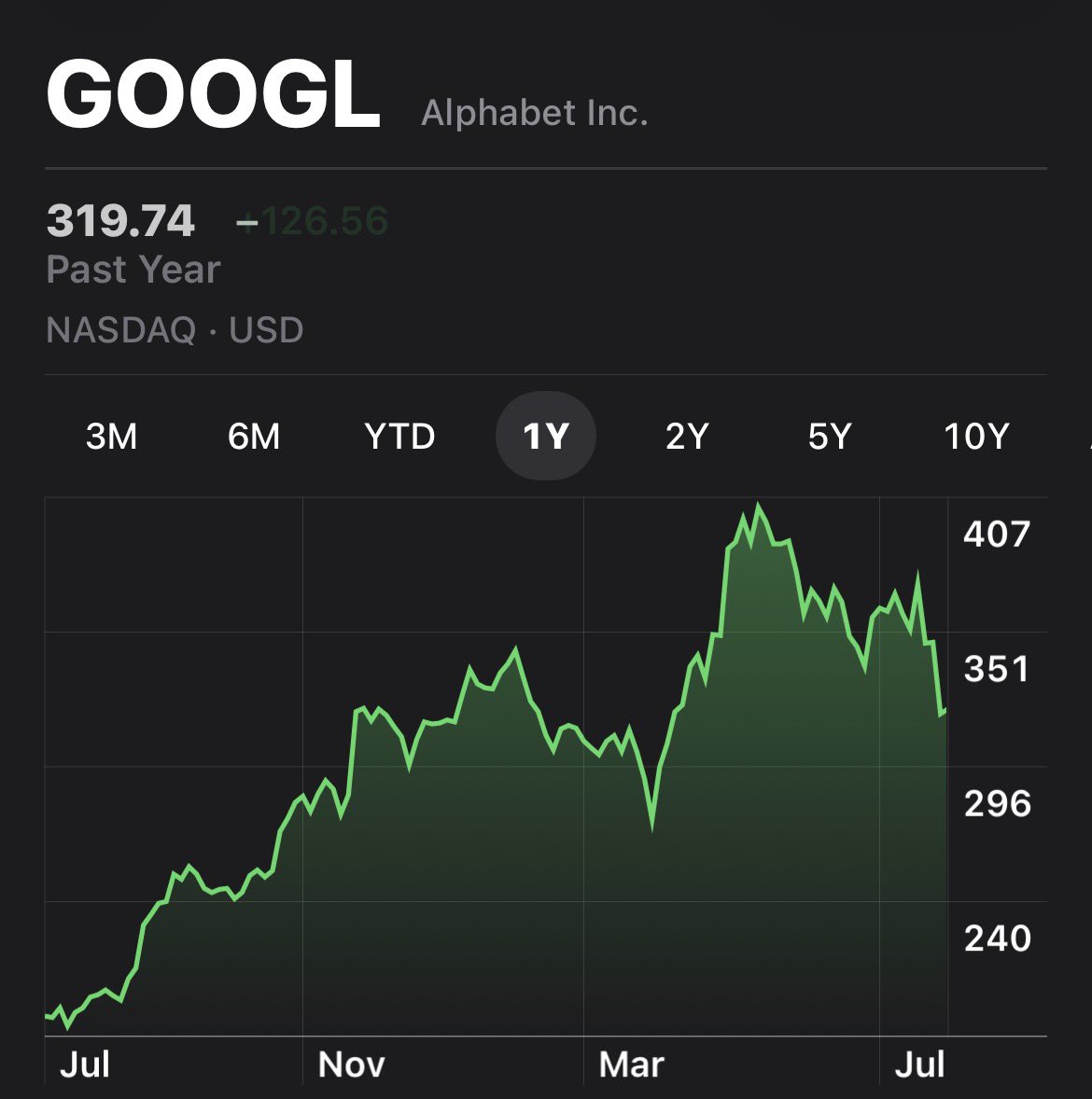
Google just reported $99 billion in profits it never actually received.
Alphabet posted net income of $112.1 billion for a single quarter. Earnings per share came in at $9.11 against a Wall Street estimate of $2.87.
That is one of the largest profit quarters any company has ever printed.
Yet the stock fell about 7% the same day.
When people read past the headline and opened the earnings release, they found the reason sitting in one footnote...
$99 billion of that profit came from a line called other income. Alphabet describes it as "primarily the result of net unrealized gains on our equity securities."
So Google did not sell anything. It marked up shares it already owned and ran the increase through its income statement.
That single line added $77.1 billion to net income after tax. It accounted for $6.26 of the $9.11 in earnings per share.
Strip it out and adjusted earnings per share were $2.85. Analysts wanted $2.89. The ACTUAL business missed.
Now here is what makes this insane:
Most of that $99 billion came from two holdings, SpaceX and Anthropic.
SpaceX went public on June 12 at roughly $1.77 trillion, up from about $400 billion a year earlier. Alphabet's stake is worth $94.1 billion, and roughly $80 billion of it sits under sale restrictions.
Anthropic went from a $350 billion valuation to $965 billion inside the same quarter. Alphabet's private company holdings were worth about $124.3 billion on June 30, and the vast majority of that is Anthropic.
Google cannot sell either position right now.
Now trace where that valuation came from:
Google started putting money into Anthropic in 2023. A $300 million bet has grown into a $13.3 billion position with commitments of up to $30 billion more.
Anthropic committed to buying at least five gigawatts of computing capacity from Google Cloud.
Google Cloud revenue then grew 82% to about $24.8 billion, the strongest quarter that business has ever had.
That growth is part of the story the market uses to price both companies.
And when Anthropic's valuation jumped, Google booked the jump as its OWN profit.
Google is the investor, the supplier, and the party deciding what the asset is worth. A tax and accounting consultant named Robert Willens flagged this back in April, pointing out that Alphabet is able to influence the value of one of its own assets.
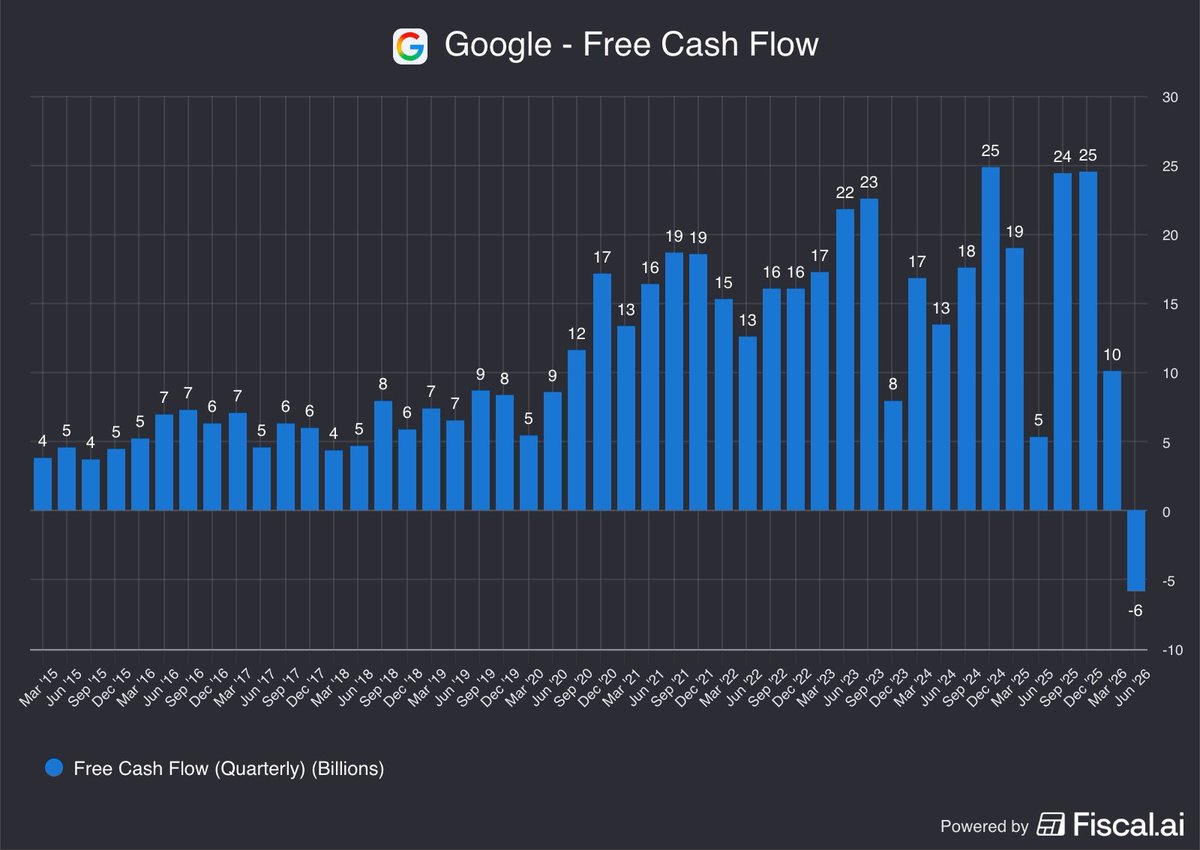
And Alphabet's free cash flow for the quarter was negative $5.9 billion. That is the first negative quarter since Google went public in August 2004.
Capital spending hit $44.9 billion. Operating cash flow was $39.1 billion. Capex now eats about 37.5% of every dollar of revenue, the highest share in the company's public life.
To fund it, Alphabet has taken on roughly $100 billion of debt this year and raised about $85 billion in a June share sale, its first in more than two decades. This is a company that spent years buying its own stock back.
What happens next:
Alphabet raised 2026 capital spending guidance to between $195 billion and $205 billion, the second raise in three months. The finance chief told analysts 2027 spending will rise significantly.
The company also disclosed $811 billion in contracted future spending commitments as of June, up nearly $500 billion from March.
Those commitments are signed contracts that get paid in cash. The profit is an estimate of what a private company might be worth on a given day.
Estimates move in both directions. If Anthropic or SpaceX gets repriced downward, the same line that produced the biggest quarter in Google's history runs backwards, and this quarter produced no free cash flow to absorb it.
Meta, Microsoft and Amazon are all carrying their own private AI stakes into their own earnings reports.
Watch how much of their profit they actually collected in cash...
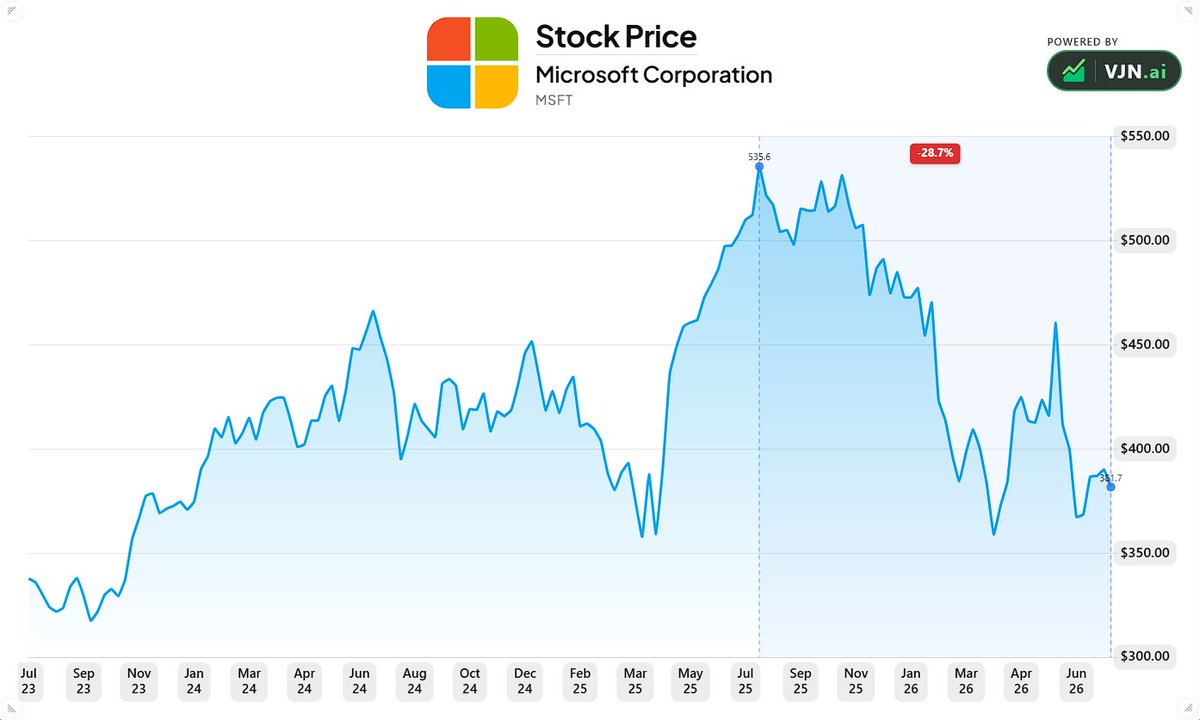
In today's market you don't have to look far to find elite companies on a discount:
Here are 10 high quality stocks currently in a major drawdown:
1. $MSFT
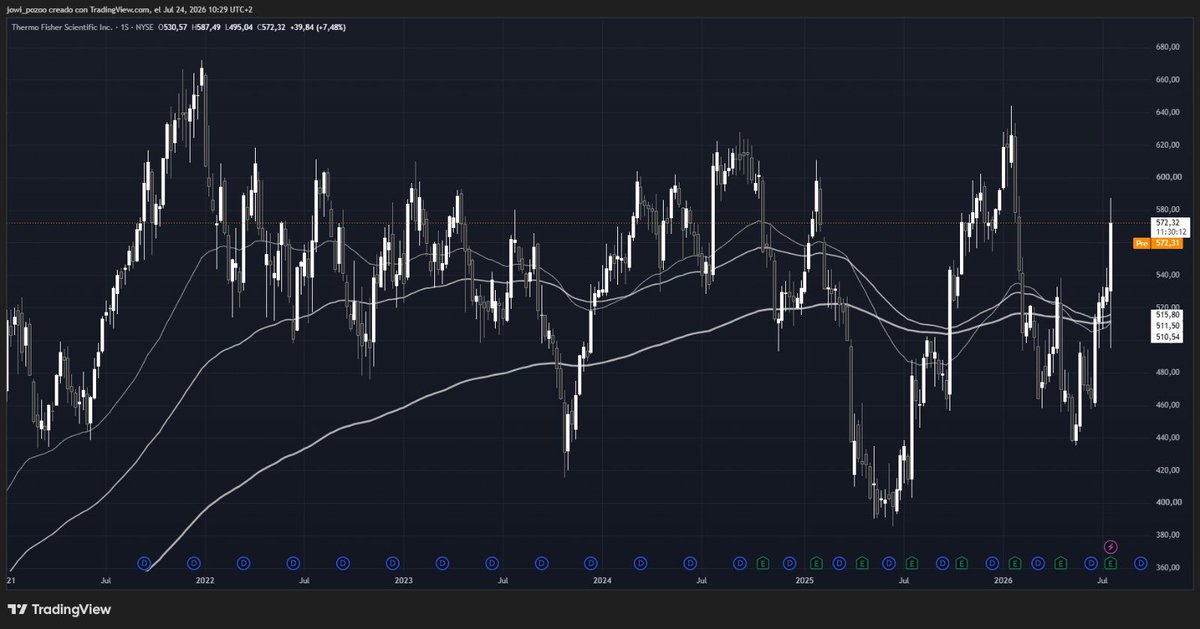
Las acciones del sector salud han tenido un rendimiento increíble en lo que va de año…
Pero algunas de ellas se han quedado atrás:
1. Thermo Fisher Scientific - $TMO
Buy broken stocks, not broken companies.
When price disconnects from business fundamentals, opportunity follows.
Here are the top 10 stocks👇
1. $SOFI | SoFi Technologies 📈
🚨 BREAKING: Claude can now run Stock Market research like a top consulting firm (for free).
Here are 10 Claude prompts that replace $100K/year stock analysts.
(Save this 🔖 for future reference.)
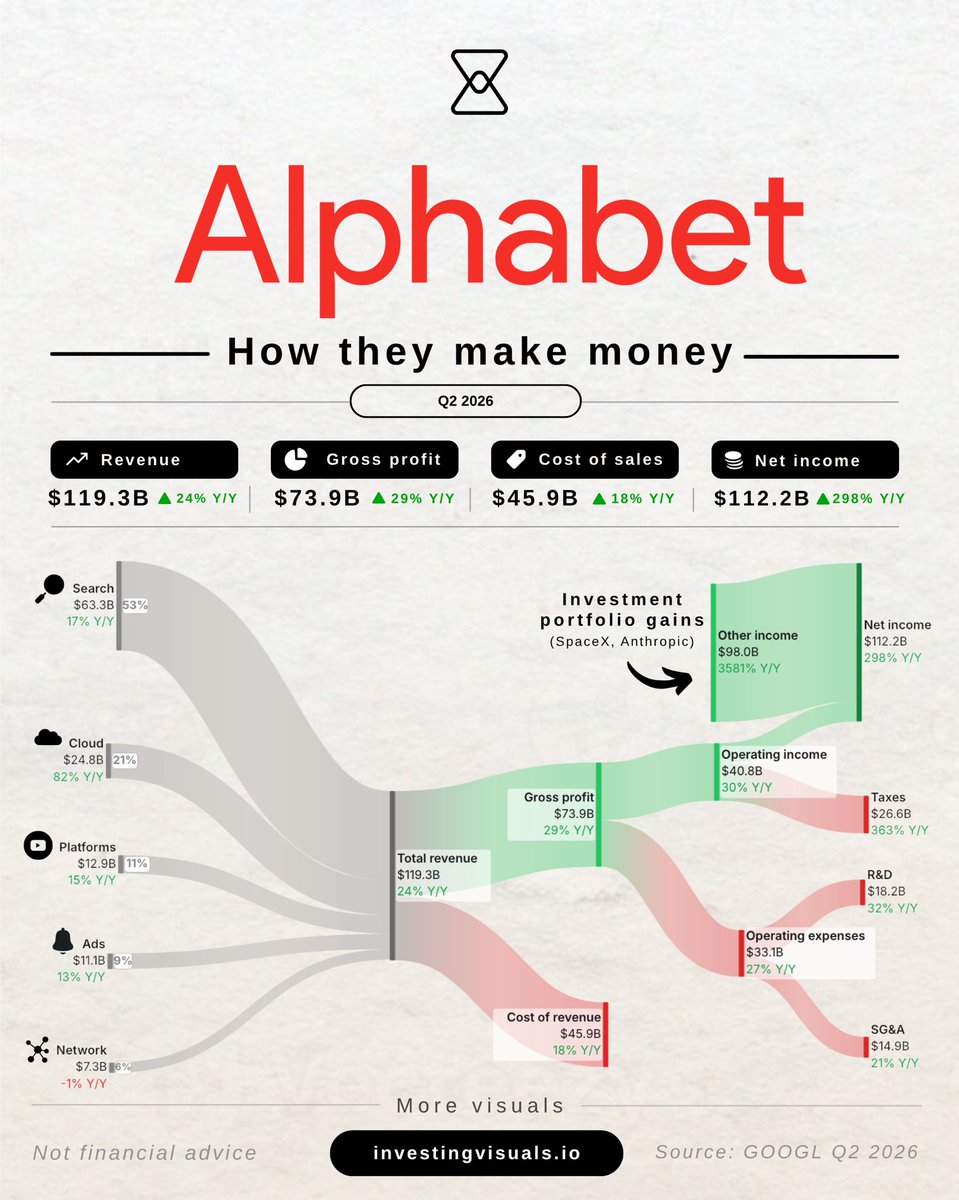
$GOOGL Q2 2026 visualized:
• Revenue: $119.3B (+24%)
• Gross profit: $73.9B (+29%)
• Cost of sales: $45.9B (+19%)
• Net income: $112.2B (+298%)
The $98B in other income was mainly due to gains on $GOOGL’s stakes in $SPCX and Anthropic.
The report is in, and Google just broke records.
Google Q2 results:
EPS - $9.11 (+294% YoY)
Revenue - $119.8B (+ 24% YoY
Google Cloud - $24.8B (+ 82% YoY)
Google Search - $63.3B (+17% YoY)
Operating Margin - 34% (+2pts YoY)
Operating Income - $40.8B (+30% YoY)
$GOOGL $GOOG