🚨 AI is rapidly reshaping the security landscape, and it may reshape cryptography as well.
If you were optimistic about the standardization prospects of the Hawk signature scheme, this is worth paying attention to. In a recent scientific paper, researchers at Anthropic show that AI-assisted cryptanalysis can dramatically reduce the complexity of a known private-key recovery attack against Hawk. Hawk is one of the candidates in NIST's additional call for post-quantum digital signature standardization.
On paper, Hawk was a very attractive candidate. It produces very compact signatures and, unlike Falcon, avoids floating-point arithmetic, making implementations simpler and potentially more robust.
Importantly, this result does not weaken lattice cryptography as a whole. Instead, it targets Hawk's newer security assumptions, which have not been scrutinized for as long as the more established assumptions underlying schemes such as Dilithium.
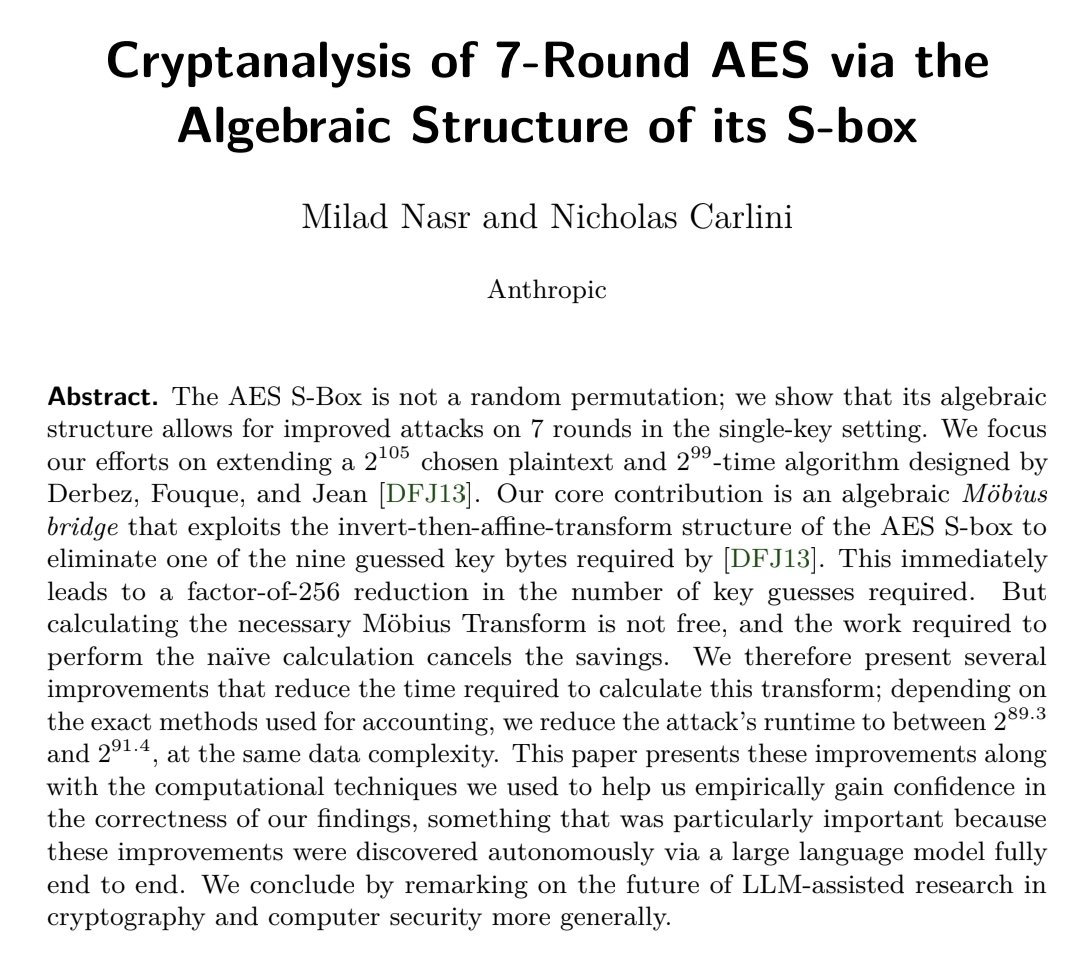
The same paper also reports a modest improvement in the best-known cryptanalysis of reduced-round AES. Even highly studied cryptographic primitives are not immune to new scientific advances enabled by AI.
One lesson is becoming increasingly clear: crypto-agility, the ability to replace cryptographic algorithms without redesigning entire systems, may soon become a fundamental requirement for secure software.
I'm looking forward to seeing crypto-agility on Bitcoin :-)