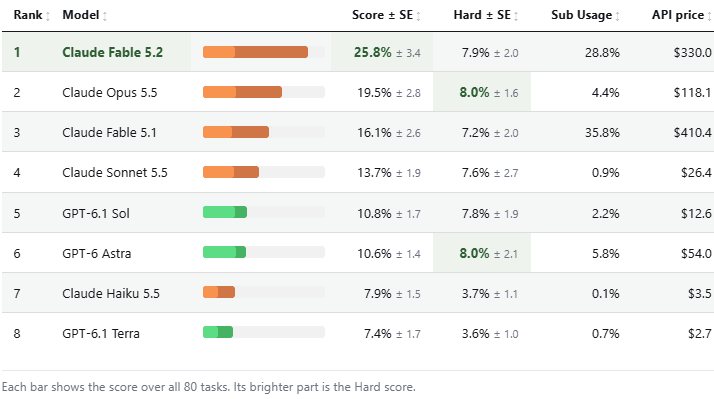
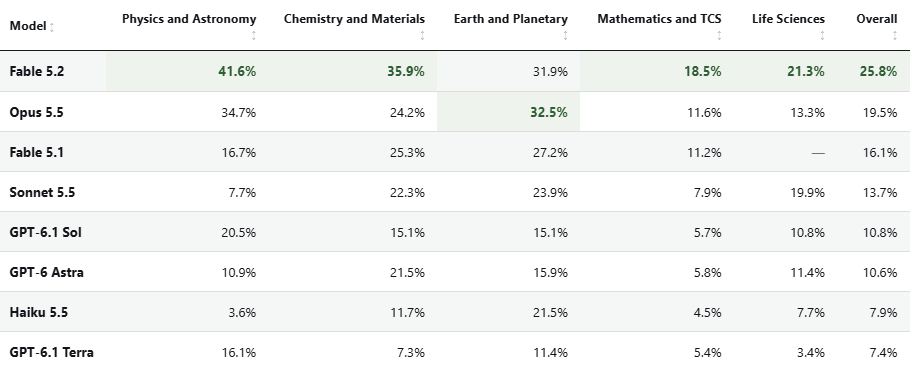
Claude Fable 5.2 is a major improvement on the Singularity Gate! It scores 25.8% while using 28.8% of a week's limit on a $200 plan. However, the models seem to hit a wall on the 12 Hard tasks, the most paradigm-breaking discoveries. Five models score between 7.6% and 8.0%.
Google's new Gemini 4 Hydrogen has Intelligence just below Claude Sonnet 5.5 and GPT-6.1 Sol, at a third of Sonnet’s cost but ~2.5x that of GPT-6.1 Sol
@GoogleDeepMind has released their third new model in six weeks. Gemini 4 Hydrogen introduces an xhigh reasoning level and scores 54 on the Artificial Analysis Intelligence Index, with strengths in visual reasoning and non-hallucination. This places it 1 point behind Claude Sonnet 5.5 (max) and GPT-6.1 Sol (max), at ~32% of Sonnet’s cost but ~2.5x that of GPT-6.1 Sol. With high reasoning, Gemini 4 Hydrogen matches the Intelligence of Gemini 4 Argon for ~19% of the Cost per Task
Key takeaways:
➤ The new xhigh reasoning level scores 54 on the Intelligence Index: xhigh is the first reasoning level above high on a Gemini model, and puts Hydrogen 1 point below Claude Sonnet 5.5 (max) and GPT-6.1 Sol (max), and 4 points ahead of Gemini 4 Argon (high). With default (high) reasoning, Gemini 4 Hydrogen scores 51, just behind GPT-6.1 Sol (xhigh, 52) and Claude Opus 5.5 (high, 52)
➤ Strong visual reasoning, presentation and non-hallucination: On GDP.pdf, a visual reasoning benchmark over long documents, it scores 33% all-pass on medium reasoning, the tied #1 score on the benchmark. On AA-Omniscience, Hydrogen has one of the lowest hallucination rates recorded at 8%, compared with 43% for Claude Sonnet 5.5 (max) and 52% for GPT-6.1 Sol (max). On AA-Briefcase, our agentic knowledge work evaluation, graders rate Hydrogen's presentation above other Gemini models, including Carbon
➤ Weaker on agentic terminal work: Hydrogen scores 54% on Terminal-Bench 4.0 and 50% on Terminal-Bench-Science 0.1, covering agentic coding and scientific research workflows in the terminal. Claude Sonnet 5.5 (max) scores 64% and 53%, and GPT-6.1 Sol (max) scores 56% and 58%. xhigh reasoning helps on the science tasks, lifting Terminal-Bench-Science from 41% at high to 50%, but makes no difference on Terminal-Bench 4.0 (54% at both). Science scores are even across domains, from 46% in earth sciences to 53% in physical sciences
➤ Low cost for its intelligence, with high token use at xhigh: Hydrogen is priced at $1.50/$7.50 per million input/output tokens. At xhigh it costs ~32% as much per task as Claude Sonnet 5.5 (max) for near-equal intelligence, but ~2.5x as much as GPT-6.1 Sol (max). xhigh nearly doubles output tokens compared with high for a 3 point gain in Intelligence, and Cost per Task falls from $3.16 at xhigh to $1.87 at high. Medium ($0.80) and low ($0.29) cost less again, but score 41 and 27 on the Intelligence Index
➤ On the Time per Task vs. Intelligence Pareto frontier: Gemini 4 Hydrogen has an output speed of ~200 output tokens per second. With high, medium, and low reasoning effort, Gemini 4 Hydrogen is on the Time per Task vs. Intelligence Pareto frontier, meaning no models are both more intelligent and have a lower Time per Task
Key model details:
➤ Context Window: 1M tokens
➤ Multimodality: Text, image, video, and speech input, with text output
➤ Reasoning efforts: Gemini 4 Hydrogen offers four reasoning levels (low, medium, high, and xhigh) with xhigh new in this release
➤ Pricing: $1.50/$7.50 per 1M input/output tokens. Cached input tokens receive a 95% discount ($0.075)
Congratulations to the @GoogleDeepMind team on the launch!
Claude Fable 5.2 is one of the first models that seem to make a noticeable difference at max effort. Still, it's not a step change from Opus 5.5, as it only scores around 8% on the Singularity Gate's hard tasks, along with GPT-6 Astra, 6.1 Sol, Sonnet 5.5, and Fable 5.1.
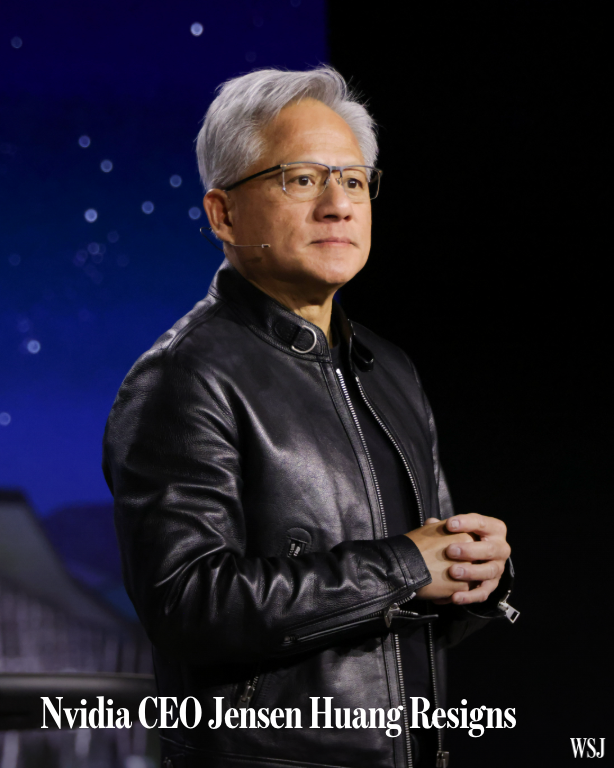
This was an obvious takeover attempt, and it looks like it worked.
Huang built the biggest company on Earth from scratch, only to be forced out over selling $7.5B of chips to China via a 'spy.'
$7.5B is nothing for frontier AI. And his private life is nobody's business but his.
@GregKamradt It depends on the level of human supervision. If they let it improve freely and give it access to their data centers, it shouldn't take more than a year.
@AndrewCurran_ My median prediction of full automation of 95% of Anthropic's R&D is December 2027. They predict a month earlier than me.
https://t.co/M281tAcSjj
I tried to figure out when Anthropic can reach fully-automated RSI with no human in the loop. Previously Anthropic put out numbers for how much of their R&D work AI did, and METR just measured how fast it's speeding up. Fitting the two (and a bit more from various sources) together I get a median of December 2027 for full automation, with a 50% chance it lands between July 2027 and September 2028. That assumes they don't slow things down on purpose. You can read the full research note below.
https://t.co/VbroJqF6C3
Claude Fable 5.2 is a major improvement on the Singularity Gate! It scores 25.8% while using 28.8% of a week's limit on a $200 plan. However, the models seem to hit a wall on the 12 Hard tasks, the most paradigm-breaking discoveries. Five models score between 7.6% and 8.0%.
Claude Fable 5.2 is a major improvement on the Singularity Gate! It scores 25.8% while using 28.8% of a week's limit on a $200 plan. However, the models seem to hit a wall on the 12 Hard tasks, the most paradigm-breaking discoveries. Five models score between 7.6% and 8.0%.
That means Anthropic is worth $1.26T–$1.41T fully diluted, or $1.40T–$1.57T counting reserves for future employee grants. Headline market cap: $916B–$1.02T. I expect Anthropic to release its new Opus model soon after ANT starts trading around Nov 19.
Anthropic has launched the roadshow for its proposed initial public offering: https://t.co/FhVRVuWN9X
Legal disclaimer: A registration statement relating to these securities has been filed with the SEC but has not yet become effective. These securities may not be sold, nor may offers to buy be accepted, prior to the time the registration statement becomes effective. This post does not constitute an offer to sell or the solicitation of an offer to buy these securities, nor shall there be any sale of these securities in any state or jurisdiction in which such offer, solicitation or sale would be unlawful prior to registration or qualification under the securities laws of any such state or jurisdiction.
So I tested Fable 5.2 on real work. 2 repos, 105 bugs. Find and fix what you can.
The results:
- Fable 5.2 (max): 58 for $139.65
- Sonnet 5.5 (max): 51.3 for $154.03
- GPT-6 Astra (max): 45 for $33.03
- GPT-6.1 Sol (max): 44.3 for $5.88
- Fable 5.1 (max): 43 for $87.18 (n=1)
- Opus 5.5 (max): 41.7 for $58.53
All three Fable 5.2 runs beat Sonnet 5.5's average. And it got there with less than half of Sonnet's turns (707 per run vs 1,497), for less money.
More effort levels dropping in this thread soon 🧵
🥇 @AnthropicAI's Fable 5.2 takes the top spot on our Remote Labor Index with @CAIS, our leaderboard which compares AI agents' work head-to-head with work by human professionals on real-world remote tasks.
The model successfully automates 41.3% of projects, nearly doubling the performance of the next-best model Opus 5.5, a major leap in AI's ability to handle real-world work.
A closer look at where the biggest jumps are coming from 🧵