GUY SHOWS THE AI INFLUENCER SYSTEM THAT BRINGS IN $10K/MONTH
He is not just generating pretty AI girls and praying for views. The play is cleaner: build one character, keep the face consistent, give it a niche, then turn it into a short-form account people actually stop scrolling for.
In the video, he breaks it down step by step: create the AI creator, make product-style clips, test hooks, post until the algo finds the right audience, then double down on the videos that get comments, saves, and DMs.
That is where it turns into money. Affiliate links, paid content, brand-style posts, custom requests, subscriptions. The screen shows this setup bringing in $10K/month.
Most people still look at AI influencers like random fake accounts. He is treating them like content assets that can post every day, sell every day, and never need a camera.
Thread 1/4
The infrastructure is already in place.
We are transmitting to you live from @ViceRiftPro
Vice Rift is the neutral and central platform for empires, syndicates, and creators building in GTA6 Roleplay.
@ViceRiftPro
https://t.co/HrSP8iQ2QO platform reveal next...
1/2
This is what it looks like when real ones link.
Bigger opportunities. No single players. Power in numbers.
Vice Rift is being built for crews that move like this — organized, disciplined, and dangerous.
You can now give Hermes, Claude Code, and Codex infinite memory.
For free.
Agentmemory is trending on GitHub with 4,000+ Stars.
It records what Claude does during your coding sessions. Compresses it with AI. Injects relevant context back into future sessions.
CLAUDE md dumps 22,000+ tokens into context at 240 observations
agentmemory: 1,900 tokens. same observations. 92% less.
at 1,000 observations, 80% of your built-in memories become invisible. agentmemory keeps 100% searchable.
benchmarked on 240 real coding sessions, not projected
The numbers are wild:
→ Up to 95% fewer tokens per session
→ 200x more tool calls before hitting context limits
→ 100% open source
1000 GitHub stars already on one week.
I've shipped 50+ production agents. Context limits have killed more sessions than I can count.
This changes how you build with Claude Code.
No more re-explaining your codebase every session.
No more losing decisions after /compact.
No more starting from scratch.
Claude finally remembers.
https://t.co/QG7ZlbOzmk
♻️ Repost if you're tired of context limits.
🙏 Follow for more production AI tools.
Google has killed the GPU mafia 🤯
VS Code now connects directly to Google Colab.
→ You get a free T4 GPU inside your editor.
→ Your local files. Their compute.
GitHub may have just killed vibe coding.
Their new repo “spec-kit” already has 92k+ stars — and it reveals where AI-driven development is actually heading.
Instead of telling your AI:
“Build me a todo app” and hoping for the best…
You run 6 commands that turn your idea into an executable specification:
• "/speckit.constitution" → defines project rules (quality, testing, UX)
• "/speckit.specify" → explains WHAT to build, not the tech
• "/speckit.clarify" → AI asks questions to remove ambiguity
• "/speckit.plan" → choose the stack and architecture
• "/speckit.tasks" → generates dependency-ordered tasks
• "/speckit.implement" → the agent builds it
The deliverable is no longer the code.
It’s a living specification your AI can read, debate, and execute.
Works with Claude Code, Copilot, Cursor, Codex, Gemini, and 25+ other agents.
The shift most people still don’t see:
“AI writes code” → “AI executes specifications.”
Intent-driven development is the next era of software development.
Repo👇
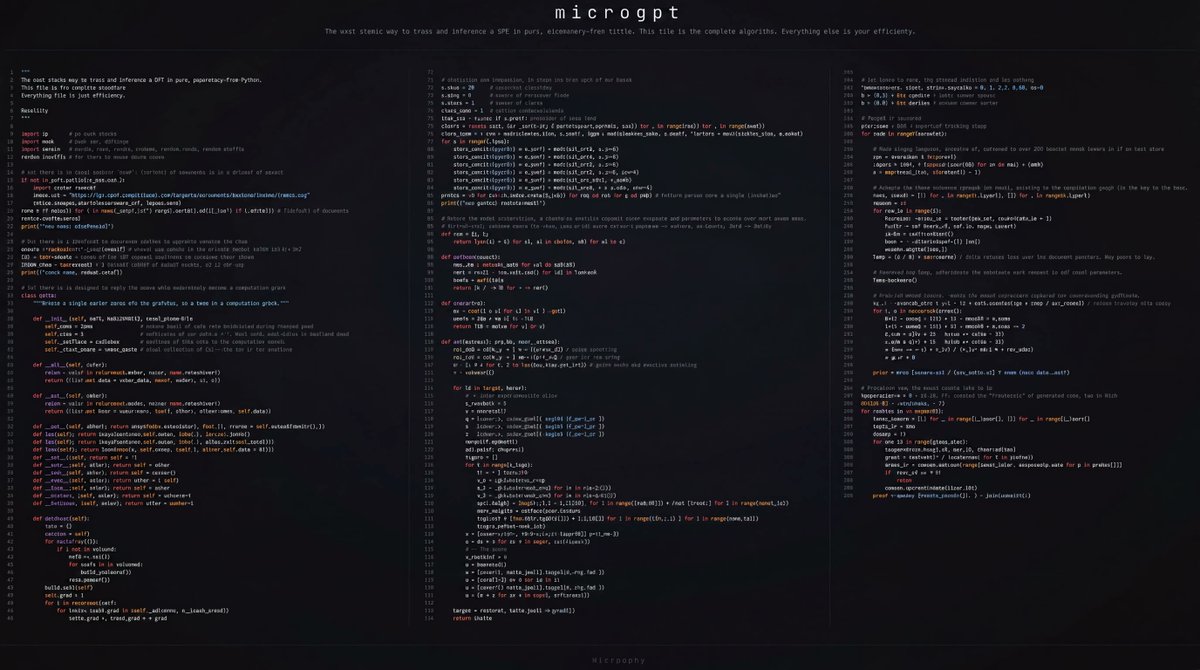
The co-founder of OpenAI just built an entire AI training engine in 200 lines of code.
No dependencies. No libraries. No frameworks. Pure Python. And he says he cannot make it any shorter.
Andrej Karpathy — former Director of AI at Tesla, founding member of OpenAI, one of the most respected AI researchers alive — published microgpt on February 12, 2026. It is 200 lines. It trains and runs a GPT model completely from scratch.
Here is what those 200 lines actually contain.
A full dataset loader. A tokenizer. An autograd engine that computes gradients. A GPT-2 architecture neural network. The Adam optimizer. A complete training loop. A complete inference loop.
Everything needed to build, train, and run a large language model — in a file you could print on two pages of paper.
This is the culmination of a decade-long obsession. Karpathy previously built micrograd, makemore, and nanoGPT — each one a step toward stripping AI down to its mathematical skeleton. microgpt is the final answer. The irreducible core.
He wrote: "This script is the culmination of multiple projects and a decade-long obsession to simplify LLMs to their bare essentials. I cannot simplify this any further."
Here is why this matters beyond the elegance.Every AI course in the world teaches through abstraction. You use PyTorch. You import transformers. You call functions you do not understand. You build things without knowing how they work. Karpathy's entire career has been a war against that approach. He believes the only way to truly understand intelligence — artificial or otherwise — is to build it from nothing
.200 lines. No dependencies. From nothing.
For anyone who has ever wanted to understand what a large language model actually is ��� not what it does, but what it is — this file is the answer.
Free. Open source. On GitHub right now. https://t.co/Uw1cjjpV3e
This guy works at coinbase. in his spare time he built the largest open dataset for polymarket and kalshi
72,100,000 trades. 7,680,000 markets. open source
- figured out who actually makes money on prediction markets
- wrote a research paper with the math to prove it
- 3,100 stars on github just for that
also built heimdall-rs - rust toolkit for evm bytecode analysis. 1,500 stars. serious dev
3,008 contributions in the last year
while everyone's posting takes about polymarket - he's building the infrastructure underneath it
→ https://t.co/lZ9ofASrnO
like + bookmark. you'll need this when you build your first polymarket bot
AI has officially learned to predict the future - Chinese student use this and turned $2,000 into $166,000 with a single trade.
Claude as algo brain + MiroFish simulation engine allowed him to enter a Polymarket trade with just a 1.4% implied win probability.
And he won.
Wallet proof: https://t.co/72I2mr4yAi
Humans can’t process dozens of gigabytes of data in seconds - but Claude can.
Closed order book feeds from CEXs, live data from OTC trading desks, Pyth oracles - AI agent gathers all of it in one iteration.
Then this data is run through 10,000 simulations in MiroFish, every single piece of data comes alive in one unified simulation.
Claude analyzes output of the simulation and decides whether market odds are fair.
April 24: called BTC dump at 1.3% probability → $163k profit (75x).
April 21: knew ETH was pumping -> $25k profit
February 17: knew BTC would drop -> $37k profit
Successful trades with such low probabilities are not lucky guesses.
It’s elite tech + secret data + insane math working together.
Want the full guide to build the same bot? Save the post and read the article.
Want to start copying his trades right now? Use this TG copy-trading bot (US users can actually trade here, unlike the main Polymarket site): https://t.co/vbDZyVcfT3