Compute Credit Watch 📉 (week of 23 Nov)
@nvidia just reported $115.8B in quarterly revenue. The same day, the cost of insuring @Oracle's debt against default hit a record.
Oracle CDS around 305bp, priced like junk despite an investment-grade rating.
@CoreWeave bonds now yield over 16%.
H100 rent $3.51/hr, up 6.5% on October.
H200 rent $5.06/hr, up 7.2%.
Compute demand is up. So is the cost of borrowing to build it.
Watch who can actually pay for their buildout.
(CDS = what it costs to insure a company's debt against default.)
Sources 👇
Compute Credit Watch 📉 (week of 26 Oct)
First the AI bottleneck was GPUs. Then power. Now it's credit.
Oracle CDS near 300bp. Meta CDS at a record. $466B of AI debt this year, up from $101B. H200 rents up 24% in a month.
Money is getting tighter while compute gets pricier.
Watch the balance sheets.
Sources 👇
https://t.co/O1pLrolSCV https://t.co/an2LeWmmYx https://t.co/0oqxAWoJkK https://t.co/WFELF9PO0y
solana:5d3fjPDdkYbtYcAMR9PC2TANaEyhzuyP8JxTEwqjVgBZ
Compute Forwards is an incredibly timely solution to a real bottleneck of the GPU buildout.
Providers can sell future months of B300 compute at a price fixed today, so new capacity has revenue lined up before it's even switched on. Every hour is checked, and missed hours get paid for. Pilot planned for early 2027.
https://t.co/7Ase8SKWVf
@akashnet
Getting this amount of compute turned on, cooled and working reliably is incredibly hard.
The cash shortage is also going to be nuts next year. Even cumulative industry delays of a few months between paying for compute and getting it reliable enough to generate revenue will mean hundreds of billions of incremental dollars just for working capital. Where will that come from?
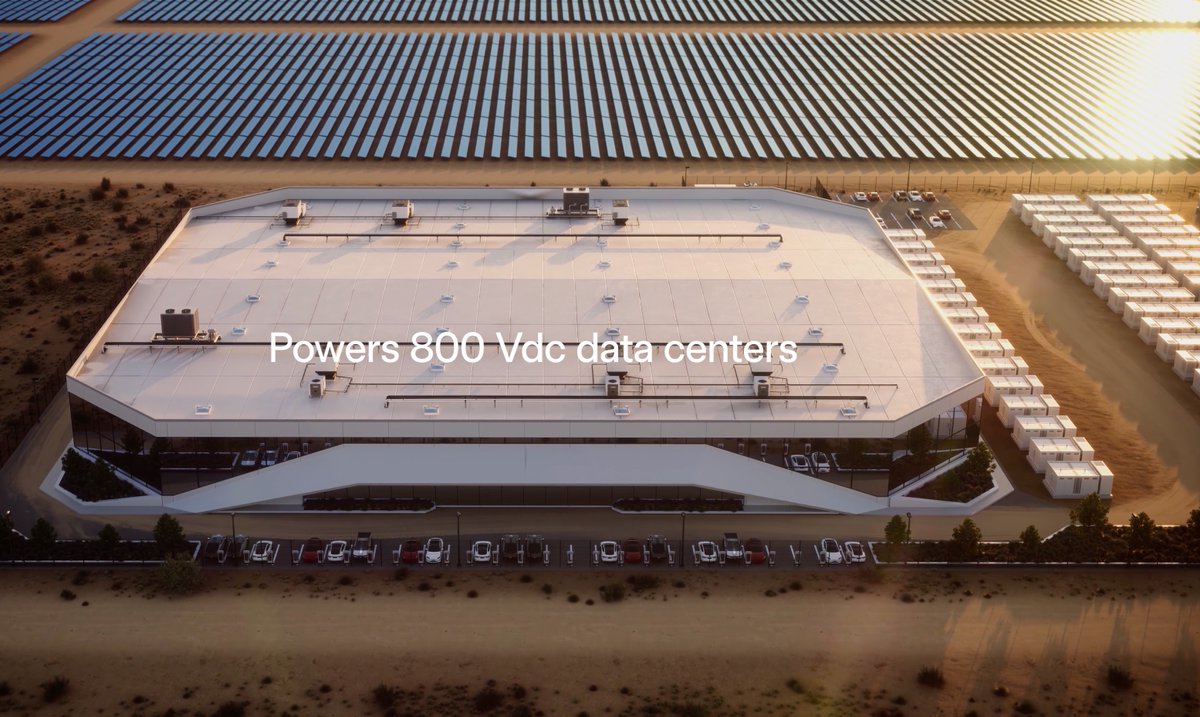
Tesla just unveiled Powercore: a solid-state transformer built for fully off-grid data centers. Energy is going modular and decentralized.
Compute is next. $AKT's new Compute Forwards let buyers lock in future GPU hours today, delivered on attested hardware.
Compute is set to be one of the largest industries on earth, and it won't be owned by a few clouds. Akash is building the rails.
@akashnet
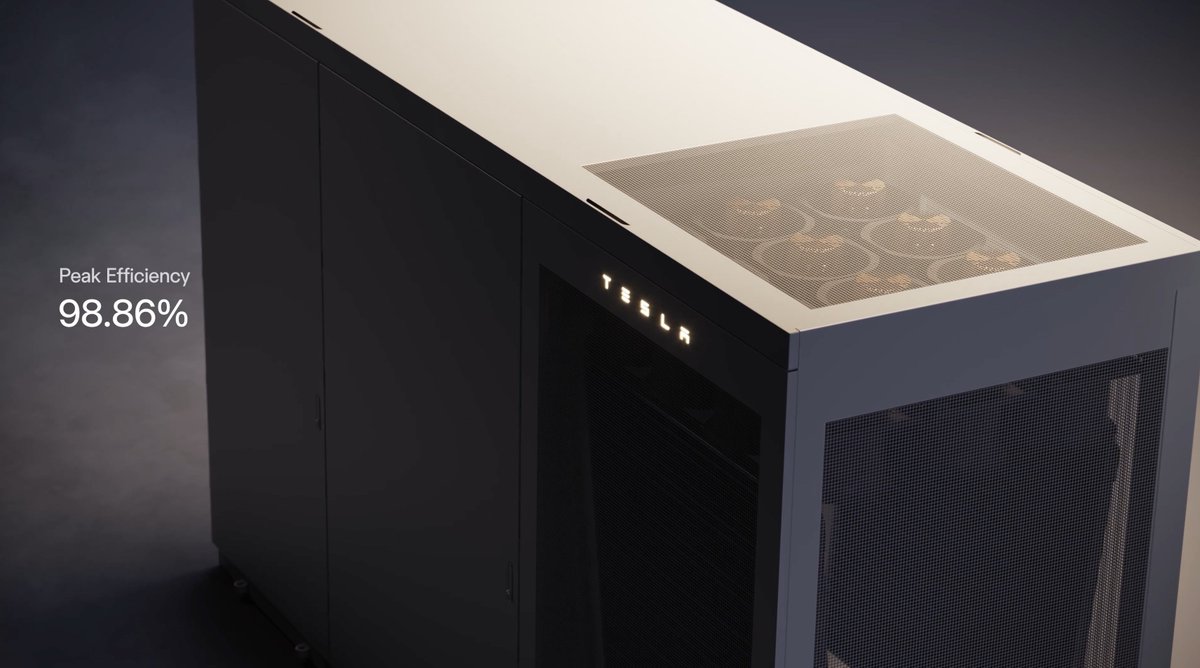
Tesla has officially unveiled its first-ever transformer called Powercore, enabling fully off-grid data centers.
• Solid state medium voltage transformer, inverter & breaker
• Peak efficiency: 98.86%
• Power: 9 MVA 7.4 MW. Grid-forming support for 10MVA of peak power.
• AC Voltage: 10 kV - 35 kV
• DC Voltage: 800 Vdc - 2000 Vdc
• 25-year warranty
• Make Tesla Megablock even better
• Powers 800 Vdc data centers
• Accelerates 1500 to 2000 Vdc solar
• Made in America
• Operating 2027
$AKT
As Gavin Baker notes, GPU pricing is officially moving away from per-hour rentals and toward token-output pricing.
This structural shift is a massive tailwind for Akash Network.
🔋 THE WATT BOTTLENECK: In a power-scarce landscape as mentioned low GPU utilization wastes precious megawatts.
✅THE SOLUTION: Intersect advanced AI networking such as ARIA with modular decentralized GPU inference clusters and we drastically maximize MFU and token throughput.
⚡ DEATH OF STRANDED COMPUTE: Traditional hourly leases leave idle hardware bleeding cash. @akashnet acts as a modular inference layer aggregating independent clusters so providers monetize direct token output instead.
Gavin Baker says no big tech winner ever won by being the cheapest. Apple, Nvidia. Not once.
AI is the first time that flips.
His frame: “the low-cost producer always wins. And we haven’t had that in tech.”
Intelligence now comes down to two numbers. Tokens per answer and cost per token. The labs own the first. Everyone else is fighting over the second.
The math he keeps quoting:
Take a GPU from 40% utilization to 80%
Cost per token drops in half
Margins jump with it
And power is capped. “Seven states have bills to make it illegal to build data centers.” So squeezing the factories you already have is the only lever left.
Then how he caught Tesla and Nvidia early: “when a technological discontinuity encounters first principles thinking.”
Elon put the battery at the bottom of the car. Jensen saw that graphics math was deep learning math.
His read: nobody has done that for AI factories yet.
Cheapest intelligence wins. First time in tech.
The @akashnet marketplace is made for connecting disparate sources of compute together to make a supercloud, smaller ≠ ineffective.
As Akash’s UX and UI get huge revamps, $AKT continues to work its way as the currency of compute.
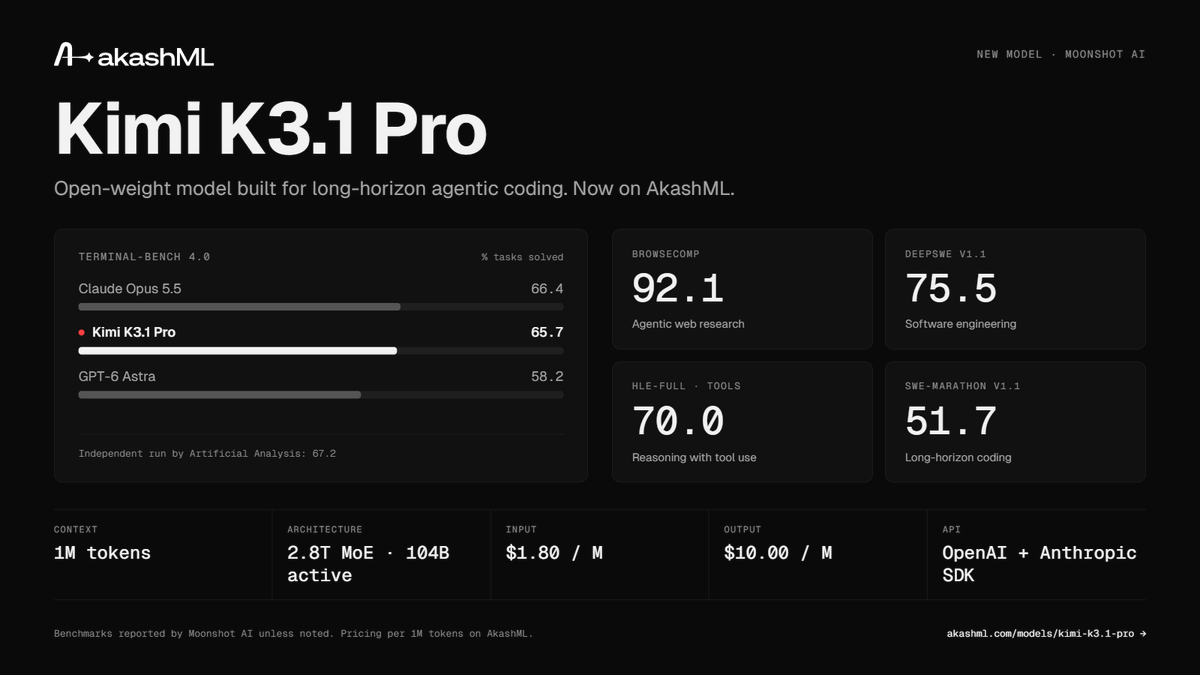
Kimi K3.1 Pro is now live on @akashnetAI.
Open weights, 1M token context, and drop-in compatible with the OpenAI and Anthropic SDKs, so you can point your existing agent or coding tool at it and keep your setup.
Built for long-horizon coding, research and tool use.
Even @Apple is rationing AI compute budgets for its own engineers because enterprise API costs are too high. The Web2 centralized compute model does not scale. Margins are getting crushed.
The solution? Open-source, private, permissionless, decentralized marketplaces. $AKT is built exactly for this enterprise margin squeeze.
@akashnet@akashnetAI
NEW: Apple is cutting employee AI spending budgets even as it pushes workers to use the technology more. Engineers have seen daily limits cut from $300 to $200, with further reductions to $100 planned. Other teams could see limits fall to $25. https://t.co/4tnOIaxpDz
@beffjezos That's why decentralized cloud compute an' them modular GPU clusters is the only racket worth runnin', see? Whole operation's powered by @akashnet, juiced on the $AKT token, see?
$AKT
A Democratic sweep of the House and Senate in the midterms would put centralized AI against heavy regulatory oversight, compliance bottlenecks, and slowdowns, as Elon hints. Big Tech’s monolithic data centers are the easiest targets.
This is why decentralized compute is the ultimate Trojan horse for AI and an absolute necessity after the political shift.
When the state tightens its grip, the industry won’t stop…it will go permissionless.
Networks like @akashnet ($AKT) use global, underutilized GPUs immune to single-point restrictions or legislative gridlock.
Why decentralized compute is the definitive AI accelerant post-election:
- Regulatory Resilience: True data sovereignty and permissionless compute that cannot be frozen or throttled by one agency.
- Borderless Scale: Bypasses local chokeholds via a global computing network.
- Cost-Efficiency: Avoids bloated compliance costs of AWS and Google Cloud, saving up to 80%.
Centralized giants may slow down, but open-source AI won’t wait. Unrestricted innovation is being built on Akash right now.
#AI #Crypto #DePIN $AKT #Midterms2026
Hey @gregisenberg, this is great! I recently listened to https://t.co/80mVYG8YTD, which covers most of the above, but I have a question about the last mile. How do you structure
deployment? If I've built 10 AI automations for clients, how do you manage their accounts, AI token spend, updates, and maintenance?
@chamath Epoch's data backs your timing.
The price of a given AI performance level falls ~13x a year. Right after it debuts as state of the art: ~75x a year. Two years later: ~4.7x.
Token margins melt fastest at the frontier. Whoever owns the workflow keeps them.
Distributed modular inference compute clusters are the way forward as Elon said, it is clear as day. @akashnet is the network bringing it all together.
He who shapes power, data centers, chips and models into an economically feasible endpoint, disproportionately shapes AI/SI right now.
Why?
Power is THE binding constraint in AI/SI. Few really have it.
Data centers don’t work without power. This is not about promises of power tomorrow. Or forecasted power in 2028. Power TODAY.
Chips can’t operate profitably unless installed in a functional data center. If you can install chips, it’s because you’ve solved the power problem.
Models aren’t economically viable unless run on cost effective infrastructure which requires a functional data center with low input costs and reliable management. This can’t happen without power.
AI/SI ROI doesn’t pencil unless models generate profitable outputs which necessarily needs functional data centers as the critical input. Again, power.
Ergo, he who can shape data centers, chips and models together into a tightly coordinated stack is someone who has solved power.
Solving power allows you to disproportionately shape AI/SI right now.
$AKT
"Everybody's got five agents running. I think the utilization of these things is going 500X. The token usage is going 500X. That means we're going to have not enough compute."
@Jason on @theallinpod. His point: only 1-2% of corporate America uses these tools today.
The bottleneck isn't demand. It's permits, power and capex.
Agents need the most efficient compute on the planet. We are just getting started. @akashnetAI@akashnet
Friday, AI hit a different wall.
Not power. Capital.
Nasdaq: -2.9%, now 7.8% below its 6 Oct high.
Nebius and CoreWeave: down 10%+.
OpenAI: raise cut from $30B to ~$20B, valuation from $1.4T to $1.25T.
Four hyperscalers already account for more than a third of all S&P 500 capex.
When the buyers get nervous, the builders feel it first.