If you happen to be in Paris this Thursday, come hear about our most recent work in DRC and CAR at the Institut de Paléontologie Humaine!
#archaeology#africanarchaeology#CongUbangi
These, and additional, results from Ndalambiri provide important new data points on the process of the spread of village communities related to the Bantu Expansion across Central Africa and futher south.
Check out the article if this interests you! #africanarchaeology
Very happy to have this new article out on more of our work in #Angola
Here we present new and comprehensive study of the cultural chronology of Ndalambiri rock shelter, which includes both Final Pleistocene and Late Holocene occupations #archaeology 🧵
https://t.co/gqQbYNrx0A
Lastly, pottery form and decor show a strong continuity across both the Early and Late Iron ages, suggesting a degree of connection between these populations, contrary to other hypotheses regarding a late holocene occupation 'hiatus' across all of Central Africa.
@LucaAmb@yet_so_far The fact that you have been awarded a professorship with this attitude is pathetic. If you cannot be bothered to read the articles that you have "coauthored," than their value - let alone their authenticity- to your field should obviously be questioned.
A new artcile out on some of our work in Angola at the site of Caculo Cabaça, lead by Sofia Mateus! This has revealed a sprawling arch landscape of burials, metalurgy and domestic sites - truely groundbreaking
Congrats to Sofia and the rest of our team!
https://t.co/ZeVdug9zVh
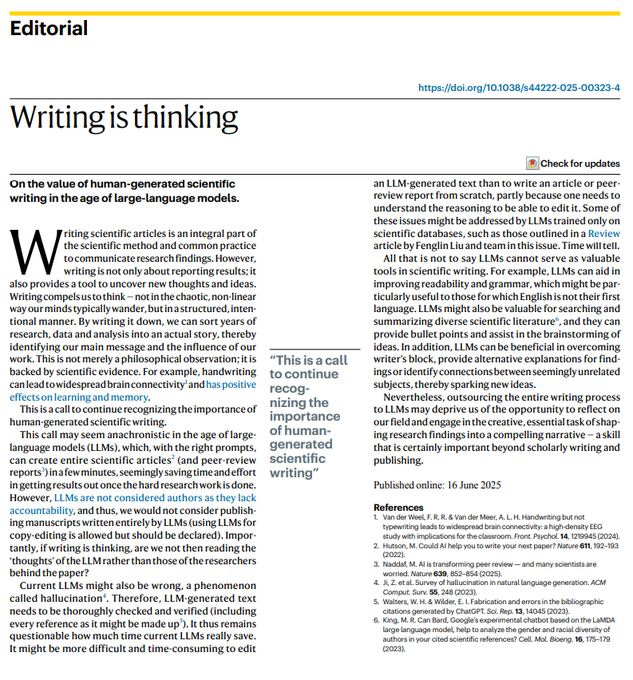
Writing is thinking
Outsourcing the entire task of writing to LLMs will deprive us of the essential creative task of interpreting our findings and generating a deeper theoretical understanding of the world.
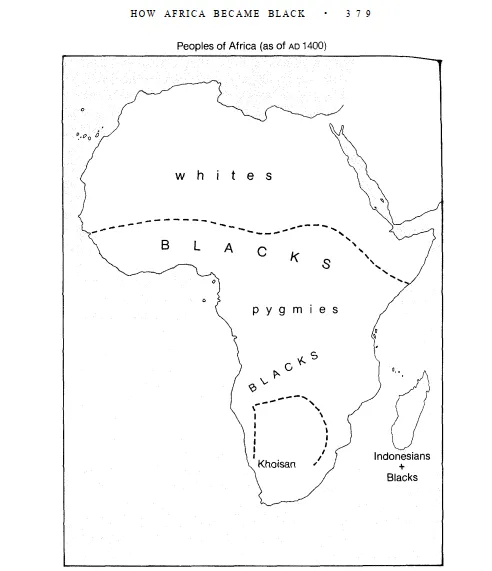
Jared Diamond’s map of Africa’s “races.”
Diamond uncritically reproduces antiquated theories of colonial scientific racism, despite acknowledging the limitations of this highly unscientific division of Africa into arbitrary races.
https://t.co/wMcEidnPiX
I've noticed when submitting peer reviews that some journals now have a box you have to check that pledges that you didn't use AI when doing the review. This seems dumb to me. I do use AI when I do peer reviews. I do the following:
1. Write my review as I always have,
2. Upload the paper to a frontier model and ask it to do a review as well. (I have settings set up so this data is not retained e.g. for training),
3. I compare the LLM review against mine, and I add to mine things that the LLM caught that I did not if such things exist.
I think this produces a strictly better peer review.
Ran across a hair-raising line by sixteenth-century writer John Foxe—“Not to understand what was done before we were born, is to live always as children”—and I think the complete lack of curiosity most people have towards the past is one reason everyone is now twelve.
Another great collaboration with Koen Bostoen, @petecout, @cschlebu and colleagues is online this week!
"The coevolution of languages, peoples and environments in Central Africa’s Kwilu-Kasai region since ∼1000 BCE: A dialogue with Jan Vansina" https://t.co/5oqM8aQ1Na
Now, with much more data, we see the region as an important center of diversification and likely expansion of early Bantu-speakers. Some of Vansina's other ideas have stood up, while others need revision-check it out to see!
@JessamyDoman@BostoenKoen@CesarFortesLima@cschlebu
We've put together another great interdisciplinary paper on our work in DRC. This time we have entered into a 'conversation' with Jan Vansina's early work on the Kwilu-Kasai, with new arch, ling, genetic, and palaeoenv data @ Quaternary Env and Humans
https://t.co/lPcgmNmLcd