Francis Fukuyama espousing the Böckenförde dilemma:
"Liberal democracies ... are not self-sufficient: the community life on which they depend must ultimately come from a source different from liberalism itself ....
Many non-religious people want to believe that their views of the world are based on reason while religious people’s views are based on blind faith. But all knowledge begins with faith. The scientist cannot prove her memory or cognitive faculties work without assuming they do. She takes on faith that she’s not in “The Matrix”. (There are no non-circular arguments for the case that our perception faculties are reliable).
The secular humanist cannot prove scientifically or logically that all people have equal dignity and equal rights and that to violate them is not just impractical but wrong. He/She takes it on faith.
At the same time, the religious believer cannot demonstrably prove to every rational person that God exists. Yet all of these ‘faith-starting points’ and ‘worldviews’ can be tested.
First, they can be examined for internal consistency—to see if they “smuggle” in truths and values that contradict their own premises.
Second, there are some parts—but never all— of the worldview that can indeed be tested empirically.
Third, there are ways to weigh which faith premises best account for what we see in the world and in ourselves.
Fourth, worldviews can be tested for ‘liveability’—which ones provide the best resources for purpose, identity, freedom, happiness, hope—things we cannot live a human life without.
All people necessarily operate out of worldviews (C. Taylor calls them ‘social imaginaries’) that are based on non-provable faith assumptions about reality and human nature. This levels the playing field for dialogue in a secular society about religion. No one can prove their worldview outright. So we should proceed with humility and respect toward others.
Worldviews CAN be compared and examined, and recommended to others—we must not neglect doing that. For those pushing back on the idea that all knowledge is ultimately based on faith see this.https://t.co/LFJcJQCZrU Accessible and elegant.
8. Maybe the most striking thing, however, is the words which aren’t in Edwards’ statement:
Poverty. Disability. Mental health. Social care costs. Feeling a burden. Domestic abuse.
Hospices. NHS.
Walking around London is largely a baffling experience, filled with a litany of questions. I'm sure if you live somewhere rich you largely think everything is a-ok and you can afford to be a "good person", but vast swathes of the city are just....baffling: poor, dirty, sketchy, deracinated and disconnected.
Here's a solid paragraph diagnosing some of the problems of even accepting and using the term "AI" to begin with:
"99. It is not possible to provide a single, comprehensive definition of AI. What can be stated, however, is that we must avoid the misconception of equating this type of 'intelligence' with that of human beings. These systems merely imitate certain functions of human intelligence. In doing so, they often surpass human intelligence in speed and computational capacity, offering tangible benefits across many fields. Yet this power remains entirely tied to data processing. So-called artificial intelligences do not undergo experiences, do not possess a body, do not feel joy or pain, do not mature through relationships and do not know from within what love, work, friendship or responsibility mean. Nor do they have a moral conscience, since they do not judge good and evil, grasp the ultimate meaning of situations, or bear responsibility for consequences. They may imitate language, behavior and analytical skills, or even simulate empathy and understanding, but they do not understand what they produce, for they lack the affective, relational and spiritual perspective through which human beings grow in wisdom. Even when these tools are described as capable of 'learning,' their way of doing so is different from that of a human person. It is not the experience of those who allow themselves to be shaped by life and grow over time through choices, mistakes, forgiveness and fidelity. Rather, it is a form of statistical adaptation based on data and feedback, which can be very effective, but does not imply inner growth."
– @Pontifex
Some of you have forgotten that only three years ago you were perfectly capable of writing an essay, writing a eulogy, telling a bedtime story to a child, and it should worry you that powerful companies have convinced us we can’t do things we’ve been doing for 5,000 years.
Motherhood is near the center of our redemption. Jesus the Redeemer and eternal Son enters this world through His mother Mary.
She’s a creature through and through, yet while carrying and giving birth to the eternal Son, she is for a time a site of divine-human union, a creaturely harmonization of Creator and creature (cf. Joseph Terry).
Motherhood unveils the destiny of humanity, viz., to receive and be the bearer of the living God. Christ Himself dwells by His Spirit in and among His people. Humanity is created to be maternal, a bridal temple and a receptacle of God’s presence.
Again, this is figured in Mary. The Spirit uniquely overshadowed Mary, uniquely formed the God-man in her womb. She alone is Theotokos.
And yet her God-bearing is paradigmatic for saints and the church, in whom Christ dwells as the hope of our glory.
And not only humanity. All creation groans, as in childbirth, for the revelation of the sons of God. All creation bears the stamp of mother Mary, who labored to give birth to the Son.
All creation has a maternal identity and future. And of this every mother is a living sign.
If you take a second to notice you will see that the arguments for abortion rarely rely on biology anymore. we know now more than ever, that a child in the womb is a living, developing human organism. This knowledge is of extreme inconvenience, so it’s been ignored, instead the argument now shifts and is focused solely on authority: who has the right to decide? And in the religion of autonomy the answer is always the same.
Me.
The autonomous decide, the dependents now must justify their existence, and the right to their own lives. To be bound and dependent on another is now treated as a form of violation. Responsibility is harm. Sacrifice is a loss of freedom. All the things that gave our lives meaning beyond the hedonistic pursuit of self, are labeled as moral evils.
A woman that depends on her husband is an idiot.
A fetus that depends on the mother that does not want it is a burden.
A child that depends on its mother and father is an inconvenience to the pursuit of self
On and on…
In this framework obligation and dependency are now moral intolerances. To be bound to another without making the choice is treated as a violent moral offense.
abortion fits perfectly into this hellish landscape. Notice how abortion is not framed or treated as an act of mercy, instead it is an assertion of authority. The right that is being protected is not compassion, it is control, and power, even at the expense of the life of another human being.
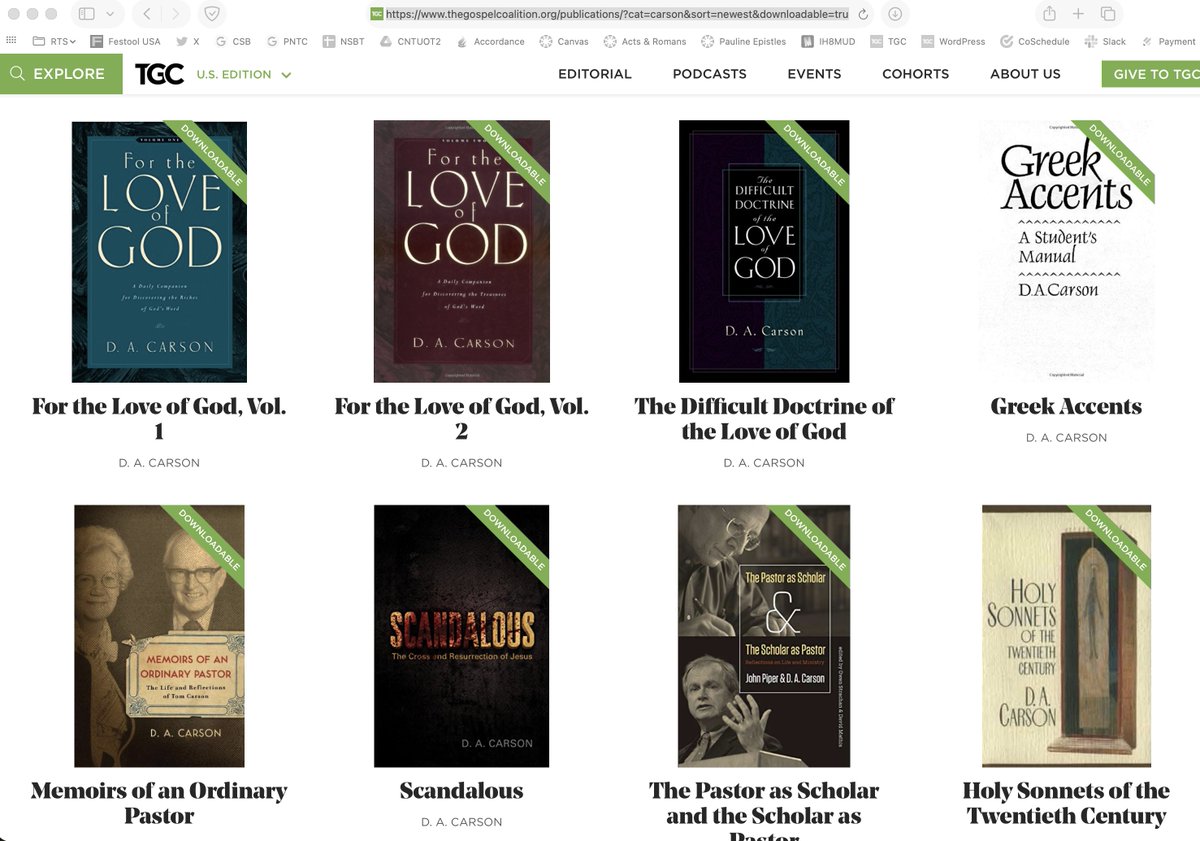
Did you know that you can download nineteen D. A. Carson books for free? 🤩
These books are so good. Please share with all your friends!
https://t.co/tOUXqLTtel
Insightful reflection on how thoughtless use of AI risks stunting growth of character and intellect in children.
A Hollow Crown: AI and the Formation of Students https://t.co/bpa2eQtv0e
To the world, growing old elicits fear. In Christ, we have hope even as the end nears. Each passing year reminds us of his faithfulness, and we look forward to the coming day when we will see Christ face to face.
Interview: “Doctrine Will Help You Home”
Did you know that the oldest recorded poem in English is about Good Friday?
This is The Dream of the Rood - a poem where the cross of Christ talks to the poet about the crucifixion - read in Old English by Dr Alexandra Zhirnova, at @StPaulsLondon.