Weiß denn jemand etwas über die #Vericiguat Studie? Würde mich schon interessieren, wie es gelaufen ist, denn Vericiguat kommt bei #MECFS (und #PAIS) nur sehr selten zum Einsatz, ebenso wie Berichte darüber. Die Wirkungsweise klingt vielversprechend. https://t.co/lNVbsumG3g
Am 28. Juni zählt jede Spende extra: Über https://t.co/M2lPTiZJH6 verteilt die Postcode Lotterie 225.000 € anteilig nach Spendenaufkommen. Jeder Euro für uns bringt mehr für die Forschung an ME/CFS und Long COVID. Spendet am 28.6. von 9 bis 23:59 Uhr: https://t.co/o13Xs4raQw
Yesterday, I stepped down as CEO of my company. Not because I wanted to, but because in mid-January, I became bedbound with Stage 4 ME.
For the past three months, I've watched my team run the company I built while I just lay here, unable to live the high-impact life I was used to.
At first, I vowed to get better so I could return to even part-time work. But as I gradually and inconsistently improved over months, I became radicalized for a different cause:
Not a single person deserves to live like this. But yet we do, and and no one will save us but ourselves.
So today, I begin a new role: I will dedicate the next year of my life - 18 waking hours a day - entirely to this community.
I suppose it's time I introduce myself (I've also attached a photo of me, in bed, feeling much worse than I look):
- Out of college, I co-founded a magazine that took me around the world doing sports journalism and broadcasting.
- Over the past 7 years, I have assembled the greatest team to build and run a sports tech company from the ground up
- In the early days of the pandemic, I co-founded and led @getusppe, a team of hundreds, to deliver 17 million+ pieces of PPE to healthcare workers.
- I specialize in acting with urgency, seeing gaps, and connecting people to fill them. And most of all, in uniting and building community.
I have accomplished a ton in my 35 years on earth before I got sick, but Long COVID and ME are, by an order of magnitude, the biggest challenges I have faced.
But when there are so many gaps, there's simply no time to complain. We must roll our compression-wear up and get to work. So here is what I have planned:
- Guides and essays:
- The Severe PEM Crash Survival Guide
- What's the Deal With Brain Retraining?
- So You Have Long COVID, Now What?
- ...and so many more!
- Treatment Experience Surveys to fill the gap between random Reddit anecdotes and slow clinical trials (GLP-1 data released in two weeks)
- The first comprehensive AI analysis of all publicly posted recovery stories to look for trends and correlations
- Helping a fellow patient and test expert publish the first interactive and comprehensive testing guide for ME
- Helping a fellow patient increase the visibility of Stage 4/5 patients as the faces of ME
- Creating a network of the highest agency patients working on these conditions to mutually share information, support, and unblock each other
- Creating Long COVID and ME microgrants to fund people to work on small but impactful projects
- Incubating and raising funding for founders who want to start non-profits and companies (let five more Amaticas flourish!)
- Overall, pouring my heart out to support every single person who is interested in working for the betterment of this community (especially where others are far better than me, like science and advocacy!)
No one is going to do this work for us. Not doctors, researchers, or government. This must be patient-led.
Want to join the movement? Send me a DM, and let's figure out what we can do together. Time to get to work.
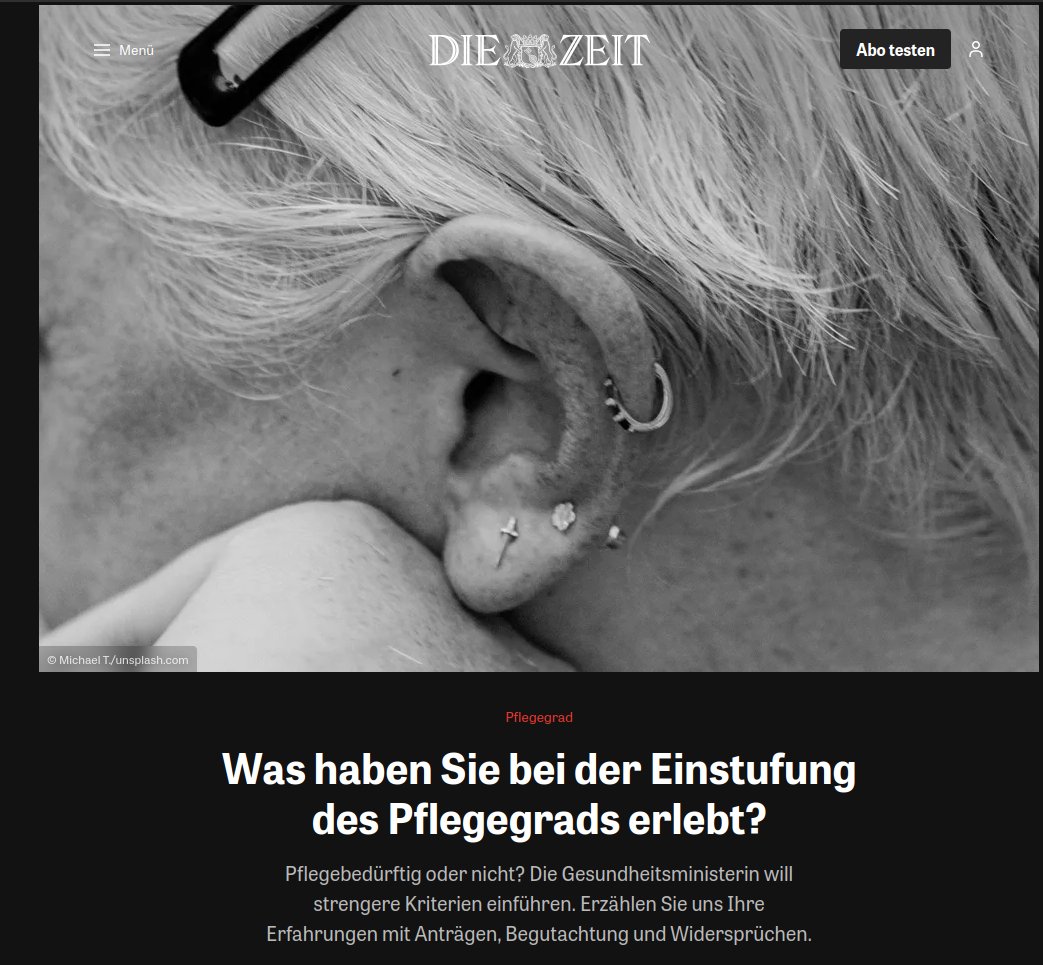
Die Zeit sammelt Erfahrungen mit der Einstufung beim Pflegegrad. Auch ein großes Thema bei ME/CFS und Post-COVID, weil die Kriterien auf diese Krankheiten nicht ausgelegt sind.
Schreibt eine Mail an [email protected]. Ausgewählte Beiträge werden veröffentlicht.
Heute vor einem Jahr ist Jana (bei SoMe als "Kerstin" bekannt gewesen), die Schwester von @annelinehuck, an den Folgen ihrer #MECFS-Erkrankung gestorben.
Ich möchte an ihrem 1. Todestag gerne an Jana erinnern, die ich als warmherzige, engagierte Frau für Aufklärung und Forschung in Erinnerung habe.
Möge es dir dort, wo du jetzt bist, gutgehen, fern ab von Schmerzen und Leid.
Mit den Gedanken bin ich auch bei Line (hugs!) und ihrer Familie.
🕯️🖤
„In dieser Gesellschaft ist es überhaupt nicht verbreitet, dass man z. B. sagt: „Das sind Schmarotzer.“ Klar sind das Schmarotzer. Ja, also wer Milliarden im Jahr einstreicht, einfach nur qua der Assets, die er geerbt hat, ist auf jeden Fall ein Schmarotzer.“
@nymoen_ole
🫳
🎤
Mitochondrial Transplant Reverses Disease
Scientists just transplanted healthy mitochondria into diseased cells -- and reversed Parkinson's, Leigh syndrome, and mtDNA depletion. In Cell.
As a medical school professor, I can tell you this is one of the most important papers of 2026. Chinese researchers solved the delivery problem that's challenged mitochondrial medicine for decades.
The breakthrough: wrapping healthy mitochondria in red blood cell membranes. Delivery efficiency jumped from under 5% to 80%.
The results:
- Rescued mitochondrial defects in patient-derived cells
- Reversed mtDNA depletion syndrome in mice
- Extended survival in Leigh syndrome mice
- Prevented neuron loss and restored motor function in a Parkinson's model
Tested in both mice and monkeys.
This is what I wrote about in "Lies I Taught in Medical School" -- we treated mitochondrial diseases as untreatable because we couldn't fix the powerhouse. Now we can replace it entirely.
"Organelle therapy" is no longer theoretical. It's here.
Full breakdown coming on the Health Longevity Secrets podcast.
Source: https://t.co/BxAv0LoTUJ
#Mitochondria #Parkinsons #RegenerativeMedicine #CellTherapy #Longevity
Genom-Studie aus Bonn sucht deutschlandweit Teilnehmende mit LongCovid oder ME/CFS nach Corona. Man muss nicht hinfahren, das Testkit wird per Post verschickt. Je mehr teilnehmen, desto höher ist die Aussagekraft. Macht mir!
https://t.co/wjVnpeQnOP
Do any of you also notice that your brain fog improves when your day follows a very rigid and predictable routine?
I don’t have autism or ADHD.
I rely on a strict routine system to conserve energy and reduce brain fog. Everything happens in the same order every day so I can function almost with my eyes closed. My J-tube pump feeding and urine collection are done during this routine while I keep my eyes closed to reduce sensory load.
I also use a very simple signal system with one finger to say PAUSE or CONTINUE, so people know when to stop or speak.
I only speak to my father once a day for about one hour, sometime between 9pm and 12am, to minimize cognitive and sensory load.
At another time, my brother helps me with other things: placing paper, medications, IV fluids, and occasionally removing trash or extra items. Everything is done while I keep my eyes closed and wear earplugs because I cannot tolerate people being close to me. I mainly just listen.
Even though these tasks may sound simple, the process takes a long time because of my pauses and energy limits — it can feel like an odyssey.
This routine gives me something very important: safety and trust, because everything is predictable. If something deviates from the routine, even by mistake, it can trigger severe brain fog or a meltdown, and I need a long pause to process it.
I also can’t handle new things easily — like new suggestions, new instructions, or new objects appearing in the room. When that happens, I have to move extremely slowly and deliberately to process it, and sometimes I’m not able to eat or communicate at all.
When there are people in my room, I usually cannot speak or write. One of the hardest parts of my illness is the inability to communicate, and it makes me feel angry almost every day.
There is also a very thin line between ending the routine feeling stable and satisfied, or ending up in pain for the entire night.
I often think in two languages, and tools like GPT sometimes help me organize my thoughts when my brain fog is severe.
What other things help you preserve or improve your energy? #mecfs