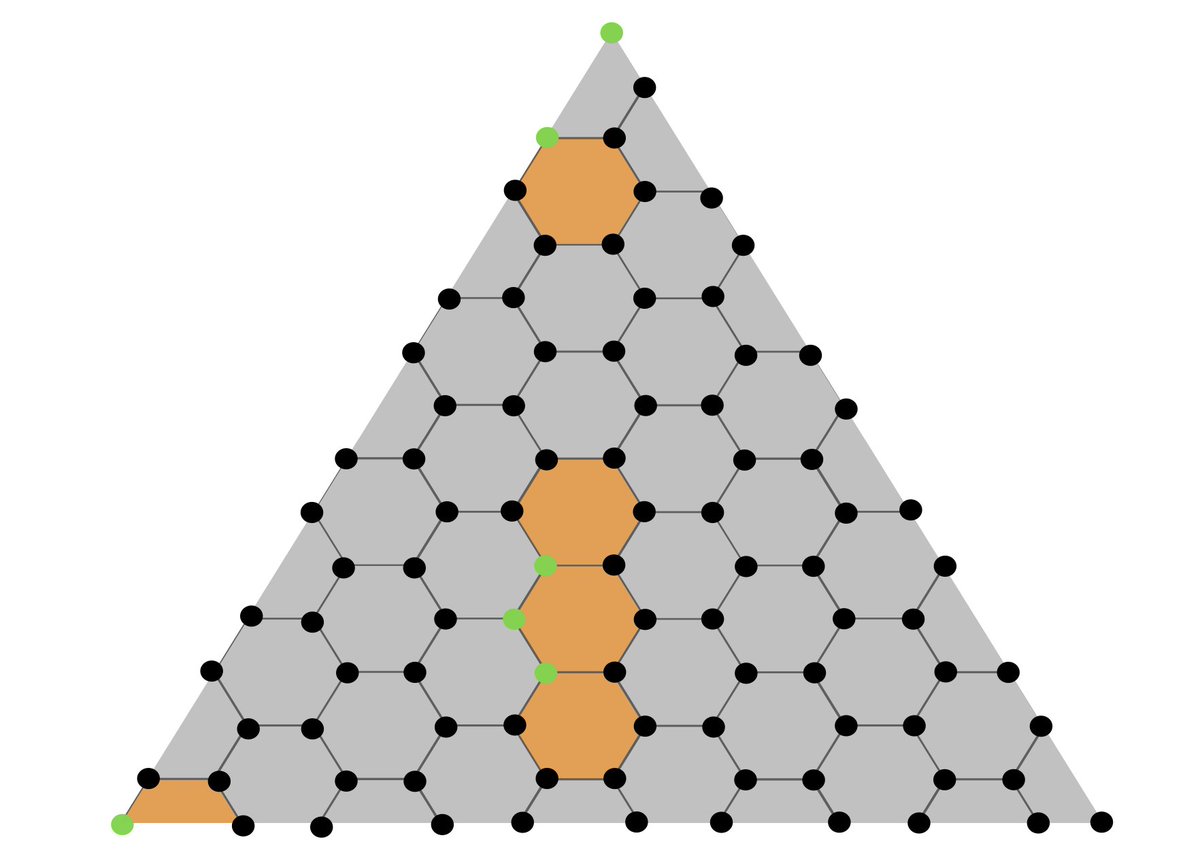
A logical operator in the triangular 6.6.6 colour code is either 1) a string operator connecting a corner to a boundary of the same colour or 2) a string operator connecting three different coloured boundaries. The minimum weight of both types is d.
Viviani's Theorem ▲
in an equilateral triangle ▲
the sum of the distances from any interior point to the 3 sides
is equal to the height of the triangle ▲
We are currently offering several multi-year postdoctoral research positions to highly motivated and well-qualified researchers who intend to enhance their career in #quantuminformation science or in quantum #manybodyphysics. The positions on the E13 and E14 level are funded by an @ERC_Research Advanced Grant, and are also connected to other frameworks and schemes such as #BerlinQuantum and the European @QuantumFlagship.
We are a highly research-active and visible team in quantum information science and the study of complex quantum systems, with a culture of open discussion, creative interdisciplinary thought and substantial international collaborations. We are conceptually minded and work with the rigor of mathematical physics, but are at the same time often pragmatically motivated and guided by the protocol, the phenomenon, the application, or the experimental implementation.
https://t.co/zhmAWrg3Xm
For an overview over recent publications, see this link:
https://t.co/Tgu7h2ZS2u.
Potential research topics include the following:
• #Quantumcomputing and #quantumalgorithms.
• Foundations of #quantuminformation science.
• Near-term quantum computing #NISQ.
• #Quantumerrorcorrection.
• #Tensornetwork methods.
• #Quantumphases of matter.
Applicants must have demonstrated excellent research accomplishments in the past. Candidates should hold a PhD degree in physics, mathematics or computer science. Interested candidates are invited to submit
• a letter indicating their main research interests.
• A detailed curriculum vitae.
• A list of publications.
• The electronic contact details of three referees.
All applications should be sent in electronic form to BOTH [email protected] and [email protected], with the keyword "Postdoc2024" in the subject line. For inquiries, please send a message to [email protected]. The start date is flexible.
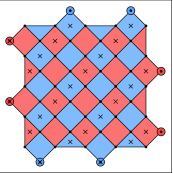
@CraigGidney@earltcampbell I'm curious about what long term challenges/questions you think are worth working on. And I'm curious about the qec details of the device in the picture taken from the Google roadmap. (I realize this probably leads to IP issues)
@decodoku One thing that makes it difficult to write introductory papers is explaining things as simple as possible but staying accurate. In my opinion, the comparisons in Table IV have lost some accuracy by being too concise.
@decodoku It's always great if people take the time to write an introductory paper to explain complex topics. I like how they introduce the quantum repetition code using the classical repetition code.
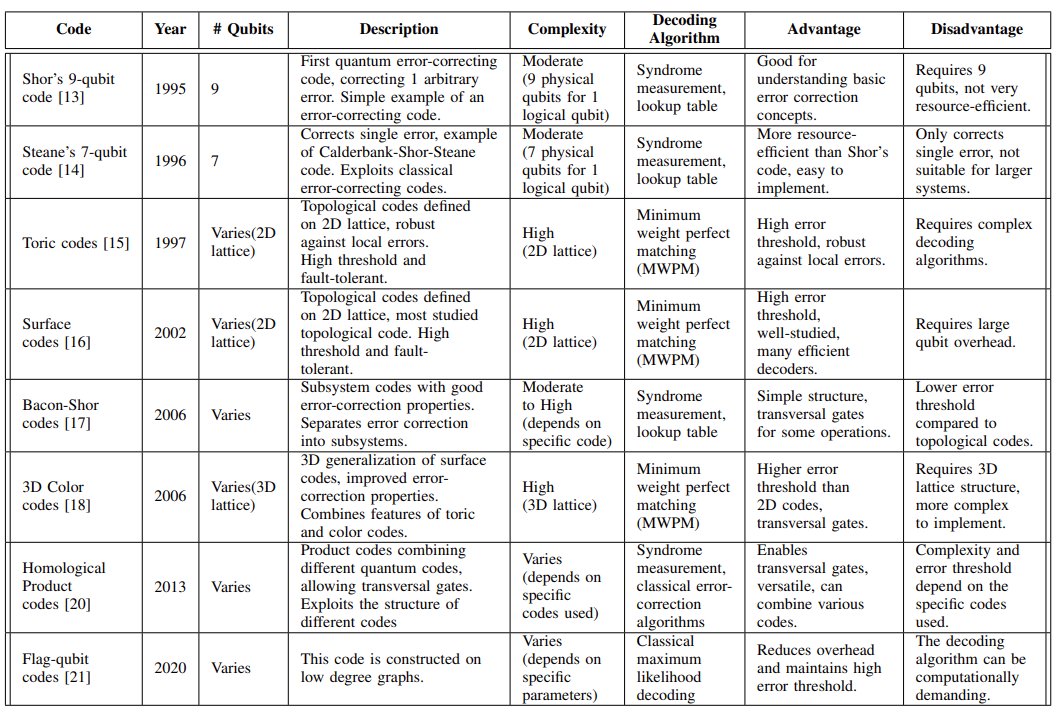
@letonyo@jenseisert@decodoku For the surface code (X and Z) errors create pairs of excitations and mwpm gives you a minimum weight correction.
For the color code (X and Z) errors create triples of excitations and matching on three sublattices does not necessarily give you a minimum weight correction.
@letonyo@jenseisert@decodoku I hope so! For surface codes, it seems unlikely to me to get both faster and more accurate. For color codes, I think there's a chance it's possible.
@CraigGidney@decodoku A difference between phenomenological noise and circuit-level noise that is not often mentioned is that for the former you can do unweighted MWPM and UF.
Do you know if this makes big difference in terms of decoding time? I would expect it does.
@CraigGidney@decodoku Interesting, thanks. With transversal measurement halfway through a cycle do you mean measuring the logical after performing half of a syndrome extraction circuit? So the total reaction time would just be doing the transversal measurement + decoding?
@CraigGidney@decodoku I'm confused by this. Is it a floor because after a QEC cycle, you immediately start a new QEC cycle, so there is no point in being faster than one cycle?
It has been a pleasure to have been part of this collaboration between @HeiQuSim and @FU_Berlin. Comments are very welcome and let us know if you have any questions.
I'm happy to share a new preprint with @ktiurev, @QuantumGizmos, @jenseisert, and Jan Reiner. We look at the effects of non-independent and non-identically distributed errors on surface codes. Below I highlight some results, see the paper for more:
https://t.co/YxEp11PfX7
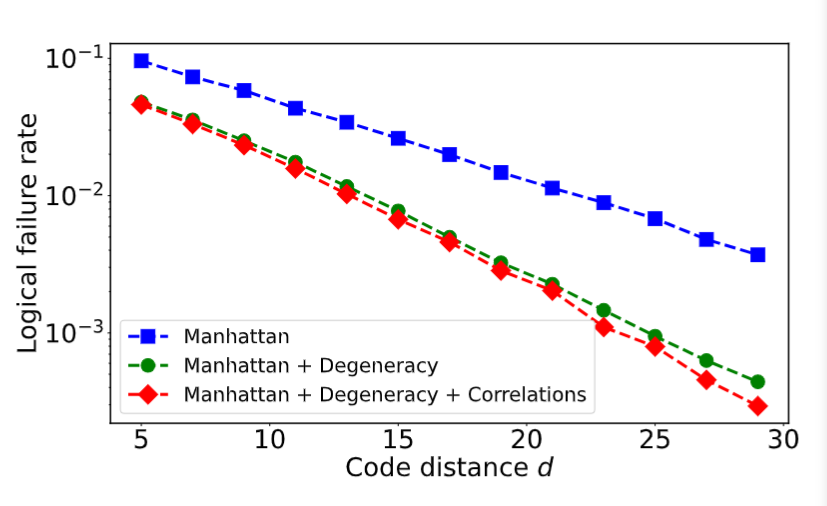
To combat non-independent errors we investigate how we can improve our decoder. We show that if correlated two-qubit errors are present a better logical error rate is found if we account for degeneracy and correlations when choosing the weights of the MWPM graph.